The global apparel industry is witnessing a significant shift. While China has traditionally dominated textile manufacturing, an increasing number of clothing brands are turning to Pakistan clothing manufacturers for their production needs.
From established international brands like Adidas and H&M to emerging direct-to-consumer startups, Pakistan has become a strategic sourcing destination. But why?
Quick Answer: Clothing brands choose Pakistan manufacturers for superior cotton quality, 10-20% lower costs than China, flexible MOQs (500-1,000 pieces vs 3,000-5,000), comprehensive certifications (OEKO-TEX, GOTS, ISO), faster turnaround times (4-8 weeks vs 10-14 weeks), and full-service capabilities including private labeling and custom packaging.
This comprehensive guide explores the Pakistan textile industry, the advantages of sourcing from Pakistani manufacturers, and how clothing brands can successfully partner with garments manufacturers in Pakistan.
Table of Contents
- Pakistan’s Textile Industry Overview
- Top 10 Reasons Brands Choose Pakistan Manufacturers
- Types of Clothing Products Manufactured in Pakistan
- Pakistan vs Other Manufacturing Countries
- How to Source from Pakistan Clothing Manufacturers
- What to Look for in a Pakistan Manufacturer
- Brands Using Pakistan Manufacturers
- Future of Pakistan Clothing Manufacturing
- Frequently Asked Questions
Pakistan’s Textile Industry Overview
Pakistan ranks among the world’s leading textile exporters, according to the World Trade Organization. The textile industry represents a cornerstone of Pakistan’s economy.
Key Statistics:
- Textiles account for approximately 60% of Pakistan’s total exports
- Over 15 million people employed in the textile sector
- 4th largest cotton producer globally
- Faisalabad serves as Pakistan’s textile capital (known as the “Manchester of Pakistan”)
- Thousands of manufacturing facilities with 50+ years of expertise
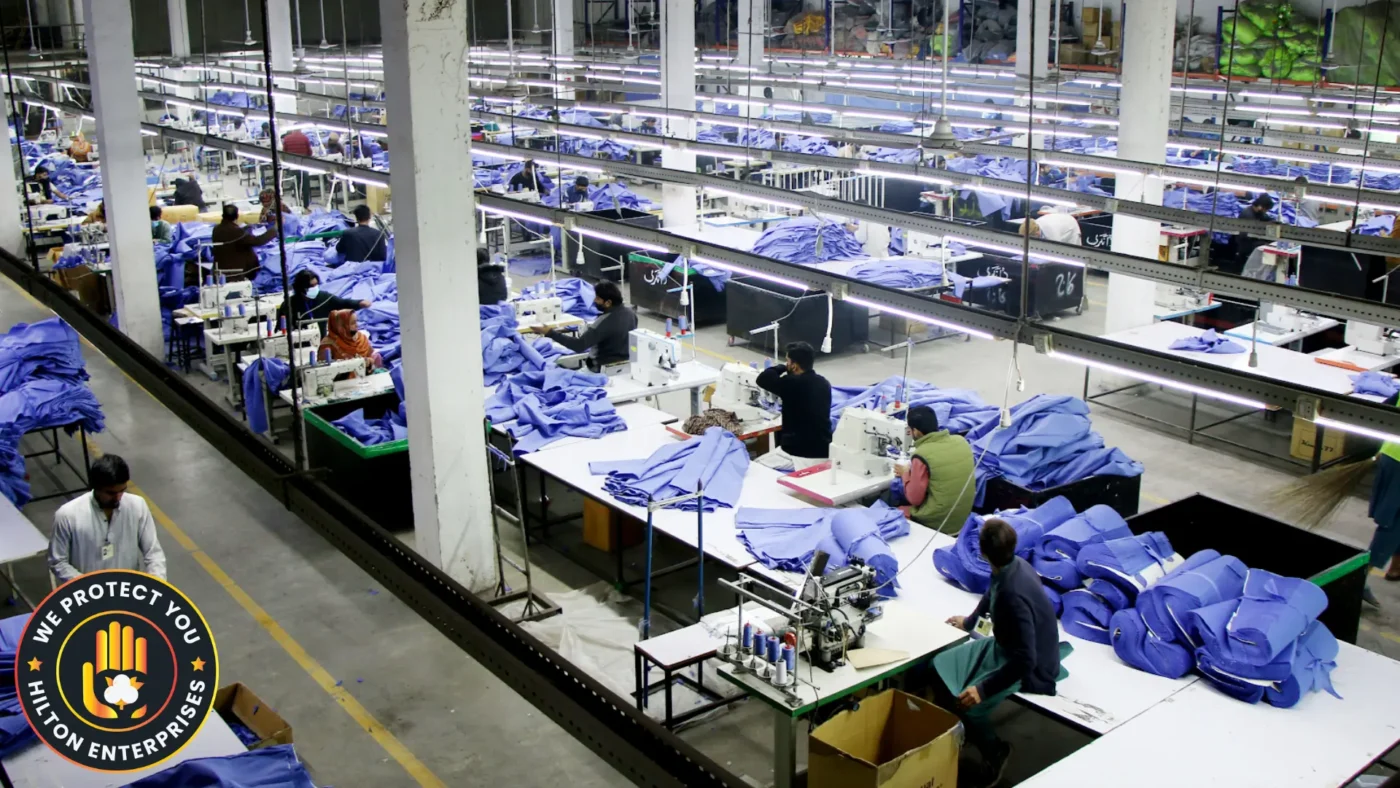
The Pakistani manufacturers have built their reputation through decades of experience, continuous investment in modern machinery, and deep understanding of international quality standards. This foundation makes Pakistan an ideal partner for clothing brands seeking reliable, high-quality production.
Top 10 Reasons Clothing Brands Choose Pakistan Manufacturers
1. Superior Cotton Quality and Raw Materials
Pakistan is the world’s fourth-largest cotton producer, growing premium long-staple cotton varieties ideal for high-quality clothing products.
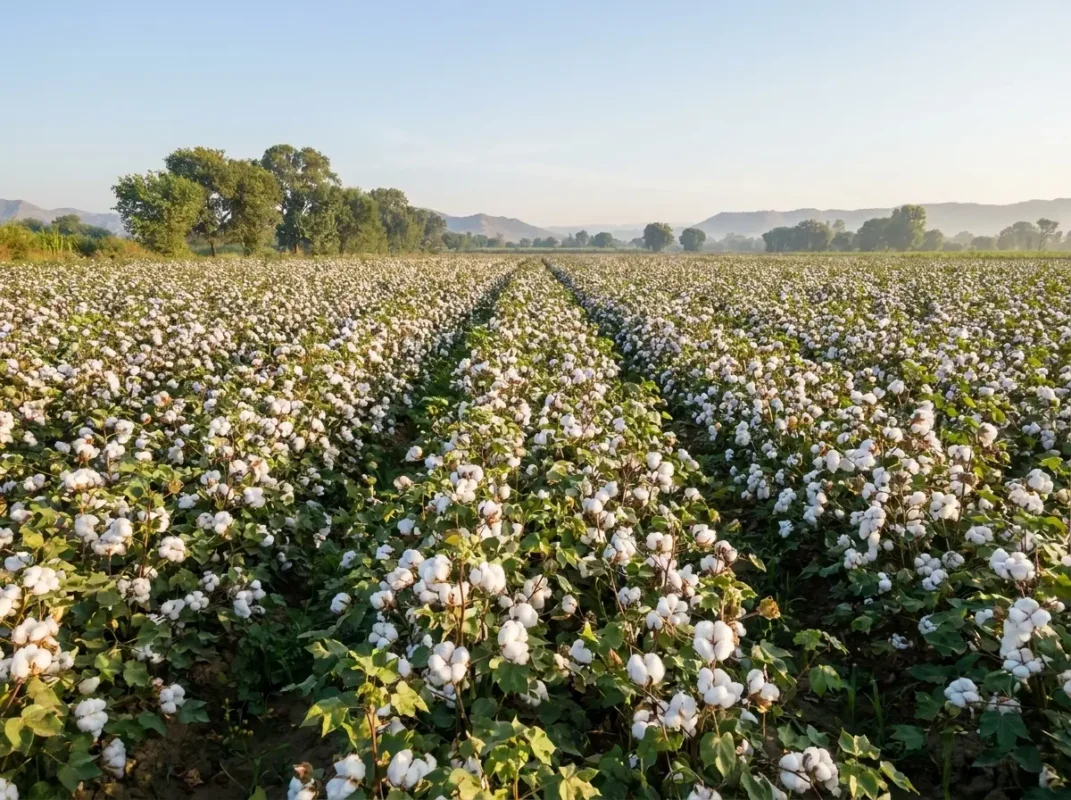
Pakistan is the world’s 4th largest cotton producer, providing premium long-staple cotton for superior textiles
Cotton Advantages:
- Premium long-staple cotton for softer, more durable fabrics
- Direct access to raw materials (no middlemen)
- Vertical integration from cotton growing to finished garments
- Better color retention compared to synthetic alternatives
- Consistent quality control throughout the supply chain
Vertical Integration Benefits:
- Cotton growing → Spinning → Weaving → Dyeing → Garment production
- All stages are controlled locally or tightly coordinated
- No markup from intermediaries
- Quality consistency from fiber to finished product
When you source cotton products from Pakistan, you’re getting fabric made from cotton grown locally. This proximity ensures freshness, quality, and traceability that few other countries can match.
2. Competitive Pricing Without Quality Compromise
One of the primary reasons why clothing brands use Pakistan manufacturers is competitive pricing that doesn’t sacrifice quality.
Cost Comparison:
| Factor | Pakistan | China | Bangladesh |
|---|---|---|---|
| Cotton T-Shirt Cost | $2.50-$4.00 | $3.00-$5.00 | $2.00-$3.50 |
| Price vs China | 10-20% Lower | Baseline | 15-25% Lower |
| Quality Level | High | High | Medium-High |
| Cotton Specialty | Excellent | Good | Limited |
Why Pakistan Offers Better Pricing:
- Lower operational costs than China
- Direct access to raw materials (cotton grown locally)
- Efficient production processes have been refined over generations
- Lower labor costs while maintaining quality standards
- No middleman markup due to vertical integration
For startups, these savings enable viable business models. For established brands, cost advantages translate directly into higher profit margins while maintaining retail competitiveness.
3. Flexible MOQ (Minimum Order Quantities)
Pakistan-based manufacturers offer significantly more flexible MOQs than Chinese factories.
MOQ Comparison:
| Country | Typical MOQ | Best For |
|---|---|---|
| Pakistan | 500-1,000 pieces per style | Startups, testing new products |
| China | 3,000-5,000 pieces per style | Established brands, proven products |
| Bangladesh | 2,000-3,000 pieces per style | Mid-size orders |
| Vietnam | 2,000-4,000 pieces per style | Medium-large brands |
Benefits of Lower MOQs:
- Test new products without massive upfront investment
- Launch brands with less capital (500 pieces vs 5,000 = $2,500 vs $25,000)
- Respond faster to market trends
- Reduce inventory carrying costs
- Minimize financial risk for unproven designs
- Order multiple styles instead of large quantities of one
Some Pakistani manufacturers focused on private label manufacturing offer even lower MOQs to brands that meet certain criteria.
4. Comprehensive Certifications and Compliance
Leading clothing suppliers in Pakistan hold internationally recognized certifications that ensure product safety, environmental responsibility, and ethical manufacturing.
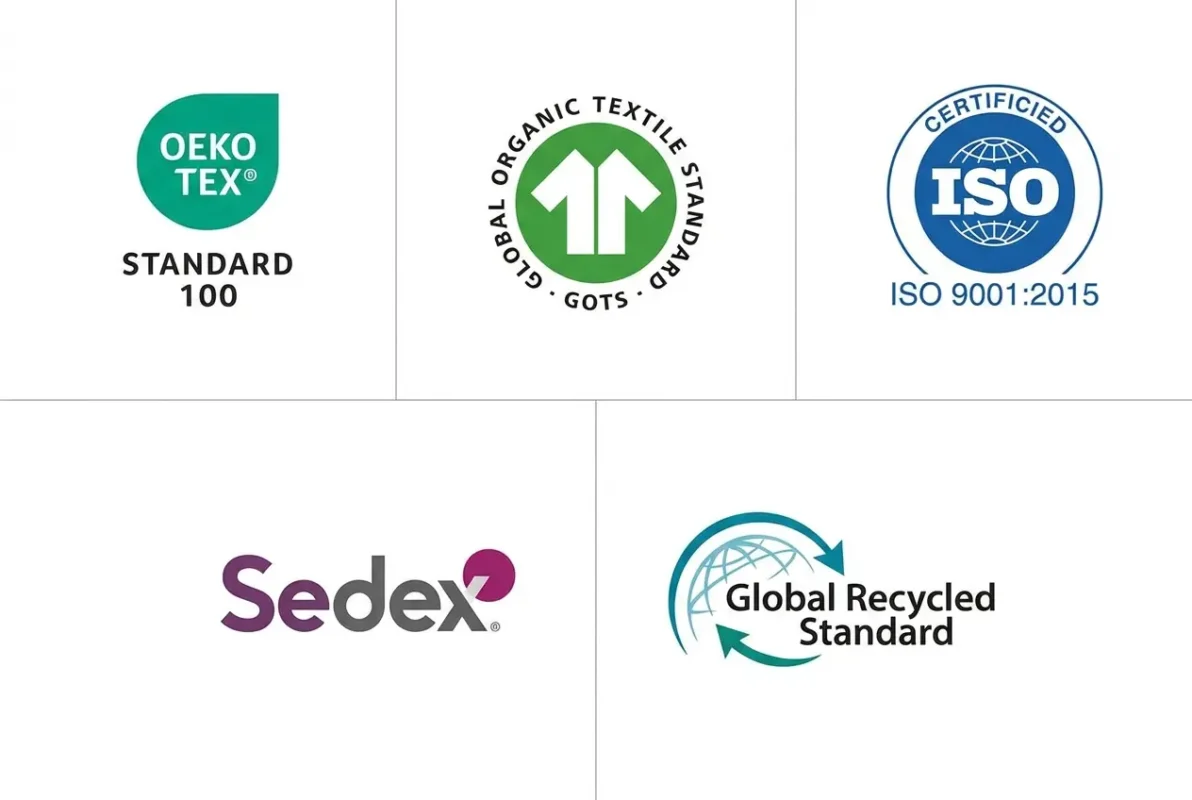
Leading Pakistan manufacturers maintain international certifications ensuring quality, safety, and ethical production
Common Certifications Held by Pakistan Manufacturers:
- OEKO-TEX Standard 100 – Textile safety and harmful substance testing (official certification)
- GOTS (Global Organic Textile Standard) – Organic material certification (learn more)
- ISO 9001:2015 – Quality management systems
- Sedex – Ethical trade and supply chain transparency
- GRS (Global Recycled Standard) – Recycled content verification
- CTPAT – Supply chain security (US Customs)
- WRAP – Worldwide Responsible Accredited Production
Why Certifications Matter:
- Guarantee product safety for end consumers
- Ensure ethical labor practices
- Verify environmental responsibility claims
- Meet retailer compliance requirements (Walmart, Target, Amazon)
- Enable marketing claims (organic, recycled, certified safe)
- Reduce liability and regulatory risk
These certifications represent genuine commitments backed by third-party audits, not just marketing claims.
5. Full-Service Manufacturing Capabilities
Pakistan’s apparel manufacturers offer comprehensive services that extend far beyond basic garment production.
- Private Label Manufacturing – Custom branding programs
- Custom Manufacturing – Products built to exact specifications
- Embroidery & Printing – Logo application, graphics, custom designs
- Custom Packaging – Branded boxes, poly bags, inserts
- Shipping & Logistics – International freight coordination
Additional Capabilities:
- Woven labels and hang tags
- Printed neck labels (tagless construction)
- Care labels in multiple languages
- Barcode application and SKU management
- Quality control and pre-shipment inspection
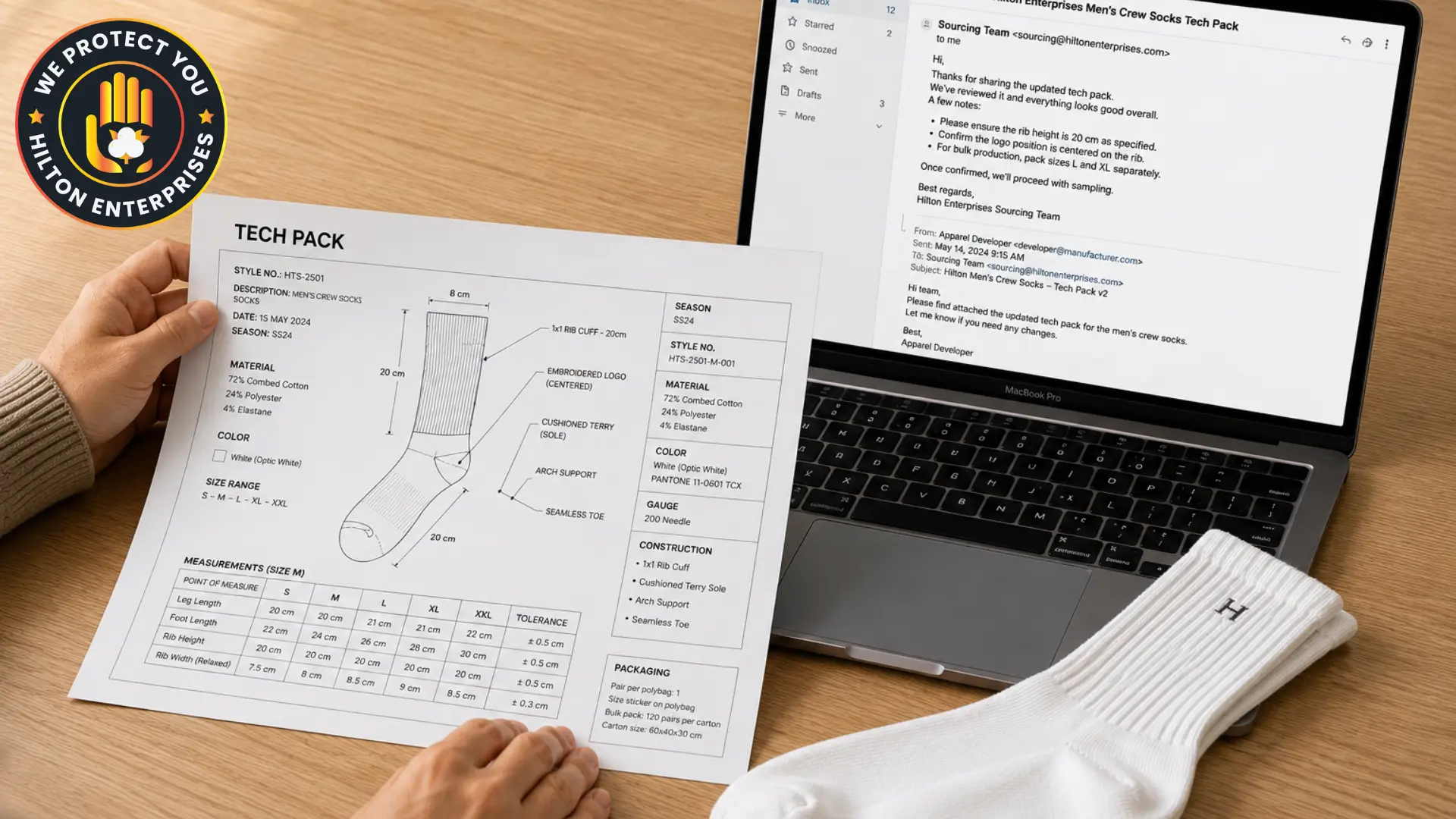
- Sample development and tech pack creation
This comprehensive service model simplifies manufacturing. Instead of coordinating multiple vendors across different countries, brands work with a single partner handling everything from fabric sourcing to delivered, retail-ready products.
6. Diverse Product Range and Specializations
The breadth of clothing products manufactured in Pakistan enables brands to consolidate sourcing rather than spread orders across multiple countries.
Men’s & Women’s Apparel:
- T-shirts and polo shirts (all styles, fabrics, weights)
- Hoodies and sweatshirts (fleece, French terry, brushed)
- Jackets and outerwear (windbreakers, parkas, bombers)
- Shorts and pants (athletic, casual, dress)
- Tracksuits and athletic sets
- Uniforms and workwear
Home Textiles:
- Printed bed sheets (reactive dye, pigment printing)
- Fitted bed sheets (deep pocket, elasticized corners)
- Comforters and duvet covers (various warmth levels)
- Towels (bath, hand, face, beach)
- Blankets and throws
Specialized Products:
- Crew socks and athletic socks (see our sock manufacturing guide)
- Sportswear and activewear (moisture-wicking fabrics)
- Safety gloves and workwear
7. Faster Turnaround Times and Better Communication
Production timelines in Pakistan significantly outpace those in China and other major manufacturing hubs.
Timeline Comparison:
| Production Stage | Pakistan | China |
|---|---|---|
| Sampling | 5-7 days | 7-10 days |
| Production | 3-6 weeks | 8-12 weeks |
| Shipping (to USA) | 2-3 weeks | 3-4 weeks |
| Total Timeline | 4-8 weeks | 10-14 weeks |
Communication Advantages:
- Widespread English proficiency in the business community
- Reasonable time zone overlap with the US and Europe
- Cultural understanding of Western markets
- Responsive communication (typically within 24 hours)
- Video calls and virtual factory tours are readily available
- No language barriers or translation misunderstandings
Speed Benefits for Brands:
- Respond faster to market trends
- Shorter cash conversion cycles
- Better inventory management
- Ability to test and iterate quickly
- Reduce time-to-market for new products
8. Skilled Workforce and Manufacturing Expertise
Faisalabad has served as Pakistan’s textile hub for over a century. Manufacturing knowledge passes through generations.
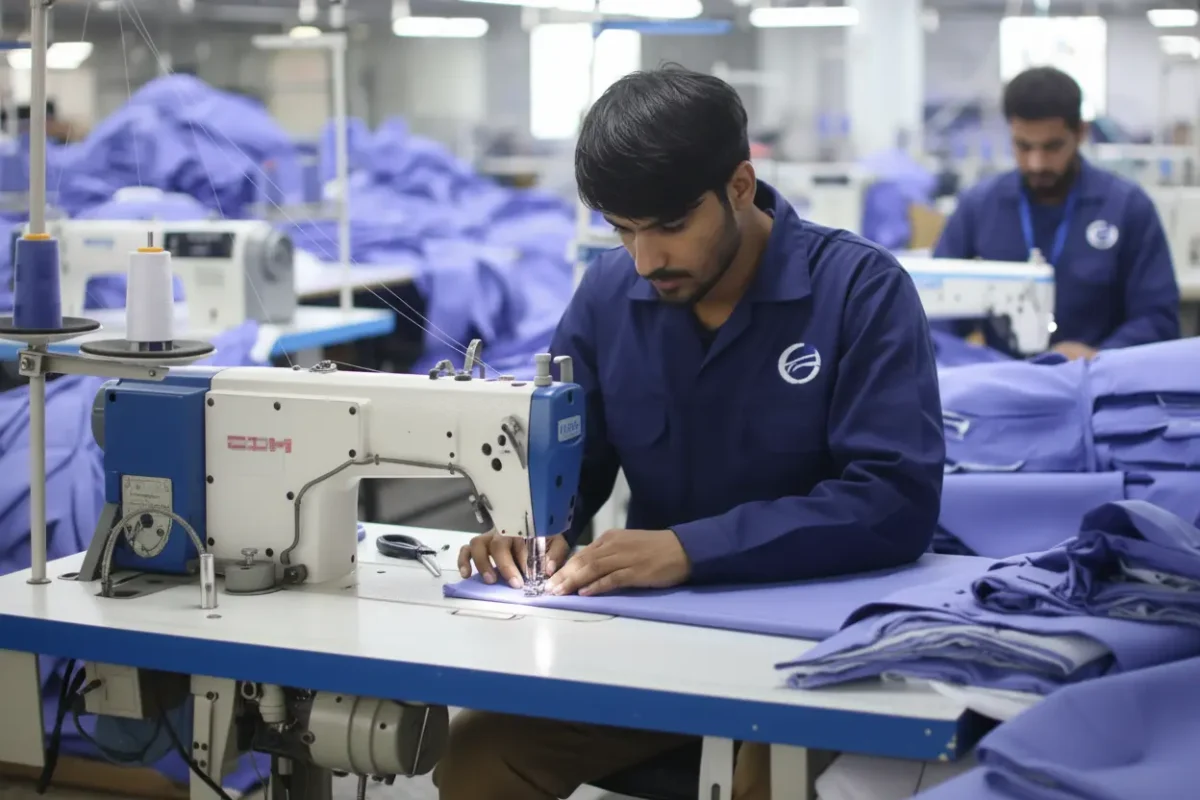
Generations of textile expertise and specialized training create Pakistan’s skilled manufacturing workforce
Workforce Strengths:
- Generational knowledge transfer (families in the textile business for 50+ years)
- Technical training institutes are continuously developing skilled workers
- Deep expertise in complex manufacturing techniques
- Precision cutting and sewing capabilities
- Intricate embroidery work (traditional and modern)
- Quality finishing that meets international standards
Specialized Skills Available:
- Multi-panel jacket construction
- Technical outerwear (waterproof bonding, taping)
- Activewear with performance fabrics
- Complex embroidery and appliqué work
- Cut-and-sew knit garments
- Custom dyeing and washing techniques
This expertise matters when brand reputation depends on consistent product quality and attention to detail.
9. Strategic Location and Export Infrastructure
Pakistan’s geographic location provides strategic access to major global markets.
Export Infrastructure:
- Port of Karachi handles massive textile export volumes
- Well-established shipping routes to North America, Europe, and the Middle East
- Efficient customs processing for textile exports
- Modern logistics facilities and freight forwarding services
- Air cargo options for urgent shipments
Trade Agreements & Benefits:
- GSP (Generalized System of Preferences) status with many markets
- Preferential tariff arrangements reducing import duties
- Free trade agreements with several countries
- Duty-free access to certain markets
Leading manufacturers offer comprehensive shipping and logistics solutions, managing international freight, customs documentation, and delivery coordination. This end-to-end service significantly simplifies the sourcing process.
10. Ethical and Sustainable Manufacturing Practices
The Pakistan textile industry has made significant strides in ethical and sustainable manufacturing.
Ethical Manufacturing Commitments:
- Fair labor practices and living wages
- Safe working conditions (building safety, fire prevention)
- No child labor policies (strictly enforced)
- Worker welfare programs and benefits
- Freedom of association and collective bargaining
- Regular third-party audits (Sedex, WRAP)
Sustainable Material Options:
- Organic cotton (GOTS certified)
- Recycled polyester from plastic bottles (GRS certified)
- Bamboo fiber (fast-growing, minimal environmental impact)
- Recycled nylon from fishing nets and industrial waste
- Low-impact dyes and chemical management
Environmental Initiatives:
- Wastewater treatment facilities
- Renewable energy adoption (solar panels)
- Water recycling systems
- Waste reduction and recycling programs
- Energy-efficient machinery investments
International brands seeking genuine sustainability credentials find committed partners among Pakistan clothing manufacturers.
Types of Clothing Products Manufactured in Pakistan
The diversity of clothing products available from Pakistani manufacturers allows brands to consolidate multiple product categories with a single manufacturing partner.
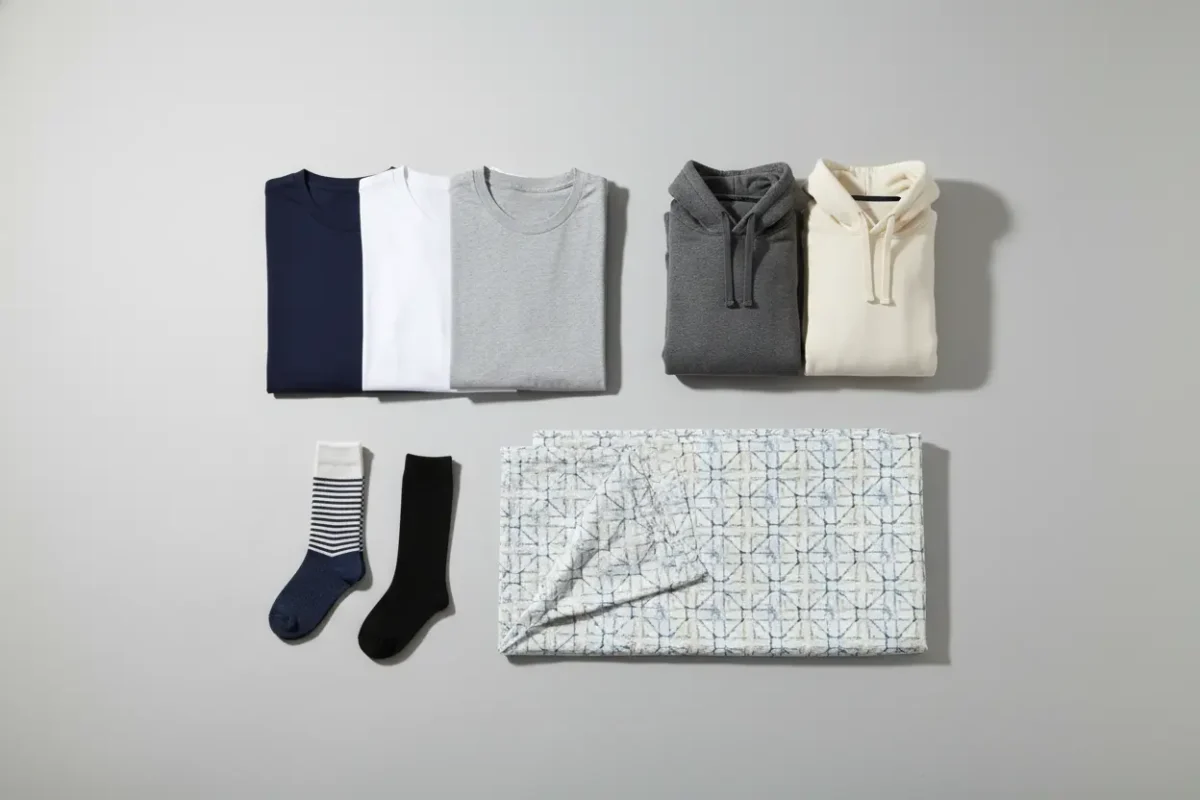
Pakistan manufacturers produce diverse categories from t-shirts and hoodies to bed sheets and socks
Apparel Manufacturing Categories
Basic Apparel:
- T-shirts (crew neck, V-neck, scoop neck, pocket tees)
- Polo shirts (pique, jersey, performance fabrics)
- Tank tops and sleeveless shirts
- Long-sleeve tees and thermals
Fleece & Sweatshirts:
- Hoodies (pullover, zip-up, cropped)
- Crewneck sweatshirts
- Quarter-zip pullovers
- Fleece jackets and vests
Outerwear:
- Lightweight windbreakers
- Insulated jackets (down, synthetic fill)
- Parkas and winter coats
- Technical outdoor apparel
- Bomber jackets and varsity jackets
Activewear & Sportswear:
- Performance t-shirts (moisture-wicking)
- Athletic shorts and pants
- Leggings and compression wear
- Sports bras and base layers
- Tracksuits and warm-up sets
Home Textile Categories
Bedding:
- Flat sheets (printed, dyed, white)
- Fitted sheets (standard, deep pocket)
- Pillowcases (standard, king, euro)
- Duvet covers and shams
- Bed skirts and decorative pillows
Comfort Products:
- Comforters (lightweight, medium, heavyweight)
- Quilts and coverlets
- Blankets (fleece, cotton, wool blends)
- Throws and accent blankets
Bath Textiles:
- Bath towels (various sizes and weights)
- Hand towels and washcloths
- Beach towels (oversized, printed)
- Bathrobes and spa wraps
Pakistan vs Other Manufacturing Countries
Understanding how Pakistan compares to alternative manufacturing destinations helps brands make informed sourcing decisions.
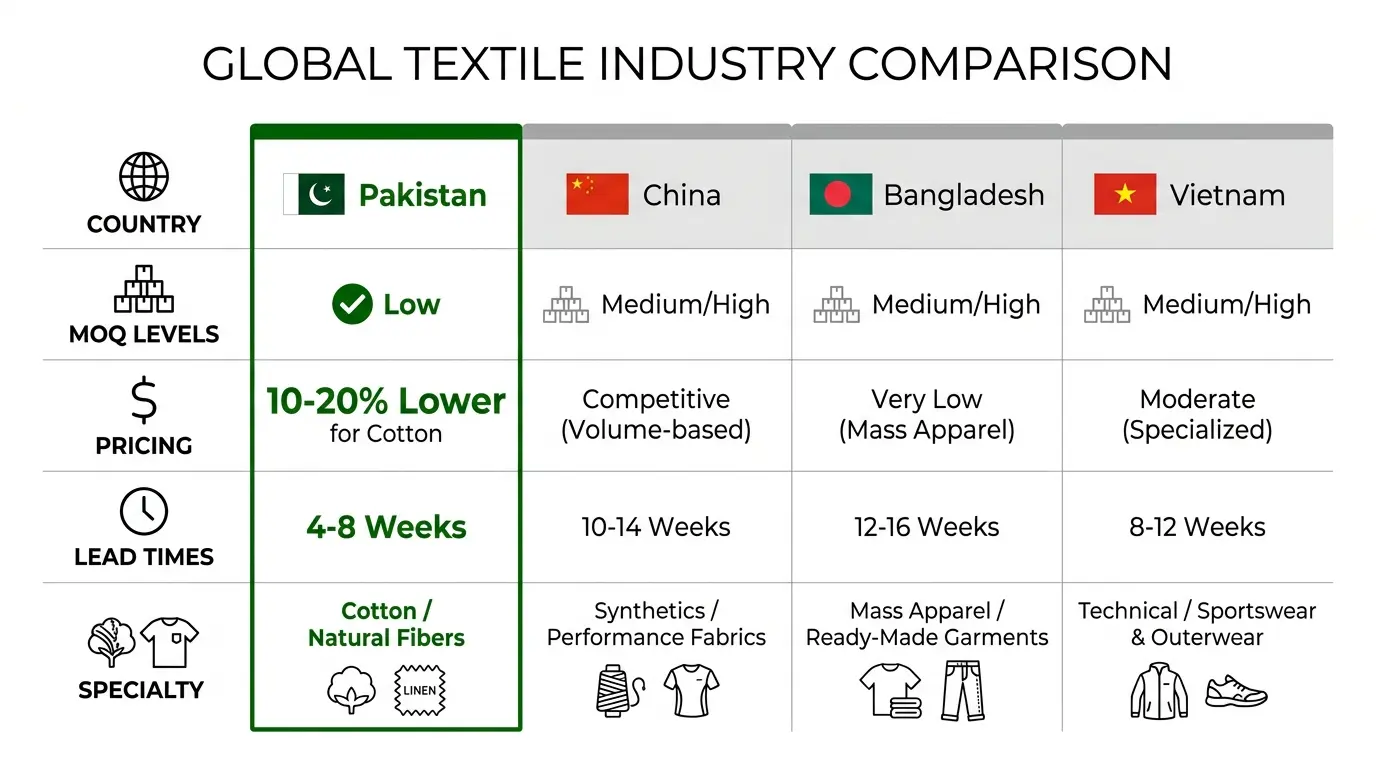
Pakistan offers competitive advantages in pricing, MOQs, and cotton-based products compared to alternatives
Comprehensive Country Comparison
| Factor | Pakistan | China | Bangladesh | Vietnam |
|---|---|---|---|---|
| MOQ | 500-1,000 | 3,000-5,000 | 2,000-3,000 | 2,000-4,000 |
| Lead Time | 4-8 weeks | 10-14 weeks | 8-12 weeks | 8-12 weeks |
| Cotton Products | Excellent | Good | Good | Limited |
| Synthetic Products | Good | Excellent | Limited | Excellent |
| Certifications | Comprehensive | Comprehensive | Moderate | Good |
| Communication | Excellent (English) | Moderate | Moderate | Good |
| Best For | Cotton apparel, startups | Large orders, synthetics | Basic budget apparel | Technical synthetics |
Pakistan vs China: Detailed Comparison
When Pakistan Wins:
- Lower MOQ requirements (better for startups and testing)
- Cotton-based products (superior raw materials)
- 10-20% lower pricing for natural fiber products
- Faster turnaround times (less factory congestion)
- Better communication (English proficiency)
- Similar quality at lower cost
When China Wins:
- Synthetic materials and technical fabrics
- Highly specialized or technical products
- Massive order volumes (100,000+ pieces)
- Access to cutting-edge manufacturing technology
- Extremely complex garment construction
Pakistan vs Bangladesh: Detailed Comparison
Pakistan Advantages:
- Higher quality standards and certifications
- More diverse product range beyond basic apparel
- Vertical integration (better supply chain control)
- Superior cotton quality
- Better for mid-tier and premium products
Bangladesh Advantages:
- Lower costs for basic apparel
- Massive production capacity
- Focus on fast fashion
- Good for ultra-budget segments
Pakistan vs Vietnam: Detailed Comparison
Pakistan Advantages:
- Cotton expertise (natural fibers)
- Lower MOQs
- Established textile ecosystem
- Vertical integration advantages
- Better for cotton and natural fiber products
Vietnam Advantages:
- Synthetic materials and technical fabrics
- Rapid infrastructure development
- Free trade agreements with multiple countries
- Focus on performance and technical apparel
How to Source from Pakistan Clothing Manufacturers
Successfully sourcing from clothing manufacturers in Pakistan requires following a structured process.
Step 1: Research and Shortlist Manufacturers
Key Research Criteria:
- Verify certifications (OEKO-TEX, GOTS, ISO, Sedex)
- Review product specializations (match your needs)
- Check MOQ requirements (within your budget)
- Assess communication capabilities (English, responsiveness)
- Verify export history and experience
- Review online presence and reputation
Research Sources:
- Online directories (Alibaba, Global Sources, TradeKey)
- Trade shows (Texworld, Magic, Apparel Sourcing)
- Industry referrals and networking
- Manufacturer websites and capabilities brochures
- LinkedIn connections in the textile industry
Step 2: Request and Evaluate Samples
Types of Samples to Request:
- Fabric samples – Assess hand feel, weight, quality
- Product samples – Evaluate finished garment quality
- Production samples – Verify the manufacturer can execute your designs
- Color samples – Test dye consistency and color matching
Sample Evaluation Checklist:
- Stitching quality (straight seams, no loose threads)
- Fabric consistency (weight, texture, hand feel)
- Color accuracy (matches your specifications)
- Finishing details (labels, tags, packaging quality)
- Sizing accuracy (grade rules, measurements)
- Overall construction quality
Sample Investment:
- Budget $200-$500 for proper sampling
- Compare samples from 3-5 manufacturers
- Request samples from recent production runs (not just showroom samples)
Step 3: Negotiate Terms and Finalize Agreements
Key Terms to Negotiate:
- Pricing structure – FOB, CIF, landed cost breakdown
- MOQ requirements – Per style, per color, total order
- Lead times – Sampling, production, shipping
- Payment terms – Deposit, milestones, final payment
- Quality standards – Acceptance criteria, defect rates
- Shipping arrangements – Who handles freight, insurance
Written Agreement Should Include:
- Detailed product specifications
- Delivery timelines and penalties
- Quality acceptance criteria
- Remedies for defects or delays
- Intellectual property protections
- Payment schedule and terms
Step 4: Production and Quality Control
During Production:
- Request production updates at key milestones
- Review pre-production samples before bulk manufacturing
- Consider third-party quality inspections for large orders
- Maintain regular communication with the manufacturer
- Address issues immediately when identified
Quality Control Checkpoints:
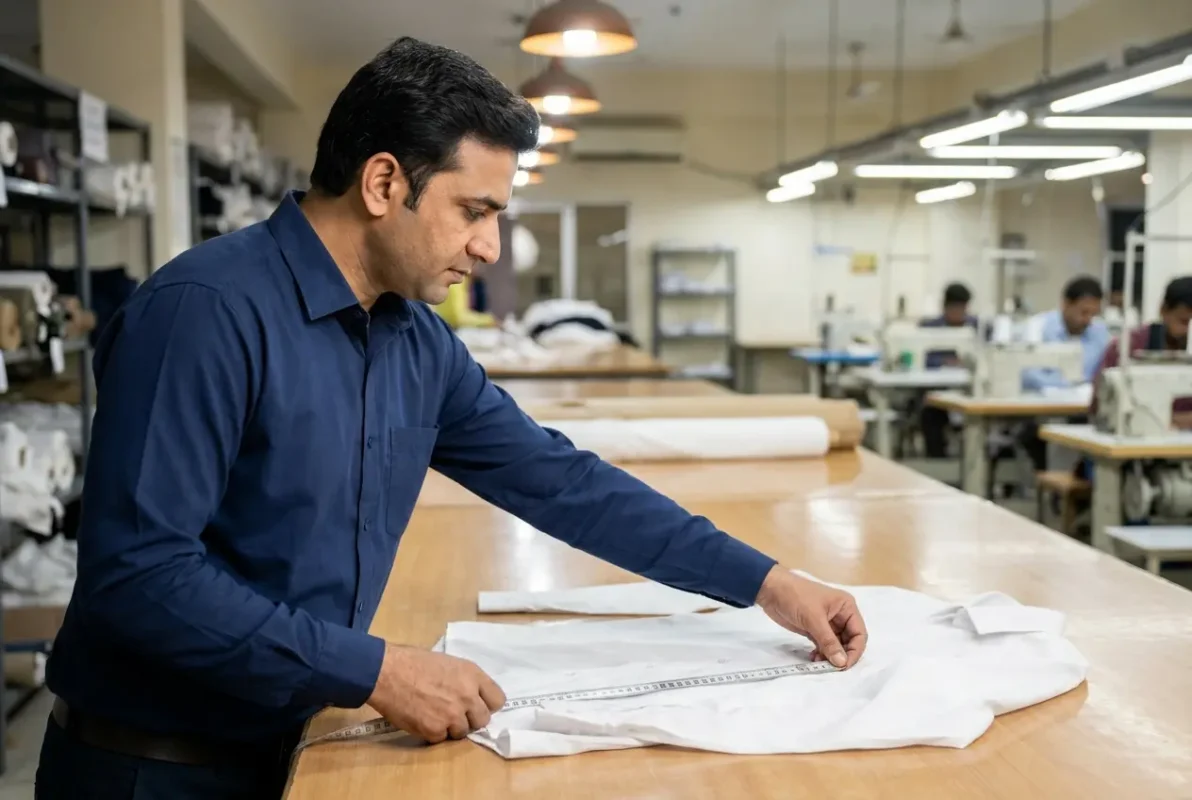
Rigorous quality control processes ensure consistent standards throughout production
- Pre-production – Approve samples before bulk production starts
- In-line inspection – Check quality during production
- Final inspection – Verify finished goods before shipment
- Random testing – Pull random samples from the production run
Leading manufacturers welcome quality oversight and provide transparency throughout the production process.
Step 5: Shipping, Logistics, and Delivery
Shipping Considerations:
- Coordinate arrangements early in the production process
- Decide on FOB vs CIF vs DDP terms
- Verify insurance coverage for shipment value
- Track shipments carefully (especially first orders)
- Prepare customs documentation in advance
Logistics Options:
- Sea freight – Most cost-effective for large orders (3-4 weeks to the USA)
- Air freight – Faster but expensive (3-7 days to the USA)
- Express courier – Best for samples (2-5 days to the USA)
Many Pakistani manufacturers offer comprehensive shipping and logistics solutions that simplify international delivery.
What to Look for in a Pakistan Clothing Manufacturer
Not all clothing suppliers in Pakistan offer the same capabilities or reliability. This checklist helps brands identify qualified manufacturing partners.
Essential Certifications (Must-Haves)
- OEKO-TEX Standard 100 – Essential for textile safety (most retailers require)
- ISO 9001:2015 – Demonstrates quality management commitment
- GOTS – Required for organic products
- Sedex or WRAP – Ethical trade certification
- GRS – If selling recycled content products
How to Verify:
- Request certificate copies with expiration dates
- Verify certificate numbers on issuing organization websites
- Confirm certificates cover the specific facility you’ll work with
- Ask for the most recent audit reports
Production Capabilities Assessment
Verify Equipment & Expertise Match Your Needs:
- Knit specialists may not excel at woven garments (and vice versa)
- Printing capabilities (screen, digital, heat transfer, sublimation)
- Embroidery equipment (number of heads, stitch capabilities)
- Cutting technology (manual, automated, laser)
- Finishing capabilities (washing, distressing, special treatments)
Capacity Considerations:
- Monthly production capacity (pieces per month)
- Current capacity utilization (avoid 95%+ facilities)
- Ability to scale if your orders grow
- Seasonal availability (busy vs slow periods)
Service Offerings Checklist
Value-Added Services:
- Custom embroidery and printing capabilities
- Private labeling programs
- Custom packaging design and production
- Quality control and inspection processes
- Fabric sourcing and development
- Design assistance and tech pack creation
- Logistics and shipping coordination
- Sample development services
Communication & Responsiveness
Evaluate During Initial Contact:
- Response time to inquiries (within 24-48 hours is good)
- Quality of responses (detailed vs vague)
- English communication skills
- Willingness to provide information
- Video call availability for deeper discussions
- Proactive communication vs reactive only
Poor communication during the sales process rarely improves during production.
References and Track Record
Request and Contact References:
- Ask for 3-5 current client references
- Contact clients producing similar products
- Ask about communication, quality, and on-time delivery
- Verify export history to your target markets
- Check experience with your product categories
Questions for References:
- How long have you worked with this manufacturer?
- What is their on-time delivery rate?
- How do they handle quality issues?
- Is communication responsive?
- Would you recommend them?
- Any issues or concerns to be aware of?
Red Flags to Watch For
Warning Signs of Potential Problems:
- ❌ Unwilling to provide samples or charging excessive sample fees
- ❌ No certifications or can’t produce documentation
- ❌ Vague or inconsistent pricing
- ❌ Poor communication and responsiveness
- ❌ Unwilling to provide client references
- ❌ Can’t provide facility tours (in-person or virtual)
- ❌ Pressure for large deposits before sample approval
- ❌ Claims to do everything (likely a broker, not manufacturer)
- ❌ No clear production timelines
- ❌ Unwilling to put agreements in writing
Why Brands Choose Hilton Enterprises for Pakistan Manufacturing
While understanding Pakistan’s textile industry advantages is important, choosing the right manufacturing partner makes the difference between success and frustration. Hilton Enterprises has served clothing brands, retailers, and distributors across the USA, Canada, and Europe for over 54 years.
Our Manufacturing Capabilities
Based in Faisalabad, Pakistan’s textile capital, Hilton Enterprises offers comprehensive manufacturing services across multiple product categories.
Apparel Manufacturing:
- Men’s Apparel – T-shirts, hoodies, jackets, pants, shorts, tracksuits, activewear
- Women’s Apparel – T-shirts, hoodies, jackets, bottoms, activewear, base layers
- Private Label Programs – Custom branding, labels, packaging for your brand
- OEM Production – Manufacturing to your exact specifications and tech packs
Sock Manufacturing:
- 11+ sock styles, including crew, athletic, dress, compression, and specialty socks
- Custom design and logo integration
- Amazon FBA preparation and compliant packaging for USA sellers
- Full private label sock manufacturing capabilities
- MOQ starting from 5,000 pairs, depending on customization
Home Textile Manufacturing:
- Bed sheets (printed, fitted, flat) with MOQ from 5,000 pieces per design
- Comforters and duvet covers in various warmth levels
- Towels, blankets, and decorative textile products
- Custom printing (reactive dye and pigment printing)
- Hospitality and retail market expertise
Our Certifications and Quality Standards
Hilton Enterprises maintains comprehensive certifications ensuring product safety, ethical manufacturing, and environmental responsibility:
- OEKO-TEX Standard 100 – Textile safety certification
- GOTS (Global Organic Textile Standard) – Organic material certification
- ISO 9001:2015 – Quality management systems
- Sedex – Ethical trade and responsible sourcing
All certifications are current, regularly audited, and cover our production facilities in Faisalabad.
Services Beyond Manufacturing
We provide end-to-end support from initial concept to delivered products:
Design and Development:
- Sample development and tech pack creation
- Fabric sourcing and material recommendations
- Design consultation for manufacturability
- Color matching and Pantone coordination
Customization Services:
- Custom embroidery (logos, graphics, text)
- Screen printing and digital printing
- Heat transfer and sublimation
- Appliqué and specialty embellishments
Branding and Packaging:
- Woven labels and printed neck labels
- Custom hang tags and care labels
- Branded poly bags and carton packaging
- Retail-ready packaging solutions
- Amazon FBA compliant packaging and prep
Export and Logistics:
- International shipping coordination (sea freight, air freight)
- Export documentation and customs support
- Quality control and pre-shipment inspection
- Direct delivery to the USA and Canadian fulfillment centers
Why USA and Canadian Brands Work With Us
Established Export Experience:
- Over 54 years of serving North American markets
- Deep understanding of USA and Canadian compliance requirements
- Experience with major retailers and e-commerce platforms
- Proven track record with Amazon FBA sellers
Communication and Support:
- English-speaking teams available during North American business hours
- Responsive communication (typically within 24 hours)
- Regular production updates and transparency
- Video calls and virtual factory tours are available
Quality and Reliability:
- Comprehensive quality control at every production stage
- Defect rates maintained below 2% industry standard
- On-time delivery track record
- Problem resolution and customer service commitment
Our Production Timeline
Understanding realistic timelines helps brands plan inventory and launches effectively:
Typical Production Schedule:
- Sampling: 5-7 days for initial samples
- Sample Approval: Client review and feedback (variable)
- Production: 4-6 weeks, depending on order size and complexity
- Quality Control: 2-3 days final inspection
- Shipping: 2-3 weeks sea freight to USA/Canada, 5-7 days air freight
Total Timeline: 6-8 weeks from order confirmation to delivery for sea freight, 4-5 weeks for air freight rush orders.
Getting Started With Hilton Enterprises
Starting a manufacturing relationship with Hilton Enterprises follows a clear process:
Initial Inquiry (Step 1):
- Contact us with your product requirements
- Share reference images, tech packs, or design ideas
- Provide target quantities and timeline
- Specify your market (USA, Canada, Europe)
Quote and Consultation ( Step 2 ):
- Receive detailed pricing based on your specifications
- Discuss MOQ options for your product category
- Review material options and customization capabilities
- Clarify timeline expectations and shipping options
Sample Development ( Step 3 ):
- Order samples to evaluate quality and specifications
- Review fabric, construction, sizing, colors, and branding
- Request adjustments if needed
- Approve final samples before production
Production Order ( Step 4 ):
- Confirm order details and specifications
- Arrange payment terms and deposit
- Receive regular production updates
- Coordinate quality control and shipping
Delivery and Partnership ( Step 5 ):
- Receive your order with all documentation
- Provide feedback on quality and service
- Plan future orders and seasonal collections
- Build a long-term manufacturing partnership
Industries We Serve
Hilton Enterprises supports diverse market segments with specialized manufacturing expertise:
- Direct-to-Consumer Brands – Emerging apparel and lifestyle brands
- Amazon FBA Sellers – Private label products with FBA-compliant packaging
- Retail Chains – Private label programs for boutiques and retailers
- Distributors – Wholesale textile products for distribution networks
- Corporate Clients – Custom uniforms and branded apparel
- Hospitality – Hotel bedding, towels, and textile products
Future of Pakistan Clothing Manufacturing
The Pakistan textile industry continues evolving to meet changing market demands and embrace new technologies.
Technology Integration and Automation
Current Technology Investments:
- Automated cutting systems (reducing fabric waste by 10-15%)
- Computerized embroidery machines (complex designs, faster production)
- Digital textile printing (custom designs, smaller runs, less water usage)
- Automated quality inspection systems (AI-powered defect detection)
- ERP systems for production management
- RFID tracking for inventory and quality control
These technologies improve efficiency, reduce errors, and enable more complex designs while maintaining competitive pricing.
Sustainability Initiatives
Environmental Investments:
- Water recycling and treatment systems (90%+ water reuse)
- Renewable energy sources (solar panel installations)
- Sustainable chemical management (ZDHC compliance)
- Waste reduction programs (fabric waste recycling)
- Energy-efficient machinery upgrades
- Carbon footprint reduction initiatives
Sustainable Material Adoption:
- Organic cotton production is increasing (GOTS certified)
- Recycled polyester from plastic bottles (GRS certified)
- Bamboo and other alternative fibers
- Low-impact dyes and chemical processes
- Biodegradable packaging materials
Government Support Programs
Pakistan’s government recognizes textiles as crucial to national economic development, according to the Trade Development Authority of Pakistan.
Government Initiatives:
- Export incentives and tax benefits for textile manufacturers
- Infrastructure development for industrial zones
- Technical training programs and skill development
- Research and development funding
- Energy cost subsidies for export-oriented units
- Streamlined customs and export procedures
Why Now Represents an Ideal Time
Market Conditions Favoring Pakistan:
- Post-COVID supply chain diversification – Brands learned not to depend on a single country
- China+1 strategy – Companies actively developing alternatives to China
- Rising costs in traditional centers – China, Vietnam, are being increased
- Sustainability demands – Pakistan’s investments position it well
- Infrastructure improvements – Better ports, roads, logistics
- Technology adoption – Closing the gap with more developed manufacturing centers
Pakistan’s combination of established expertise, ongoing modernization, and competitive advantages positions it for continued growth in global textile manufacturing.
Frequently Asked Questions About Pakistan Clothing Manufacturers
Q. Why do clothing brands choose Pakistan manufacturers?
Clothing brands choose Pakistan manufacturers because the country offers strong cotton expertise, competitive production costs, skilled textile workers, export experience, and private label manufacturing capabilities. For brands selling in the USA, Canada, and Europe, Pakistan is especially useful for cotton apparel, socks, bedding, hoodies, activewear, and other textile products.
Q. Is Pakistan a good country for private label clothing manufacturing?
Yes. Pakistan is a strong private label clothing manufacturing destination for brands that need custom apparel, branded labels, packaging, and export-ready production. Hilton Enterprises serves brands across the USA, Canada, and Europe with OEM apparel manufacturing, custom socks, and home textile products.
Q. What products can Pakistan clothing manufacturers make?
Pakistan clothing manufacturers produce a wide range of textile products, including t-shirts, hoodies, sweatshirts, jackets, pants, activewear, socks, uniforms, bed sheets, comforters, towels, blankets, and home textile products. The strongest categories are usually cotton apparel, knitted garments, socks, bedding, and value-added textile products.
Q. What products can Hilton Enterprises manufacture?
Hilton Enterprises manufactures private label clothing, OEM apparel, custom socks, and home textiles. Product categories include men’s and women’s t-shirts, hoodies, jackets, pants, activewear, socks, bed sheets, comforters, towels, blankets, and selected safety textile products.
Q. What is the MOQ for Pakistan clothing manufacturers?
MOQ depends on the product type, fabric, customization level, and packaging requirements. At Hilton Enterprises, socks typically start at 5,000 pairs, custom bed sheets at 5,000 pieces per design, and custom apparel MOQs vary by style and complexity. Basic garments, private label products, and standard specifications may offer more flexible arrangements after project review.
Q. Can I get samples before placing a bulk order?
Yes. Most reliable Pakistan clothing manufacturers offer samples before bulk production. Samples help buyers check fabric quality, stitching, sizing, colors, printing, embroidery, labels, and packaging before confirming a full order. Hilton Enterprises also supports sample development for private label apparel, socks, and home textile projects.
Q. Can Pakistan manufacturers make custom labels and packaging?
Yes. Established Pakistan manufacturers can provide custom labels, woven labels, printed neck labels, hang tags, polybags, cartons, barcode labels, and retail-ready packaging. This is useful for private label brands, Amazon sellers, boutique retailers, and wholesale buyers who need finished products ready for sale. Hilton Enterprises offers comprehensive custom packaging solutions.
Q. Can Pakistan clothing manufacturers ship to the USA and Canada?
Yes. Pakistan clothing manufacturers regularly export apparel, socks, and home textiles to the USA and Canada. Depending on the order, manufacturers can handle sea or air freight, export documents, customs coordination, carton packing, and direct delivery to warehouses or fulfillment centers. Hilton Enterprises supports North American buyers with shipping and logistics solutions.
Q. Can Pakistan manufacturers prepare products for Amazon FBA?
Yes. Some Pakistan manufacturers can prepare products for Amazon FBA by handling compliant packaging, labeling, barcode placement, carton packing, and direct shipping support. Hilton Enterprises offers Amazon FBA preparation for custom socks and selected private label textile products for USA sellers.
Q. Can Hilton Enterprises manufacture clothing for USA and Canadian brands?
Yes. Hilton Enterprises manufactures private label and OEM apparel for USA and Canadian brands, including men’s, women’s, and activewear, as well as t-shirts, hoodies, jackets, pants, socks, and home textiles. The company also supports branding, packaging, sampling, and export coordination. Contact us to discuss your requirements.
Q. What certifications should a Pakistan clothing manufacturer have?
Important certifications may include ISO 9001 for quality management, OEKO-TEX Standard 100 for textile safety, GOTS for organic cotton, GRS for recycled materials, Sedex for ethical trade, and WRAP for responsible production. Buyers should always verify certificates, expiry dates, audit scope, and whether the certificate applies to the actual production facility.
Q. How do I verify a Pakistan clothing manufacturer?
To verify a Pakistan clothing manufacturer, check its website, factory history, product categories, certifications, client references, export experience, sample quality, communication speed, and willingness to provide documentation. Serious buyers should request samples, confirm business details, review previous work, and start with a controlled trial order before scaling.
Q. What information should I send to get a manufacturing quote?
To get an accurate quote, send your product type, quantity, fabric details, GSM or material composition, size range, colors, artwork files, logo placement, label requirements, packaging needs, delivery country, and target timeline. If available, also send a tech pack, reference images, measurement chart, and preferred shipping method.
Q. Is Pakistan better than China for clothing manufacturing?
Pakistan can be a better choice for brands focused on cotton apparel, socks, home textiles, flexible private label manufacturing, and competitive pricing. China may still be stronger for highly technical synthetic products, very complex trims, and extremely large-scale specialized production. The better country depends on product type, order size, quality expectations, and sourcing strategy.
Partner with Experienced Pakistan Clothing Manufacturers
Understanding why clothing brands use Pakistan manufacturers reveals clear advantages in quality, pricing, flexibility, and comprehensive service capabilities. Pakistan’s textile industry offers compelling value propositions for brands of all sizes.
Key Takeaways:
- Superior cotton quality from world’s 4th largest cotton producer
- 10-20% lower costs than China with comparable quality
- Flexible MOQs (500-1,000 pieces vs 3,000-5,000 in China)
- Faster turnaround (4-8 weeks vs 10-14 weeks)
- Comprehensive certifications (OEKO-TEX, GOTS, ISO, Sedex)
- Full-service capabilities (private label, custom manufacturing, packaging, logistics)
- Diverse product range (apparel, home textiles, specialized products)
- Ethical and sustainable manufacturing practices
The combination of superior raw materials, skilled craftsmanship, competitive pricing, and comprehensive certifications positions Pakistan as an ideal manufacturing destination. As global brands increasingly diversify their supply chains, Pakistan’s infrastructure, expertise, and commitment to quality ensure continued growth and success.
For brands ready to explore Pakistan manufacturing opportunities, partnering with experienced, certified manufacturers streamlines the process. Hilton Enterprises brings over 54 years of textile manufacturing expertise from Faisalabad, Pakistan’s textile capital.
Our capabilities include:
- Comprehensive product range (apparel, home textiles, socks, accessories)
- Full certifications (OEKO-TEX, GOTS, ISO 9001:2015, Sedex)
- Flexible MOQs tailored to your needs
- Custom manufacturing capabilities
- Custom embroidery and printing
- Custom packaging solutions
- Comprehensive shipping and logistics
- Commitment to quality, ethical manufacturing, and customer service
We’ve enabled successful partnerships with brands across North America and Europe, from startups testing their first products to established companies scaling production.
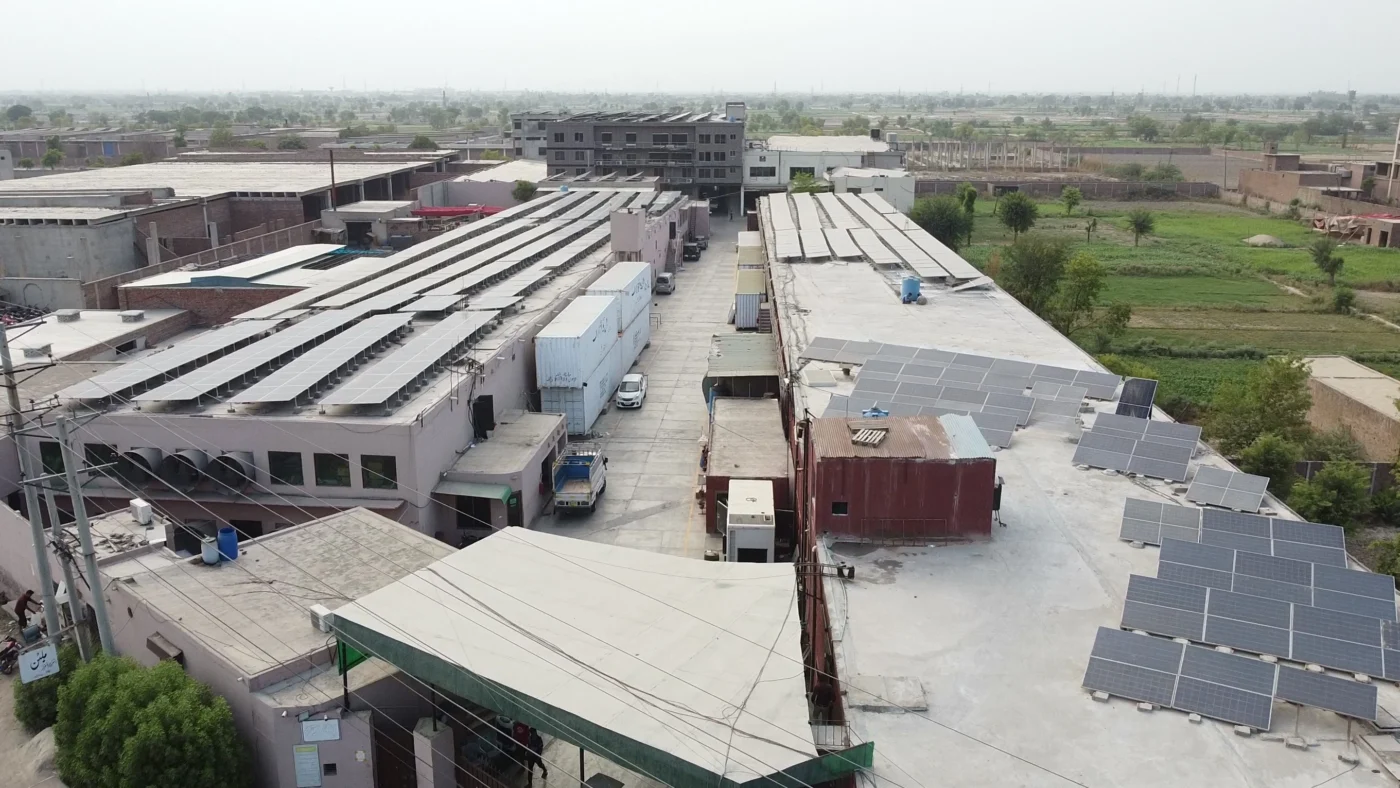
Hilton Enterprises: 54 years of textile manufacturing expertise serving brands across North America and Europe
Ready to explore Pakistan manufacturing for your brand?
Contact us to discuss your requirements, request samples, or schedule a facility tour. Discover how partnering with experienced Pakistan clothing manufacturers can strengthen your supply chain and enhance your product offerings.
Additional Resources:
- Visit our website to explore our full capabilities
- View our exhibition gallery of past work
- Learn about our business model
- Explore on-demand manufacturing services
- Read our complete sock manufacturing guide