Private label socks are one of the lowest-risk, highest-margin product categories in branded apparel — and one of the most misunderstood when it comes to how the manufacturing side actually works. Most guides cover the brand launch playbook. This one covers the factory side: what to look for in a manufacturing partner, what things actually cost at scale, and what the production timeline looks like in reality.
At Hilton Enterprises, we have manufactured private label socks for brands in the USA, UK, Canada, Europe and the Gulf since 1970 from our facility in Faisalabad, Pakistan. This guide is written from the maker’s perspective. Browse our full Private label Sock range with an in-depth 6-step custom socks manufacturing process before or after reading.
What are private label socks?
Private label socks are socks manufactured by a third-party factory to a brand’s specification — covering material, construction, sizing, and branding — and sold exclusively under that brand’s name, with no manufacturer label visible on the finished product.
The keyword is specification. Private label is not buying generic socks off a shelf and adding a logo. It is having socks built to your requirements: your yarn composition, your cushioning zones, your colorways, your cuff height, and your label. The manufacturer executes production. The brand owns the product identity.
Three factors make private label socks a commercially attractive product category:
- Repeat purchase behavior. Socks wear out. A customer who buys your branded sock and likes it will reorder — creating a revenue cycle that most apparel categories cannot match.
- High gross margin at scale. At manufacturer-direct pricing, a sock with a $15–25 retail price can have a landed cost of $3–7 per pair, yielding 60–80% gross margins —significantly higher than in most apparel categories.
- Universal demand, niche positioning. Everyone wears socks. A brand entering the category does not have to educate a market — it positions within one: athletic, medical, luxury, sustainable, grip, occupational.
Private label vs white label socks: what is the actual difference?
Private label socks are manufactured to your specifications — you define the construction, materials, and design. White label socks are pre-manufactured generic products where you add your branding, but cannot change the underlying sock. The distinction determines how differentiated your product is and how defensible your brand position becomes over time.
| Actual difference | White Label | Private Label |
| What it is | Pre-made sock + your branding applied on top | Sock built to your specification from yarn upward |
| Customisation | Branding only — color, label, packaging | Full — material, construction, fit, color, grip, label |
| Differentiation | Low — identical base product available to any buyer | High — your specification, your product |
| Time to market | Fast — 2–4 weeks | 35–90 days depending on development scope |
| MOQ | Lower — sometimes 100–500 pairs | Higher — typically 5,000 pairs at the direct manufacturer |
| Defensibility | None — a competitor can stock the same sock tomorrow | Strong — your construction and design are not replicated |
| Best for | Market testing, promotional merchandise, fast launches | Building a real sock brand with repeat purchase potential |
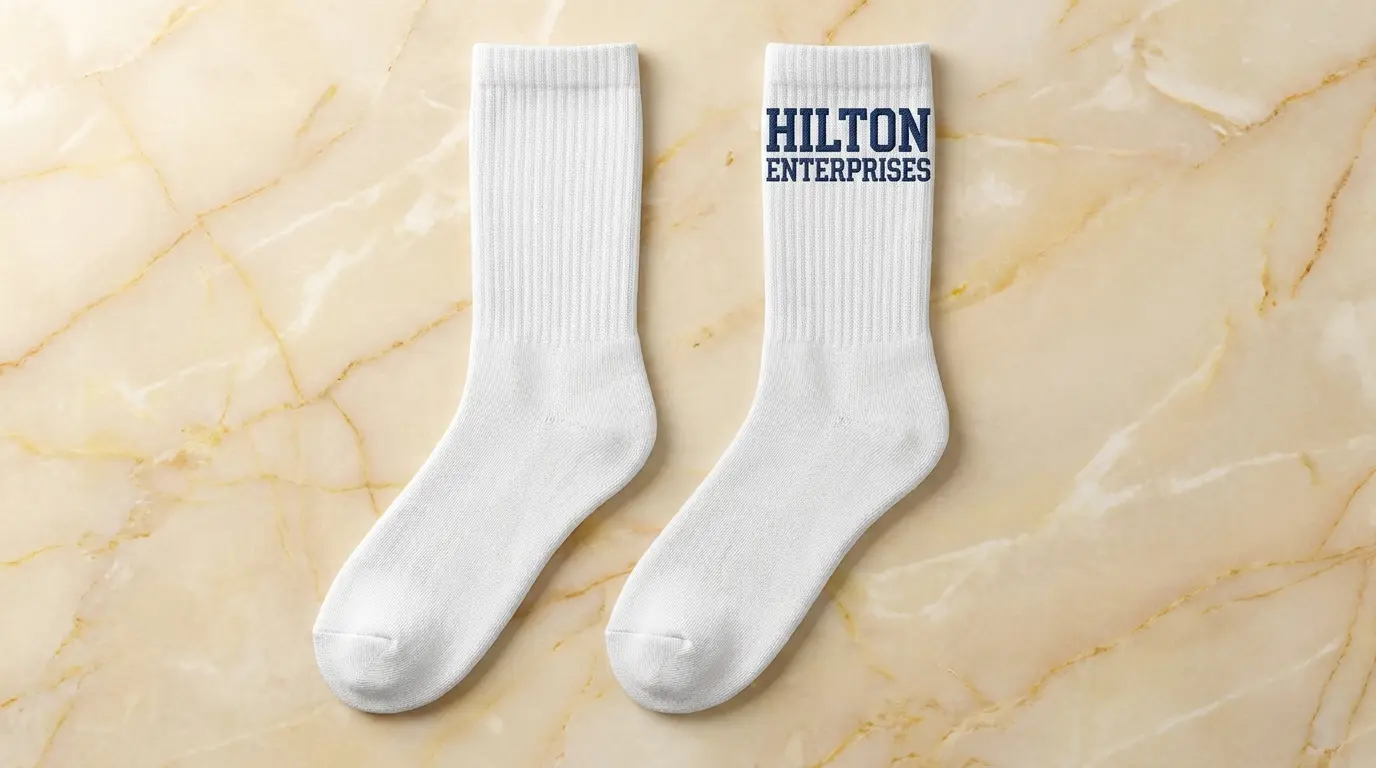
Left: white label — generic base sock with your branding applied. Right: private label — your specification from yarn upward, your design woven in. Same category, completely different product defensibility
Most serious sock brands start with a white label to validate demand — then move to private label once they have proven a market. Brands that try to build on white-label indefinitely discover margin compression that comes from competing on branding alone, without any product differentiation.
How to find a sock manufacturer: 5 questions to ask before you commit
Finding a sock manufacturer is straightforward. Finding one that will not cause problems at scale — inconsistent quality, missed lead times, compliance failures at customs — requires asking the right five questions before placing a single order.
1. Are you a manufacturer or a sourcing agent?
A sourcing agent places your order with a factory that they do not own and takes a margin. A manufacturer operates the production facility directly. Ordering from a manufacturer means lower costs, direct quality control, and no third-party with misaligned incentives. Ask for the factory address, registration documents, and a video walkthrough of the production floor.
At Hilton, you can verify this directly. Our Private Label Manufacturing service page outlines our full production scope, certifications, and capability across socks, apparel, and home textiles — with no sourcing layer between you and the factory.
2. What certifications does your facility hold?
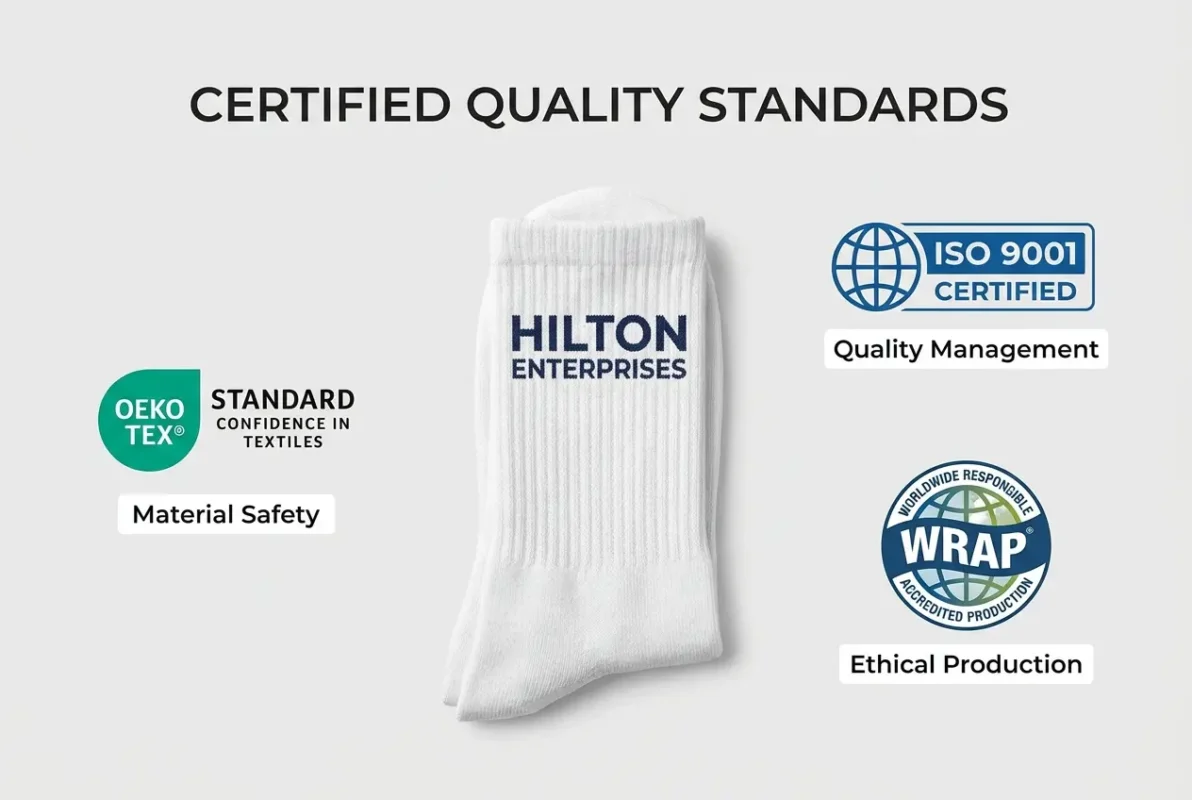
For socks exported to the USA, EU, UK, or Canada, the required baseline certification is OEKO-TEX Standard 100 — independent testing confirming that all sock components are free from harmful substances. ISO 9001 certifies quality management systems. WRAP and BSCI cover ethical labor standards. A manufacturer that cannot provide OEKO-TEX certification documents is not suitable for a private label brand selling into regulated markets.
3. What is your MOQ — per style, per color, and per order?
Manufacturers quote MOQ in different ways. Some offer a low total MOQ but require 500+ pairs per colorway, forcing a large inventory commitment for each color. Ask specifically: what is the minimum per style, and what is the minimum per color within a style? The colorway minimum is often the binding constraint on a first order.
4. Can I see a production sample before the bulk order?
No reputable manufacturer will refuse this. A pre-production physical sample is the standard quality gate before bulk production begins. Any manufacturer that pushes for bulk payment without a sample stage or charges prohibitively high sample fees is a risk signal. At Hilton, the sample stage is built into every order as a standard step, not an upsell.
5. What are your standard lead times, and what happens if you miss them?
Lead time commitments mean nothing without accountability. Ask: What is the timeline from sample approval to shipped goods? What freight options are available? What is the remedy if the delivery window is missed? Manufacturers who cannot answer this clearly have not built the production planning systems that consistent delivery requires.
USA sock manufacturers vs Pakistan: cost, lead time & compliance compared
Brands searching for private label sock manufacturers in the USA are typically looking for domestic production — shorter lead times, easier communication, and ‘Made in USA’ labeling. What they usually find is significantly higher per-pair cost, smaller production capacity, and fewer private label specialists than expected.
| Factor | USA Manufacturer | Pakistan Manufacturer (Hilton) |
| Per-pair manufacturing cost | Higher domestic labor rates | Lower — competitive at scale, quality comparable |
| MOQ | Often lower — 200–600 pairs | 5,000 pairs for a custom private label |
| Lead time | Shorter — 3–6 weeks typical | 35–45 days sea freight; 25–30 days air freight |
| ‘Made in USA’ label | Yes — if required for brand story | No — country of origin label |
| EU export — GSP+ duty | Standard WTO tariff applies | 89% of Pakistan textiles enter the EU duty-free under GSP+ |
| US export — tariff | No tariff (domestic) | 19% under the July 2025 US-Pakistan trade deal |
| OEKO-TEX compliance | Available from certified US mills | Available — Faisalabad manufacturers certified |
| Production capacity | Limited — a few large-scale sock mills | High — Faisalabad is one of the world’s largest hosiery hubs |
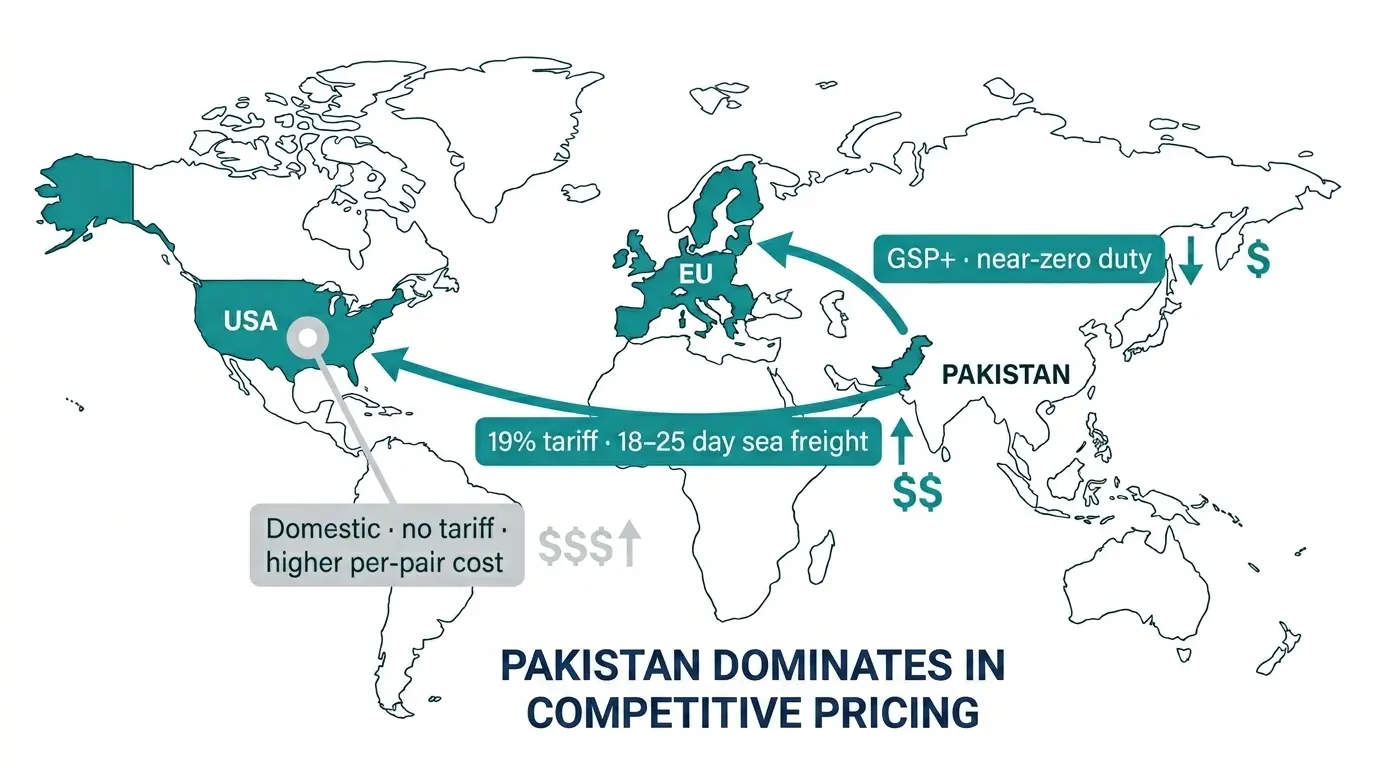
Pakistan to USA: 19% tariff, 18–25 day sea freight, factory-direct pricing at scale. Pakistan to EU: GSP+ near-zero duty. The landed cost comparison shifts significantly at 5,000+ pairs.
The EU GSP+ advantage for brands selling into Europe
For brands distributing into European markets, Pakistan’s GSP+ trade status delivers a measurable cost advantage. According to official EU trade data, around 89% of textiles and clothing imported to the EU from Pakistan enter at a preferential tariff rate under GSP+ — near-zero import duty for most sock categories. Pakistan is the largest beneficiary of the EU’s GSP+ program.
The US tariff context post-July 2025
For US-based brands, the tariff context changed in July 2025. Following bilateral negotiations, Pakistani goods exported to the USA are now subject to a 19% tariff, reduced from 29%. As the Pakistan Textile Council analysis notes, this places Pakistan in a comparable position to most other major manufacturing countries for US import purposes. The landed cost — manufacturing plus 19% tariff plus freight — still compares favorably to US domestic manufacturing on a per-pair basis at 5,000+ pairs.
From idea to finished product: the private label sock manufacturing process
Taking a private label sock from concept to delivered product involves six stages — from brief development through to bulk production and export — and takes 35–90 days depending on design complexity and whether custom yarn dyeing is required.
See our full factory process and virtual tour.
| Stage | Duration | You Provide | Manufacturer Delivers |
| 1. Brief development | Day 1 | Sock type, target market, fabric preferences, colorways, logo files | Quote, material recommendations, yarn options |
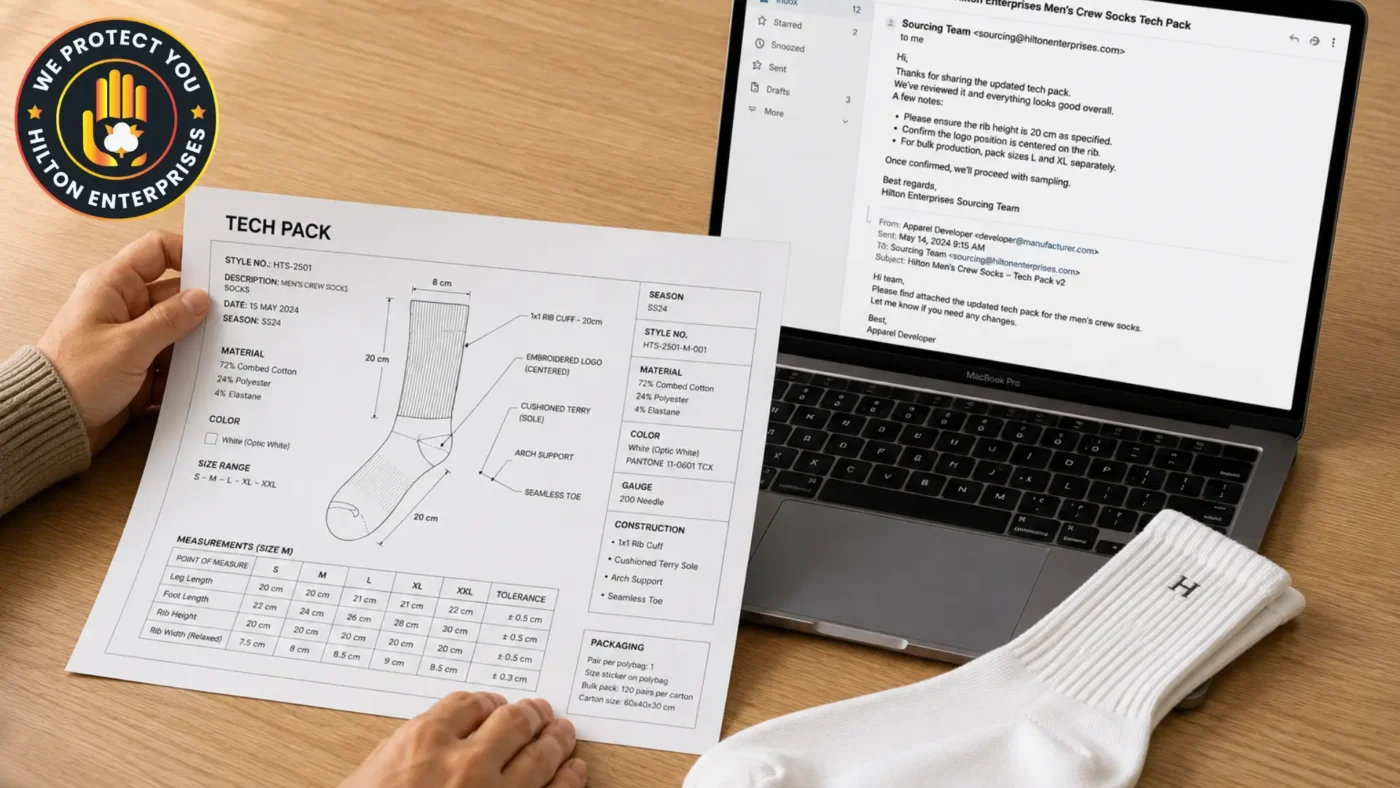
| 2. Tech pack | 3–5 business days | Brand guidelines, design references, size range | Technical specification sheet covering construction, materials, sizing, and labeling |
| 3. Digital proof | 2–3 business days | Approval or revision notes | Design mockup showing branding, colors, and construction on the sock template |
| 4. Physical sample | 7–14 days | Review: fabric hand, fit, grip, adhesion, logo clarity, color match | 1–3 physical pairs to specification |
| 5. Bulk production | 18–22 business days | Written sign-off on the sample | Full order manufactured, QC inspected, individually paired, and packed |
| 6. Shipping | 18–25 days (sea) | Delivery address, customs documentation | Door-to-door delivery with tracking |
The tech pack — what it is and why it matters
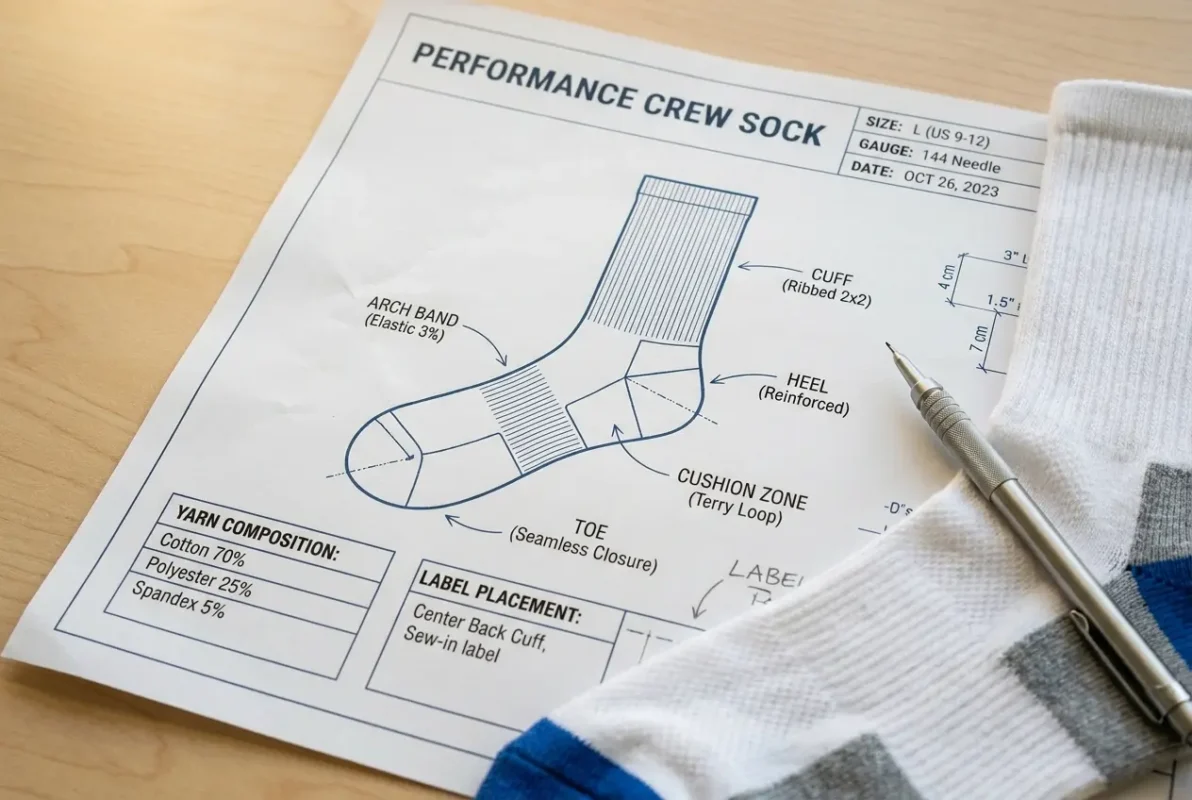
The tech pack is the contract between brand and manufacturer — every yarn specification, cushion zone, stitch count, and label placement is defined before a single pair is knitted.
A tech pack is the technical specification document that defines every measurable detail of your sock: yarn composition, stitch count per inch, cushion zone placement, elastane percentage, label content and placement, packaging requirements, and quality control parameters. It is the contract between you and the manufacturer — the reference standard for every pair in the production run.
Most manufacturers help develop the tech pack for first-time private label buyers. But you need to understand what is in it. If a quality dispute arises, the tech pack is what determines who is right.
What is the minimum order quantity for private label socks?
At Hilton Enterprises, the minimum order quantity for private label socks is 5,000 pairs per design — the threshold at which jacquard knitting machine programming, custom yarn dyeing, label production, and quality control are cost-effective at factory-direct pricing.
Why do MOQs vary so much across the market?
- Print-on-demand platforms can produce single pairs — but the per-pair cost is 5–10x manufacturer pricing, and performance fabric specifications are unavailable.
- Small-batch intermediaries offer 200–600-pair MOQs — but they place your order with a factory they do not own, adding a margin to the transaction.
- Direct manufacturers like Hilton require 5,000 pairs — because this is the minimum at which custom knitting setup, yarn dyeing, and label production are viable at factory-direct pricing.
A note on ‘cheap socks in bulk.’
Searches for cheap socks in bulk typically land on marketplace listings from intermediaries. The per-pair prices shown are often achievable — but they reflect either generic unbranded socks with minimal specification control, or private label socks through an intermediary at 2–3x factory-direct cost. The genuinely cheapest private label socks per pair, with a consistent quality standard, come from ordering directly from a manufacturer at volumes that justify the setup cost.
MOQ planning for new brands:
A new brand not ready for 5,000 pairs has two practical options: start with white label (generic socks with your branding, lower MOQ, shorter lead time) to validate demand, then transition to private label once you have proven sales velocity. Or consolidate your first private label order into two or three sock styles at 5,000 pairs each, building a complete collection from a single production run.
How much does it cost to launch a private label sock line?
The total investment to launch a private label sock line from a direct manufacturer ranges from $15,000 to $40,000 for a first order of 5,000 pairs — covering manufacturing, packaging, freight, and import duties — with per-pair landed cost typically falling between $3.00 and $8.00 depending on specification complexity.
| Cost Component | 5,000 Pairs — Estimate Range | Notes |
| Manufacturing (per pair) | $1.50–$4.00 | Depends on yarn composition, construction complexity, and grip type |
| Custom packaging (per pair) | $0.20–$0.80 | Hangtag, polybag, custom label — optional at first order stage |
| Sea freight | $800–$2,500 | Depends on container size and destination port |
| Import duties (USA) | 19% of FOB value | Post-July 2025 US-Pakistan trade deal tariff rate |
| Import duties (EU) | 0–2% of FOB | GSP+ preferential rate for eligible Pakistan textile exports |
| Sample development | $200–$600 | Credited against the bulk order if production proceeds |
| Total landed — 5,000 pairs | $15,000–$40,000 | Wide range reflects spec variation from basic to premium construction |
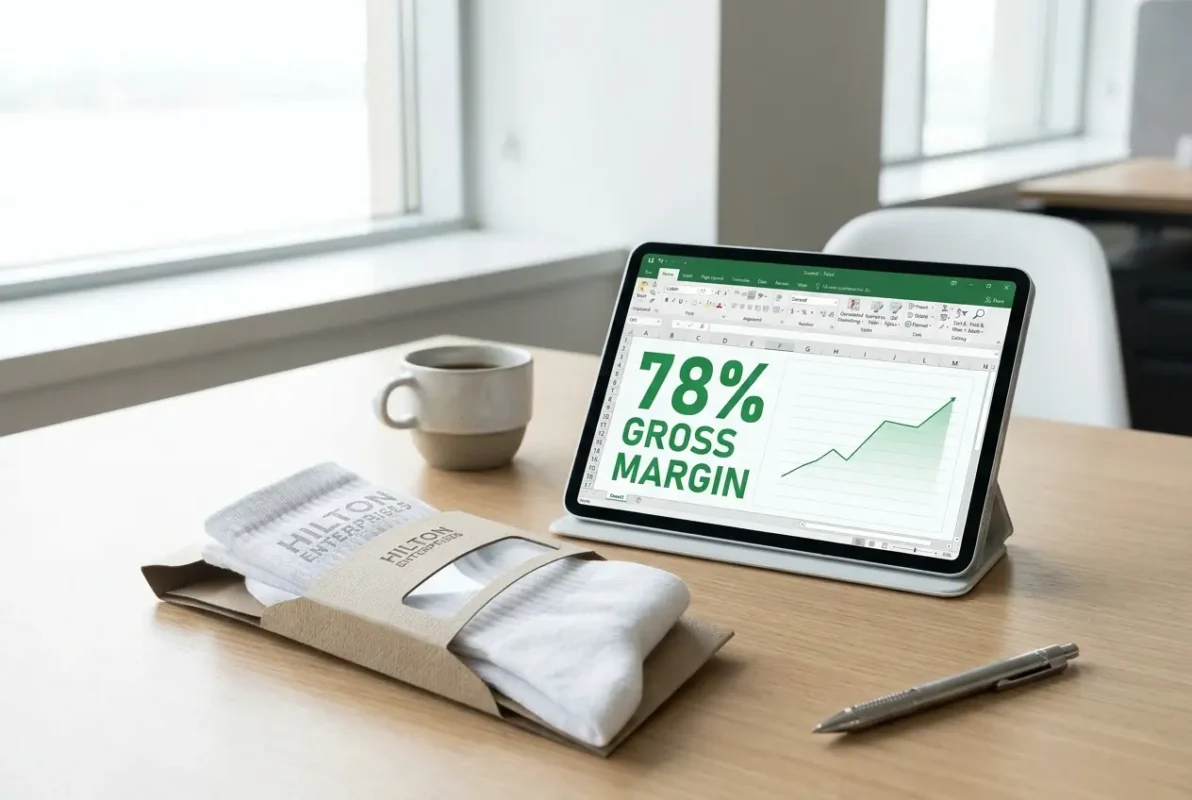
At $4 landed cost and $18 retail, a private label sock line generates a 78% gross margin — one of the highest in branded apparel. The margin maths work at scale.
What drives cost within the range
- Yarn composition. Merino wool or bamboo-blend socks cost significantly more per pair than standard cotton-nylon. The material investment is justified for a premium retail price point — less so for a branded sock selling at $12 retail.
- Construction complexity. Cushion zones, reinforced heel and toe, arch compression, and grip-sole application — each adds to the per-pair manufacturing cost. A basic branded crew sock and a technical grip performance sock are entirely different cost propositions.
- Colorway count. Custom yarn dyeing for multiple colorways adds setup cost. Launching with one or two colorways in the first run, then adding colors once demand is proven, is the most cost-effective approach.
The margin maths at private label scale:
At a landed cost of $4.00 per pair (5,000 pairs, mid-spec construction, sea freight to USA), a brand selling at $18 retail achieves a 78% gross margin before marketing and fulfillment costs. At $25 retail for a premium spec sock, the margin structure is even stronger. This is why private label socks are among the most commercially attractive branded apparel categories for brands with an existing audience.
How long does it take from design approval to first delivery?
From design approval — when you sign off on the physical sample — to delivery to your warehouse, a Hilton Enterprises private label sock order takes 20–28 days via sea freight and 8–12 days via air freight. The full timeline from first contact to product delivery is 35–55 days for a straightforward order.
| Stage | Duration | Variable Factors |
| Initial brief and quote | 1–3 days | Your brief clarity — a complete spec moves faster than an open brief |
| Tech pack development | 3–5 business days | How much development input is needed vs. the standard spec |
| Digital proof | 2–3 business days | Revision rounds — most orders take 1–2 |
| Custom yarn dyeing | 0–14 days | Only required for non-stock colors — standard colors skip this |
| Physical sample production | 7–14 days | Standard construction: 7 days. Complex: up to 14 days |
| Your sample review | 1–10 days | The most variable stage — depends on your internal process |
| Bulk production | 18–22 business days | Fixed — depends on order size |
| QC and packing | 2–3 business days | Fixed |
| Sea freight | 18–25 days | Port-to-port, depending on the destination |
| Air freight | 5–7 days | Available for urgent launch deadlines |
The stage brands consistently underestimate
Sample review. Brands routinely allocate one or two days internally, then take two to three weeks because the right decision-makers are not available, or the sample reveals a detail that needs revisiting. Build at least five business days into your timeline for sample review — and identify who has final sign-off authority before the sample arrives.
Why brands choose Pakistan for private label sock manufacturing
Brands choose Pakistan for private-label sock manufacturing because Faisalabad — Pakistan’s textile manufacturing center — is one of the world’s highest-volume hosiery production hubs, combining the cost structure of a developing economy with the machinery, certification, and export infrastructure that global brands require.
Production scale and technical capability
Pakistan’s hosiery sector runs Italian Lonati circular knitting machines — the same equipment used by major European sock manufacturers. Several Pakistani manufacturers produce more than 40 million pairs annually, supplying global sportswear brands that are stocked in major Western retail chains. The technical capability is not a second-tier approximation of European manufacturing — it is the same production infrastructure at a different cost base.
Compliance certifications — what is actually available
Pakistani sock manufacturers hold the full range of certifications required by regulated export markets. For brands selling into the EU or USA: OEKO-TEX Standard 100 (harmful substance testing), ISO 9001 (quality management), WRAP (ethical labor), and BSCI/SEDEX (social compliance audits). Hilton Enterprises manufactures to these standards — certification documentation available on request.
The EU GSP+ advantage
For private-label brands distributing in European markets, Pakistan’s GSP+ status offers a meaningful cost advantage. According to official EU trade data, around 89% of textiles and clothing imported to the EU from Pakistan enter at a preferential tariff rate — near-zero import duty for most sock categories. Pakistan is the largest beneficiary of the EU’s GSP+ program, contingent on maintaining compliance with 27 international conventions on labor rights and environmental standards.
The supply chain context in 2025
Pakistani textile exports grew approximately 9.3% year-on-year in the first eight months of FY2025, driven by knitwear and apparel as brands diversified away from China and Bangladesh. With the July 2025 US-Pakistan trade deal reducing tariffs from 29% to 19%, Pakistani goods now enter the USA at a tariff level comparable to those of most other major manufacturing countries. As the Pakistan Textile Council analysis notes, the landed cost at 5,000+ pairs compares favorably to US domestic manufacturing.
Why Hilton specifically
- Manufacturing in Faisalabad since 1970 — 50+ years of export relationships with USA, UK, Canada, and EU brands
- Direct factory — no sourcing agents, no intermediaries, no hidden margins on your order
- Full private label capability — tech pack development, bulk production, packaging, and export documentation
- Physical sample before every bulk order — standard, not optional
- Sea freight direct to the USA, UK, Canada, EU, Australia — 18–25 days from dispatch
- Full service overview — capabilities, certifications, and product categories — on our Private Label Manufacturer page
Launch Your Private Label Sock Brand with Hilton Enterprises
Hilton Enterprises has manufactured private label socks for brands in the USA, UK, Canada, and Europe since 1970 — directly from our Faisalabad facility. No intermediaries. Factory-direct pricing. OEKO-TEX compliant materials. Physical sample before bulk production.
Browse our full range in the Private Label Socks category page.
Read about our 50-year manufacturing background on our About page.
Submit your private label inquiry via our Contact page — include your sock type, quantity, target market, and brand guidelines. We respond within 1 business day.
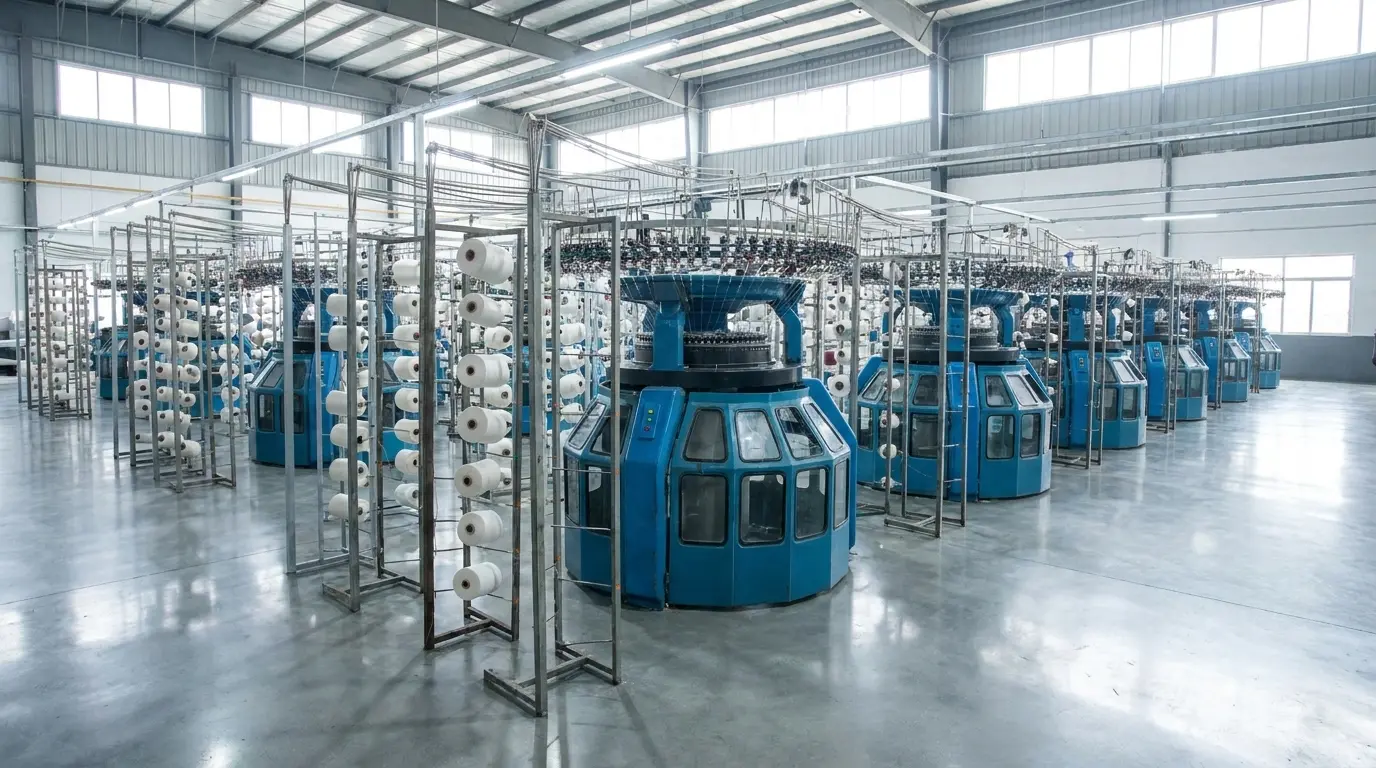
Italian Lonati circular knitting machines at Hilton Enterprises’ Faisalabad facility — the same equipment used by major European manufacturers, at factory-direct cost. Manufacturing private label socks since 1970
Related guides in this cluster:
Custom Grip Socks Wholesale: Pilates & Yoga Studio Manufacturing Guide
Wholesale Pilates Grip Socks: MOQ, Lead Times & Custom Branding
How Socks Are Made: A Manufacturer’s Guide
For a full overview of Hilton’s private label manufacturing capabilities across socks, apparel, and home textiles — including certifications and production scope — visit our Private Label Manufacturer service page.
Frequently Asked Questions: (FAQs)
Q: What are private label socks?
A: Socks manufactured to your specification — material, construction, branding — by a third-party factory, sold under your brand name with no manufacturer label visible. Full definition in Section 1.
Q: What is the difference between private label and white label socks?
A: White label = pre-made sock, you add branding. Private label = sock built to your specification. White-label is faster and has a lower MOQ; private-label is defensible and offers higher margins in the long term. Comparison in Section 2.
Q: How do I find a private label sock manufacturer?
A: Ask five questions before committing: manufacturer or agent? What certifications? MOQ per colorway? Physical sample available? What if they miss the lead time? Full checklist in Section 3.
Q: Are there sock manufacturers in the United States?
A: Yes — US manufacturers offer lower MOQs and ‘Made in USA’ labeling at a higher per-pair cost. For EU-destined brands, Pakistani manufacturers carry a significant GSP+ duty advantage. Full cost comparison in Section 4.
Q: What is the MOQ for private label socks at Hilton Enterprises?
A: 5,000 pairs per design — the factory-direct minimum at which custom knitting setup, yarn dyeing, and label production are cost-effective. Options for brands not yet at this volume are in Section 6.
Q: How much does it cost to launch a private label sock line?
A: $15,000–$40,000 total for 5,000 pairs, including manufacturing, packaging, sea freight, and import duties. Per-pair landed cost $3–$8, depending on specification. Full breakdown in Section 7.
Q: Do you offer OEKO-TEX certified materials?
A: Yes — Hilton manufactures to OEKO-TEX Standard 100 specification. Certification documentation available on request. Essential for brands selling into EU and UK-regulated markets. See what to verify in any manufacturer in Section 3.