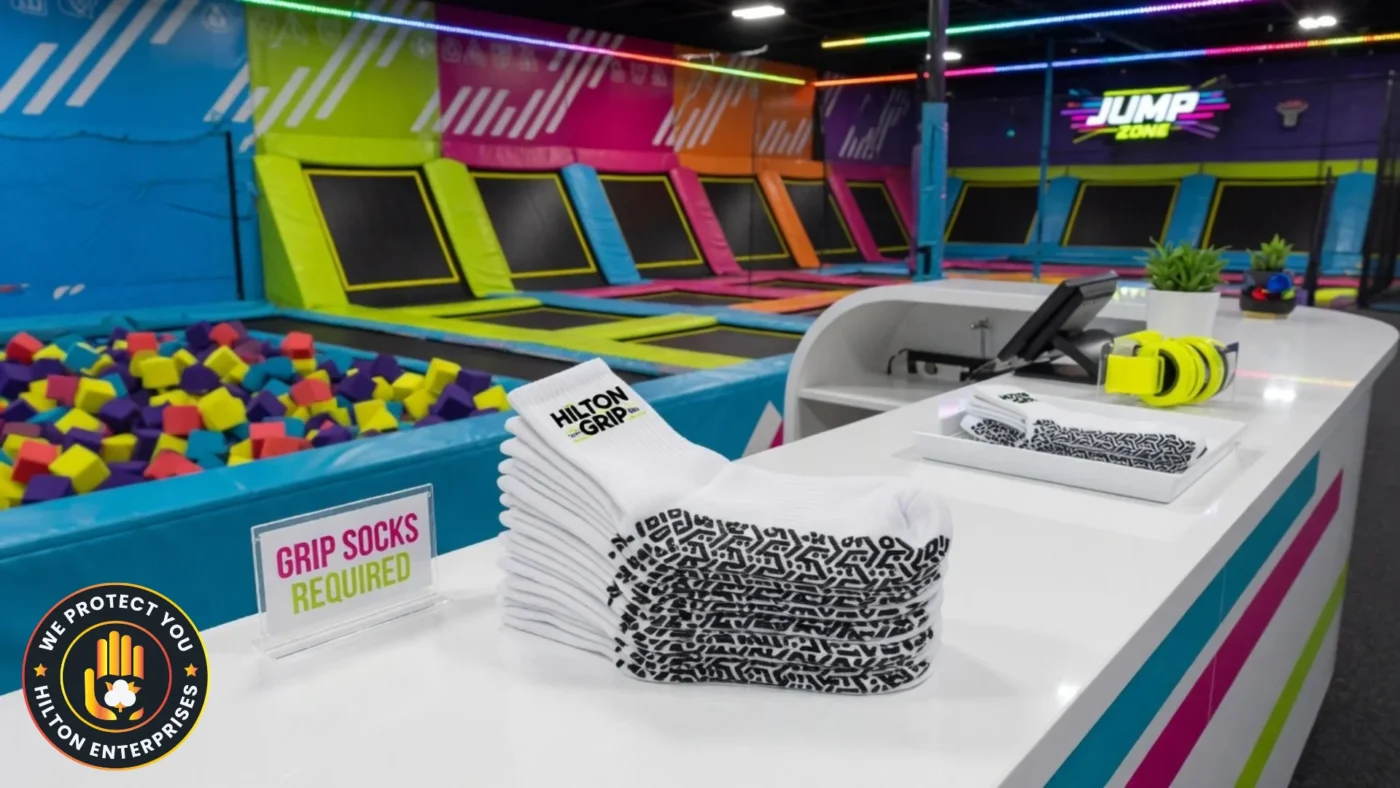
Trampoline parks are one of the fastest-growing segments of the indoor entertainment industry. The global market has expanded rapidly, and with growth comes a practical challenge that every park operator faces from day one: grip socks. They are mandatory, they are consumable, and when managed well, they are also a meaningful revenue line and a brand asset.
At Hilton Enterprises, we manufacture custom grip socks for trampoline parks, adventure venues, and family entertainment centres worldwide. This guide is written for venue operators — covering safety standards, material requirements, stock calculations, custom branding, and the economics of selling socks at the gate. You can explore our grip sock range on the Grip Socks category page.
If you are a visitor searching for what to wear to a trampoline park, jump to Section 2 for a quick answer.
Why do trampoline parks require grip socks?
Trampoline parks require grip socks because the polypropylene mesh surface of a trampoline bed becomes extremely slippery when in contact with bare feet or smooth-soled footwear, creating a risk of falls that venue operators are legally obligated to mitigate.
The grip sock requirement at trampoline parks serves three distinct functions:
- Safety: the non-slip grip sole prevents foot slippage on the trampoline surface during landing, jumping, and sidewall contact
- Hygiene: socks create a barrier between shared surfaces and bare skin, reducing the transmission of bacteria and fungal infections across hundreds of daily users
- Liability: venues that enforce grip sock policies demonstrate reasonable duty of care, which is relevant to insurance underwriting and incident liability assessments.
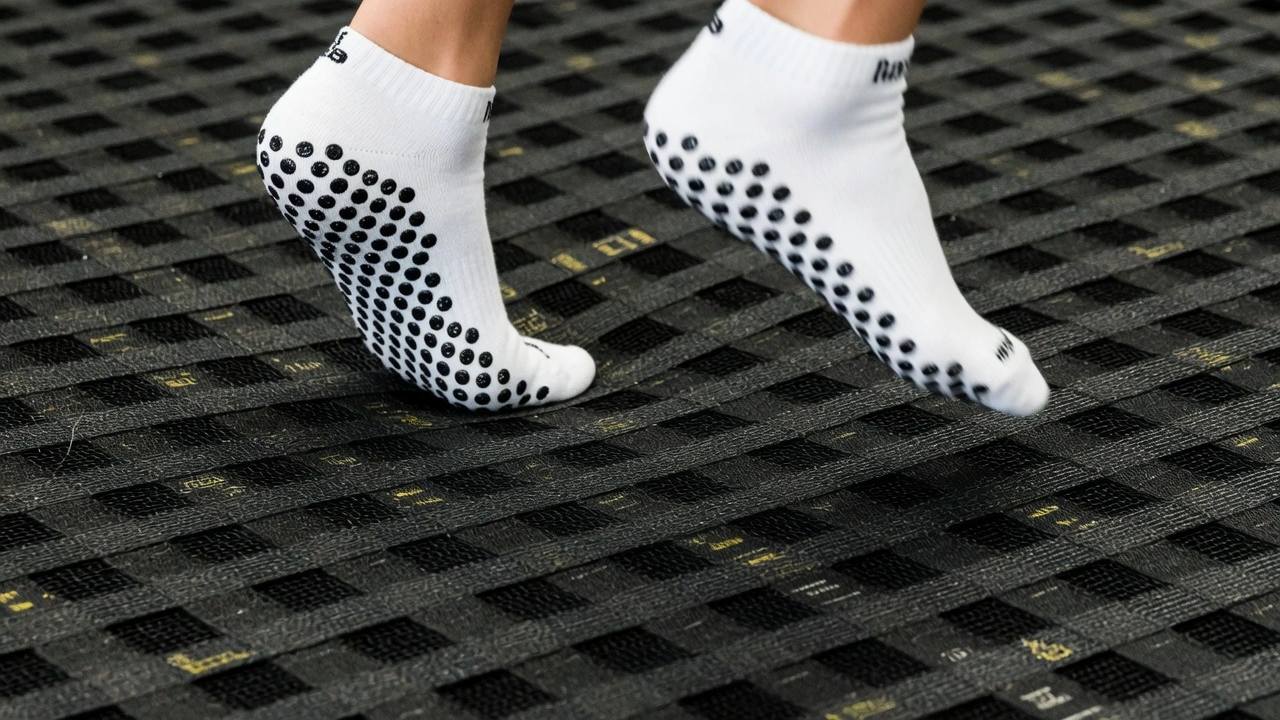
The PVC grip pattern on a venue sock makes direct contact with the trampoline’s polypropylene mesh — the difference between controlled landing and a slip incident.
Unlike casual gym environments, where grip socks are recommended, trampoline parks treat them as a non-negotiable entry requirement — on par with removing shoes. This creates a mandatory purchase moment at the entry desk for every guest who arrives without socks, which is the primary reason venue socks become a reliable secondary revenue stream.
What should I wear to a trampoline park?
You need grip socks to enter a trampoline park — standard trainer socks, ankle socks without grip, or bare feet are not permitted on the trampoline surfaces because they do not provide adequate traction on the polypropylene mesh.
Here is what to know before you go:
- Most trampoline parks sell grip socks at the entry desk. If you do not have a pair, you can buy them on arrival — usually for £2–4 in the UK or $3–5 in the USA.
- Grip socks purchased at the park are yours to keep and reuse. Bring them back on your next visit to avoid paying again.
- Look for socks with a rubber or silicone grip pattern on the sole. Regular cotton socks, sports socks, or non-grip ankle socks are not an acceptable substitute.
- Trampoline park socks are almost always white. This is the industry norm — see the explanation in Section 5..
- Children need the same grip sock requirement as adults. Most parks stock socks in sizes for toddlers through to adult XL.
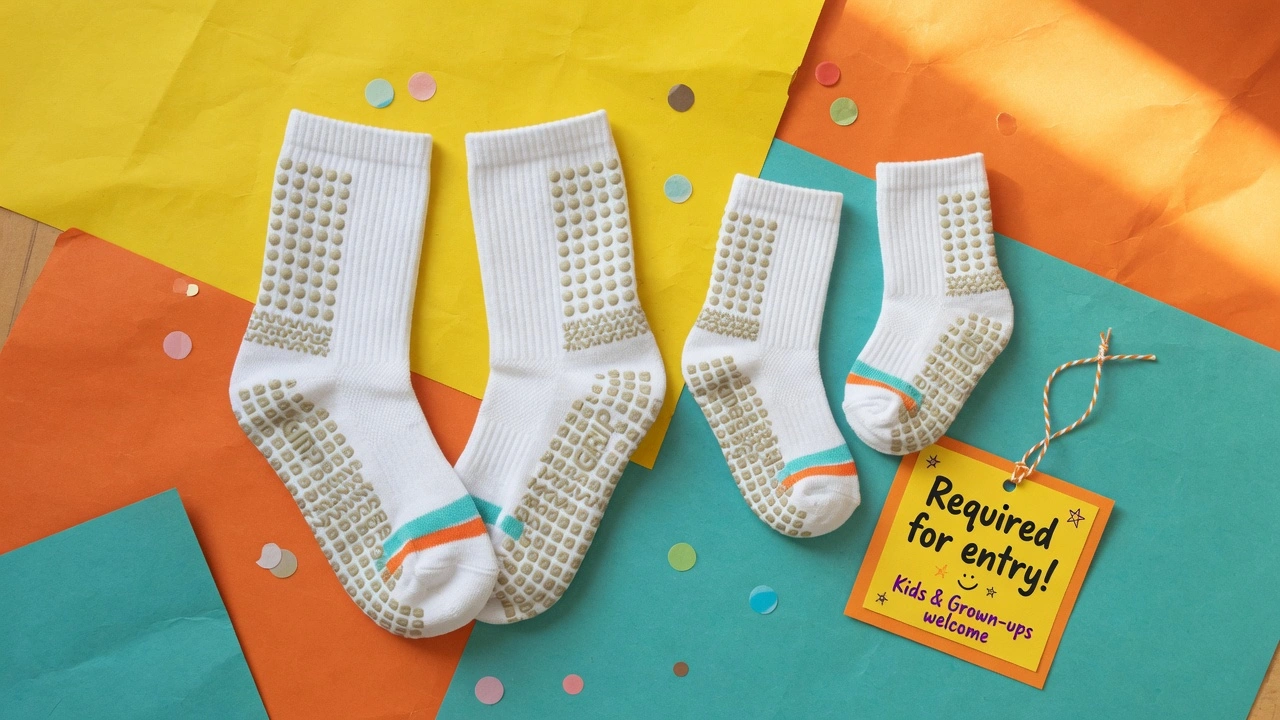
Grip socks are required for all ages at trampoline parks — available in sizes from toddler to adult XL at the venue entry desk.
If you are a park operator reading this, this is the page your guests will land on when searching ‘what to wear to a trampoline park.’ Having your own branded page with this information — and a direct link to purchase socks at entry — converts search intent into footfall. The operators who answer this question well online have lower sock friction at the gate.
What safety or liability standards apply to trampoline park socks?
Trampoline park grip socks must meet the surface traction requirements defined by ASTM F2970 — the standard specification for trampoline courts — which forms part of the broader safety framework that venue operators in the USA are expected to follow. In the UK and Europe, parks operate under EN 913 (gymnastic equipment safety) and the Health & Safety at Work Act, which together establish the duty of care framework for trampoline surfaces.
Important note on compliance:
Hilton Enterprises manufactures grip socks to the material and traction specifications park operators require. We are not a compliance testing body and cannot certify socks to ASTM or EN standards on your behalf. Venue operators should confirm their sock specification requirements with their insurers and safety consultants. We can provide material data sheets and grip pattern specifications to support that process.
What insurers and industry bodies look for
The International Association of Trampoline Parks (IATP) provides operational guidelines that inform what responsible sock enforcement looks like. Insurers typically look for evidence that:
- Grip socks are mandatory for all guests — not optional or recommended
- Socks are available for purchase at the entry point, so no guest is unable to participate due to a lack of socks
- The sock product used has a demonstrable grip sole — a product with visible traction material on the sole, not a smooth-soled alternative
- Staff enforce the policy consistently at every session
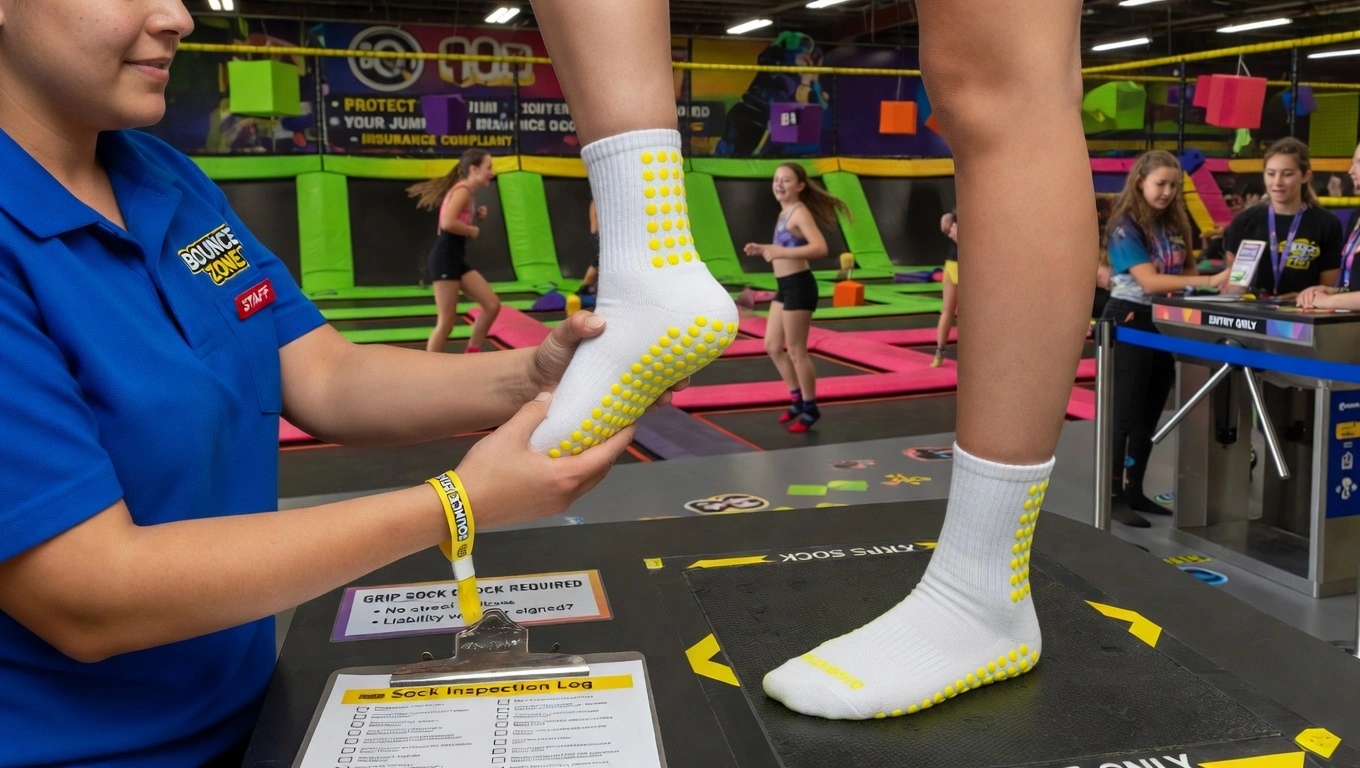
Consistent sock enforcement at the entry point is a key component of the duty of care framework that venue insurers and the IATP recommend.
From a manufacturer’s perspective, the most relevant specification is grip durability. A venue running 500 guests per day needs socks whose grip pattern remains effective through repeated use and machine washing — not a decorative pattern that wears off after 10 uses. This is one of the most important differences between venue-grade and retail-grade grip socks.
What grip and material features matter most for venue socks?
For trampoline park venue use, the three features that matter most are grip durability under repeated heavy use, anti-microbial yarn to manage hygiene across hundreds of daily users, and a size range broad enough to cover all age groups from toddlers to adults.
Grip material: PVC is the right choice for trampoline venues
Unlike pilates and yoga studios — where silicone grip is the preferred specification (see our Custom Grip Socks Wholesale Guide) — trampoline parks require PVC grip. PVC is harder, more abrasion-resistant, and maintains its grip pattern under the high-impact surface contact of trampoline jumping. Silicone grip, which is softer and more flexible, degrades faster under the friction and impact forces of trampoline use.
Custom soccer socks worn inside football boots also feature PVC grip, prioritizing abrasion resistance during lateral movement. For sports team applications, see our Custom Soccer Socks for Teams guide.
| Feature | Venue Requirement | Why It Matters |
| Grip material | PVC — screen-printed, bold pattern | Durability under impact and abrasion. Silicone degrades faster on trampoline mesh |
| Grip coverage | Full sole, including heel and toe box | Trampoline landing forces are distributed across the whole foot |
| Yarn composition | 80% cotton / 20% polyester with anti-microbial treatment | Moisture control and hygiene across 400–800 daily users |
| Sock weight | Medium weight — 80–90g per pair | Durable enough for venue use, light enough for active movement |
| Sole thickness | Standard knit — no extra padding | Padding reduces surface feel and traction feedback on trampoline mesh |
| Size range | Toddler (S) through Adult XL — minimum 4 sizes | Trampoline parks serve all age groups; running out of children’s sizes is a common operational problem |
| Colour | White as standard; custom colours available | Industry norm — see Section 5 for the reasoning |
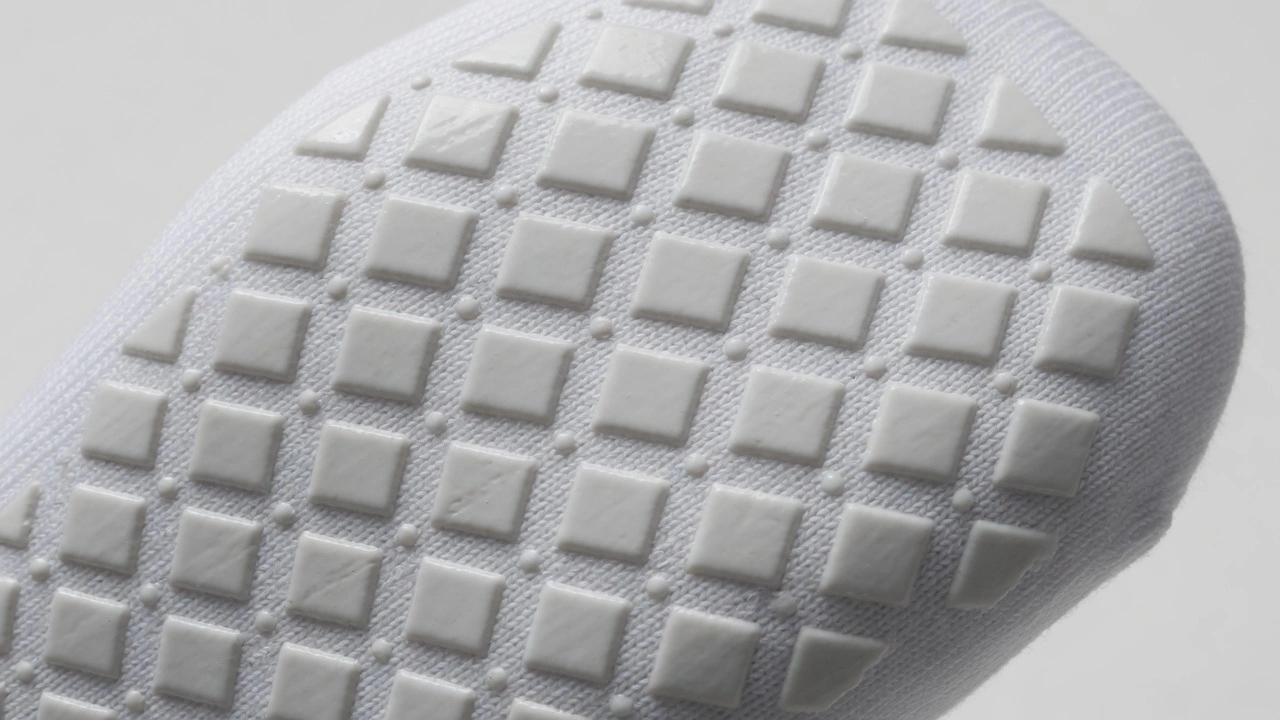
Bold PVC grip — screen-printed across the full sole including heel and toe box — is the correct specification for trampoline venue use. More abrasion-resistant than silicone under high-impact jumping conditions.
Anti-microbial yarn: the most overlooked specification
Trampoline parks are high-traffic, high-sweat environments. A venue running 500 guests per day generates enormous sock turnover. Guests who purchase socks and reuse them across multiple visits carry those socks through conditions that standard cotton yarn does not handle well. Anti-microbial treatment in the yarn — either a silver-ion or zinc-oxide based finishing process — inhibits bacterial and fungal growth, extending the hygienic life of each pair and reducing odour complaints that parks receive from repeat visitors.
Why are trampoline park socks usually white?
Trampoline park socks are almost universally white because white is the only colour that makes hygiene immediately visible — a dirty or worn pair of white socks signals to both staff and guests that the sock has been used, making it far harder to sneak in a previously purchased pair without buying a new one.
There are three operational reasons the industry has converged on white:
- Hygiene enforcement. White socks show dirt, sweat staining, and wear patterns clearly. Staff can make a rapid entry-desk judgment on whether a sock is new or previously used — something that is impossible with dark-coloured socks.
- A white sock with the venue’s logo creates a clean, professional look across the park floor. Mixed coloured socks from different brands create a visually chaotic environment that undermines premium venue positioning.
- Colour consistency for branding. White is the ideal base for any logo colour. A park’s teal, orange, or red brand colour prints crisply on white without dye bleeding or colour shift — a problem that occurs when printing on pre-coloured sock yarn.
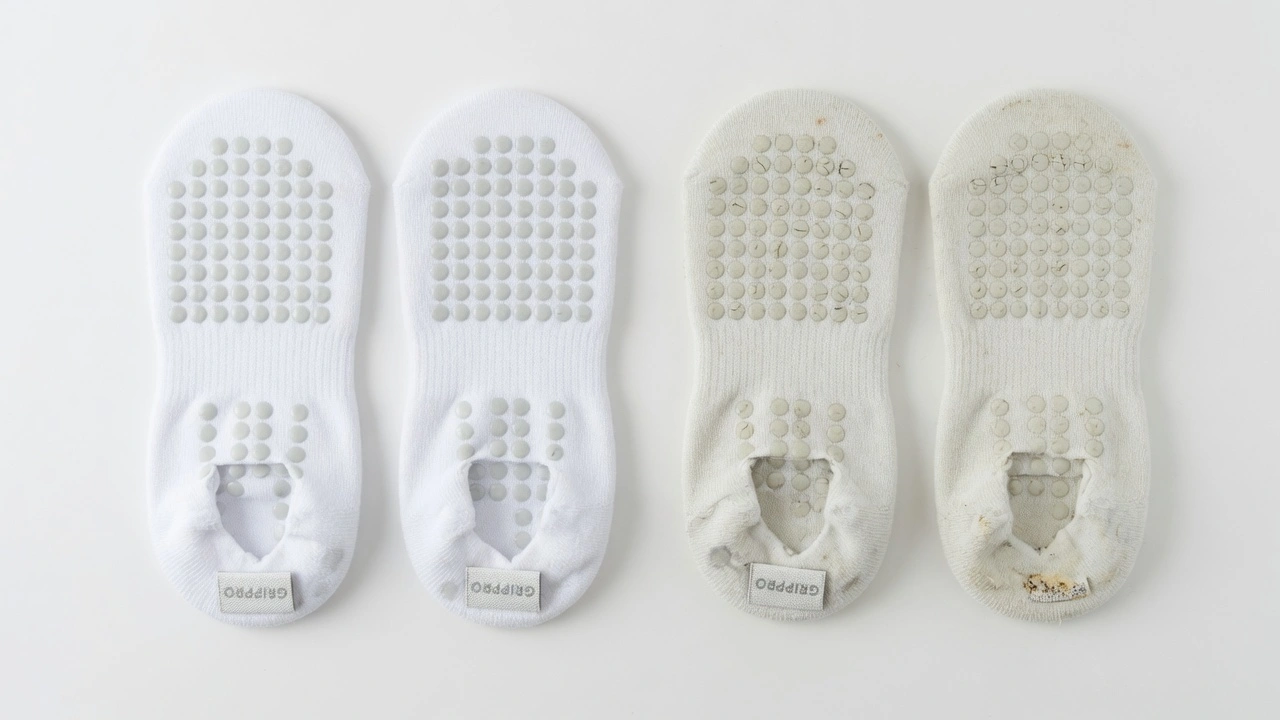
White makes hygiene status immediately visible to staff — a new pair versus a worn pair is readable at a glance. No other base colour provides this operational clarity.
Can we order trampoline park socks in other colours?
Yes — we manufacture custom trampoline park socks in any base colour. However, we recommend white for the operational reasons above. If you choose a coloured base, be aware that logo colours need to be specified carefully to ensure sufficient contrast, and that colour-matching across production runs requires Pantone references. Speak to our team when submitting your design brief.
How many socks does a trampoline park typically need to stock?
A trampoline park with 500 daily visitors and a 30% sock purchase rate needs to stock approximately 150 pairs per day — meaning a 5,000-pair order covers roughly 33 days of peak demand at that conversion rate, with reorder cycles planned around seasonal peaks.
Here is how to calculate your stocking requirement:
| Variable | What to Estimate | Example |
| Daily visitors | Your average footfall on a busy day | 500 guests/day |
| Sock purchase rate | % of guests who arrive without socks and buy at the desk | 30% = 150 pairs/day |
| Peak season uplift | School holidays and weekends drive 40–80% higher footfall | Peak days: 200–250 pairs/day |
| Reuse rate | % of repeat visitors who bring their own socks back | An estimated 40–60% of regulars |
| Buffer stock | Keep 2–3 weeks of peak demand in reserve | 500–750 pairs minimum buffer |
| Reorder trigger | Order when stock reaches your buffer level | Order at 500–750 pairs remaining |
Seasonal planning for trampoline park sock orders
Trampoline parks experience sharp seasonal demand spikes — school holiday periods (summer, Christmas, Easter) and half-term weeks can double or triple daily footfall versus off-peak. This has two implications for sock ordering:
- Order ahead of your peak season, not during it. A 5,000-pair order takes 35–45 days from design submission to delivery. If your peak season begins in late July, your order needs to be placed by mid-June at the latest.
- Order more than you think you need. Running out of socks during a peak weekend creates guest friction and lost revenue that exceeds the cost of any overstock. Unsold socks do not expire.
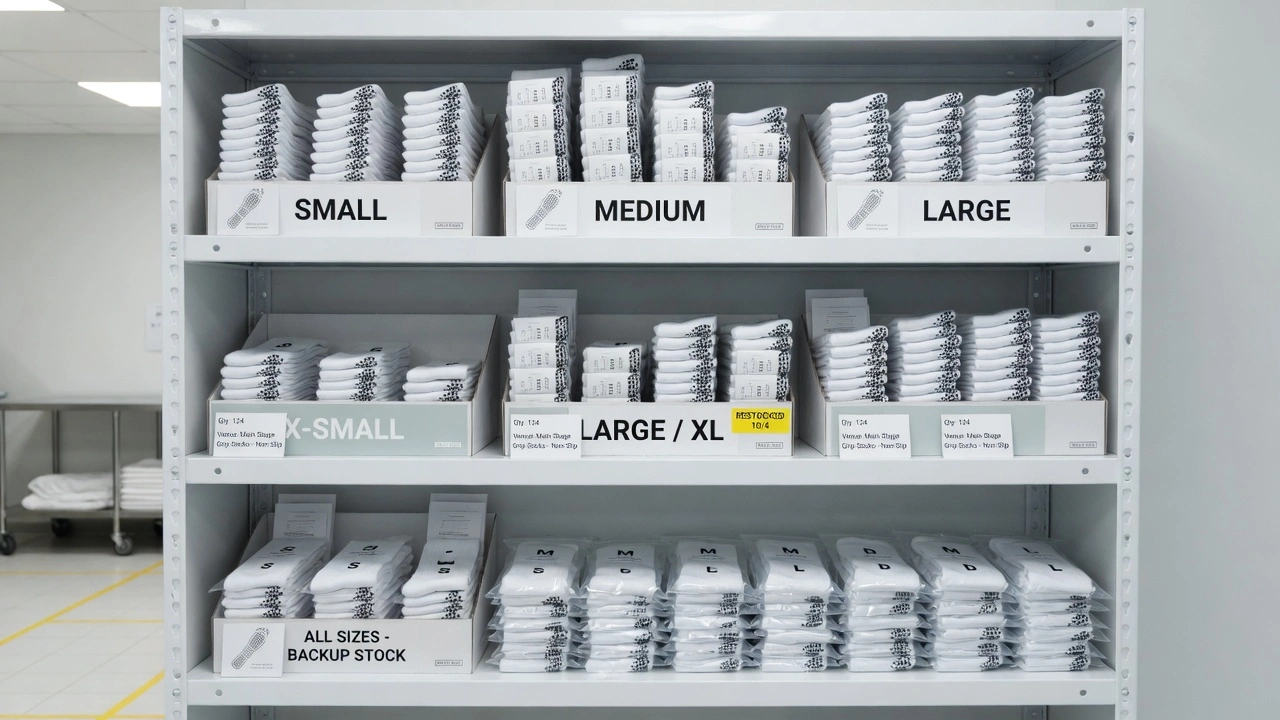
A well-stocked trampoline park keeps 2–3 weeks of peak demand across all size ranges — from toddler through adult XL — to avoid running out during school holiday surges.
Size distribution guide for trampoline park orders:
Based on typical park demographics, we recommend the following size split for a 5,000-pair order:
Toddler / Child S (ages 2–5): 15% · Child M (ages 6–9): 20% · Child L / Junior (ages 10–13): 20% · Adult S–M: 25% · Adult L–XL: 20%
Parks with a higher proportion of adult-only or corporate event bookings should shift the split toward adult sizes. Confirm your demographic split with our team when placing the order.
Can trampoline venues get socks printed with their own logo?
Yes, every order from Hilton Enterprises includes full custom branding: your park’s logo, name, and brand colours woven or printed directly onto the sock, with no third-party labels.
Two branding methods
The same two methods available for pilates and lagree socks apply to trampoline park socks — with a clear recommendation for venue use:
- Jacquard knitting (recommended). Your logo is woven into the sock structure during knitting — it cannot peel, crack, or fade with washing. This is the most durable option for socks that guests may reuse across multiple visits.
- Heat-transfer printing. Allows full-colour or photographic designs. Less durable than jacquard over repeated washing — better suited for socks intended for single-use or low reuse contexts.
The same two methods are used across all our custom grip sock production — for pilates studios, Lagree venues, and trampoline parks alike. For a detailed breakdown of how jacquard knitting and heat-transfer printing compare across fitness applications, see our Custom Grip Socks Wholesale Manufacturing Guide
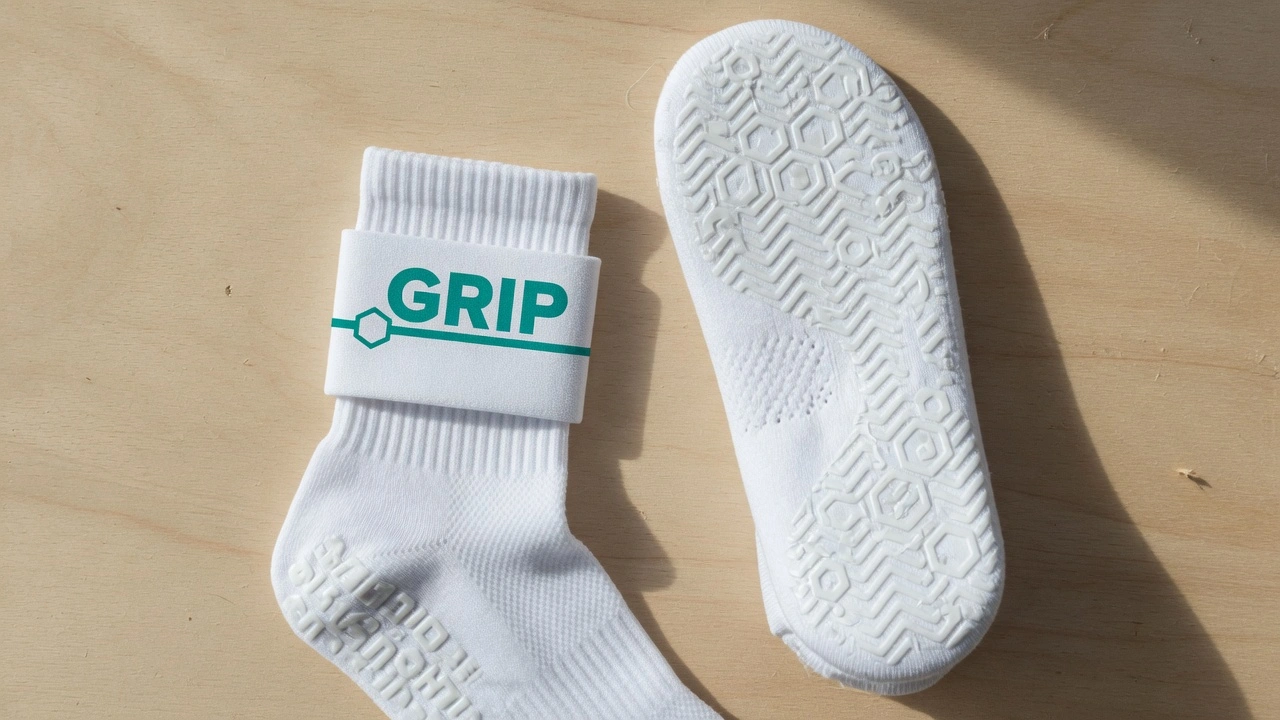
Jacquard-woven logo on the ankle cuff — bold, legible across the park floor, and fully integrated into the sock structure so it cannot peel or fade with washing.
What makes a good trampoline park sock logo
The best performing designs for venue socks are bold, simple, and readable at a glance across a busy park floor. Specific recommendations:
- Park name or abbreviated logo mark on the ankle cuff — visible when walking and during static positions
- A single accent colour on the toe and heel that matches your primary brand colour
- Avoid photographic or gradient designs — they require heat-transfer printing and are less durable for venue use
- Include your website or social handle on the sole or cuff if you want socks to drive repeat bookings
Design submission process
- Submit your logo in vector format (.AI, .EPS, or 300dpi PDF)
- We produce a digital proof within 48 hours, showing your exact logo and colour placement
- You approve the proof or request revisions — typically 1–2 rounds
- We manufacture a physical sample pair for your approval before bulk production
- Bulk production begins on your written sign-off
What is the MOQ and lead time for bulk venue grip socks?
Hilton Enterprises’ standard MOQ for custom trampoline park grip socks is 5,000 pairs per design — the minimum at which jacquard knitting setup, PVC grip application tooling, and custom label production are cost-effective for both parties.
See our production facility and QC process.
| Order Quantity | Relative Pricing | Lead Time | Includes |
| 5,000–9,999 pairs | Standard rate | 35–40 days | PVC grip + jacquard logo + custom label |
| 10,000–24,999 pairs | 5–10% reduction | 30–35 days | PVC grip + jacquard logo + custom label |
| 25,000–49,999 pairs | 10–18% reduction | 28–32 days | PVC grip + jacquard logo + label + packaging |
| 50,000+ pairs | Contact for a quote | 25–30 days | Full custom — grip, label, packaging, dedicated QC |
Full timeline from design to park floor
| Stage | Duration | What Happens |
| Design submission | Day 1 | Submit logo, colour, size split, and quantity |
| Digital proof | 2–3 business days | We produce a mockup of your branded sock design |
| Proof approval | 1–5 business days | You review and approve — or request 1–2 revision rounds |
| Physical sample | 5–7 business days | One finished pair produced for your sign-off |
| Bulk production | 18–22 business days | Full order manufactured, grip-applied, QC inspected |
| Sea freight | 18–25 days | Door-to-door to USA, UK, Canada, Australia, EU |
| Air freight (urgent) | 5–7 days | Available if your opening date or peak season is imminent |
Planning around your opening date or peak season
If you are opening a new park or expanding into a new venue, allow 45–50 days from first contact to sock delivery via sea freight. If your timeline is tighter, air freight reduces this to approximately 25–30 days total. Contact us as early as possible — sample approval is the most variable stage in the timeline, depending on how quickly your team can review.
If you supply both trampoline venues and pilates or yoga studios, our Wholesale Pilates Grip Socks guide covers the MOQ, pricing tiers, and lead times specific to studio wholesale — a useful comparison if you are sourcing both product types in a single order cycle.
How do trampoline parks typically price socks to guests?
Most trampoline parks price grip socks to guests at £2.50–£4.00 in the UK and $3.00–$5.00 in the USA, applied as a mandatory addition to the session fee for guests who arrive without socks — creating a predictable, near-100% capture rate at that price point.
Pricing models used by park operators
| Pricing Model | How It Works | Best For | Typical Price Point |
| Mandatory add-on | Guests without socks must purchase — no exception to entry policy | High-volume venues, enforced policy | £2.50–£3.50 / $3–$4 |
| Optional upsell | Recommended at check-in but not enforced — guests can wear their own socks | Relaxed policy venues | £2.00–£3.00 / $2.50–$3.50 |
| Session bundle | Socks included in the session price — no separate charge | Premium positioning venues | Absorbed into the session fee |
| Retail display | Socks are sold alongside merchandise at a higher price point | Parks with branded merchandise lines | £4.00–£6.00 / $5–$8 |
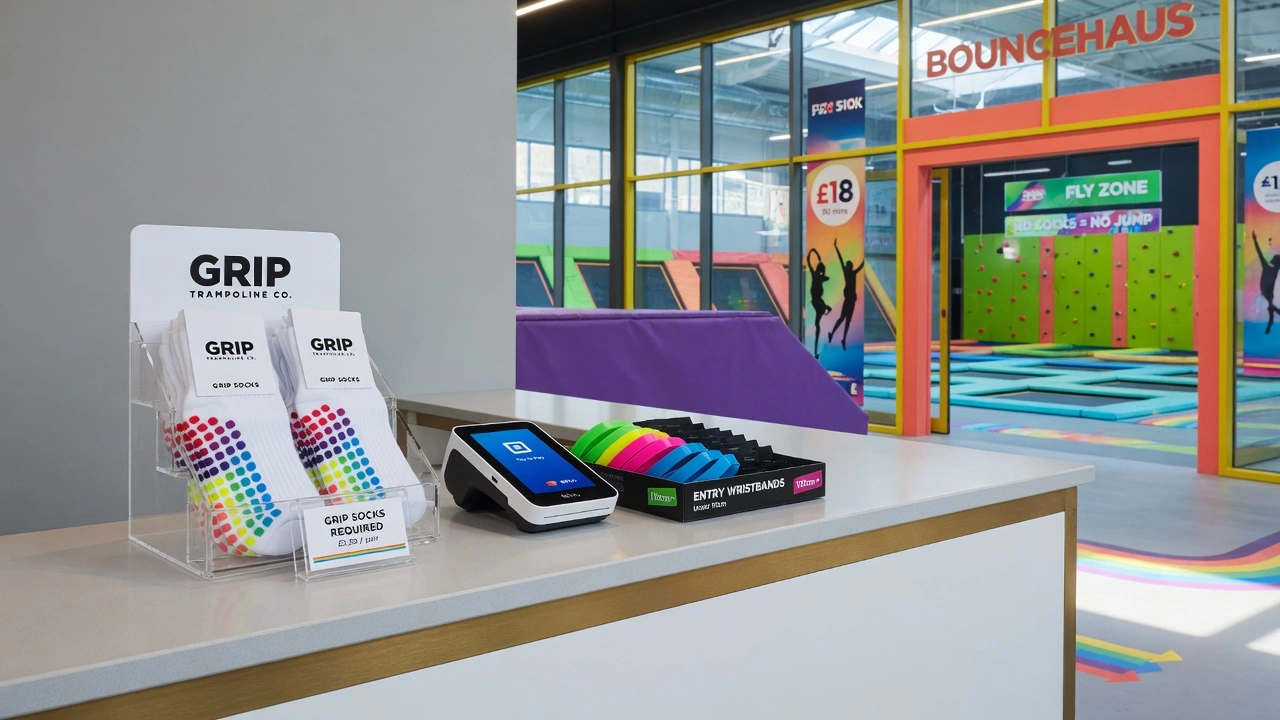
At £3 per pair and 150 sales per day, venue socks generate over £160,000 per year in ancillary revenue — among the highest-margin product lines in trampoline park operations.
The revenue maths of venue socks
At a mandatory £3.00 price point, a park selling 150 pairs per day generates £450 per day in sock revenue — £164,250 per year at that daily average. At a wholesale cost of well under £1 per pair at 5,000-unit MOQ, the margin on venue socks is among the highest of any ancillary revenue line in trampoline park operations.
Parks that move to custom-branded socks from unbranded or third-party stocked socks typically see no change in guest purchase rate — guests buy socks because they need them, not because of the brand on the sock. The margin improvement is entirely from lower wholesale cost and the brand equity retained on every pair sold.
Managing the ‘I already have socks’ problem
The most common operational friction at trampoline parks is guests claiming they have grip socks that do not actually have a functional grip sole. A clear visible grip pattern policy — communicated at the entry desk and on pre-visit communications — reduces this friction significantly. Some parks apply a UV stamp to their branded socks at purchase, allowing staff to instantly verify at re-entry that guests purchased the socks at the venue.
Order Custom Grip Socks for Your Trampoline Park:
Hilton Enterprises manufactures custom grip socks for trampoline parks, adventure venues, and entertainment centres worldwide. We supply direct from our Faisalabad facility — full custom branding, anti-microbial fabric options, PVC grip soles built for heavy daily venue use, and a 5,000-pair MOQ with physical sample before bulk production.
- Browse grip sock styles and specifications on our Grip Socks category page.
- Learn about Hilton’s 50-year manufacturing background on our About page.
- Submit your inquiry — park name, required quantity, colour, and logo — via our Contact page. We respond within 1 business day.
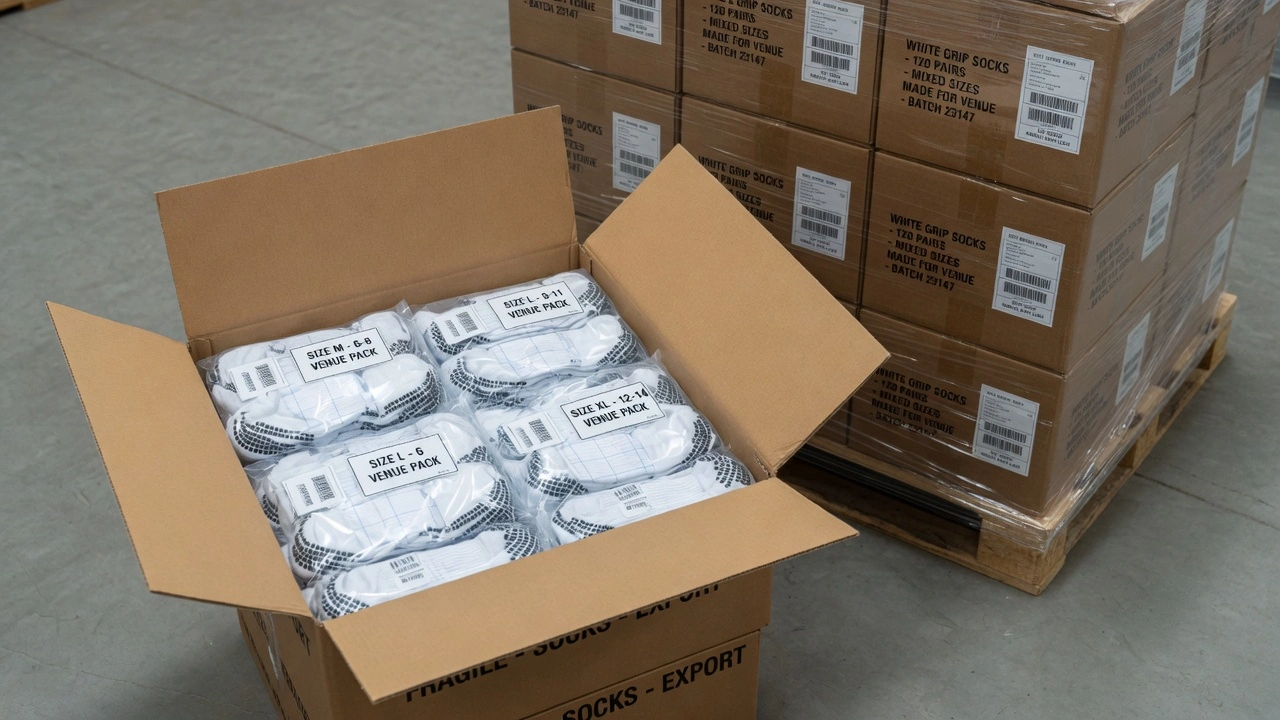
A standard Hilton Enterprises wholesale order — individually paired, size-sorted, QC inspected, and packed for export to the USA, UK, Canada, and Europe.
Also in This Series:
Custom Grip Socks for Pilates & Yoga Studios: Wholesale Manufacturing Guide
Lagree Socks Explained: What Studios Use and How to Order Custom Branded Pairs
Wholesale Pilates Grip Socks: MOQ, Lead Times & Custom Branding
Frequently Asked Questions
Q: Why do trampoline parks require grip socks?
Safety and insurance. Non-slip PVC soles prevent falls on slippery trampoline beds, while the socks act as a mandatory hygiene barrier across hundreds of daily users. Most parks require them as a condition of entry for liability reasons. See the full breakdown in Section 1.
Q: What should I wear to a trampoline park?
Grip socks with a visible rubber or silicone sole pattern — not standard trainer socks. If you do not have a pair, the park sells them at the entry desk for £2–4 (UK) or $3–5 (USA). Full guidance in Section 2.
Q: Do trampoline park socks need to meet safety standards?
No individual sock product is certified to ASTM F2970 or EN 913, but your venue’s grip sock policy must satisfy the duty of care requirements those standards inform. Your insurer and the IATP are the right reference points. See Section 3 for the full compliance note.
Q: Why are trampoline park socks usually white?
White makes hygiene status visible at a glance — staff can instantly tell whether a sock is new or previously used, which is impossible with dark colours. It is also the most versatile base for any logo colour. Full reasoning in Section 5.
Q: How many pairs of socks does a trampoline park need to stock?
At a 30% purchase rate, a 500-visitor park sells roughly 150 pairs per day. A 5,000-pair order covers approximately 33 days of peak demand. Use the calculation table in Section 6 to model your own figures.
Q: Can we get socks printed with our park logo?
Yes — every Hilton order includes full custom branding via jacquard knitting, which is woven into the sock structure and cannot peel or fade. Digital proof within 48 hours, physical sample before bulk production. See the design process in Section 7.
Q: What is the minimum order quantity?
5,000 pairs per design. Pricing reduces at 10,000+ pairs. To get a quote, visit our Contact page with your quantity, size split, and logo.
Q: Do you offer samples before we commit to bulk?
Yes — we manufacture a physical sample pair to your exact specification before bulk production begins. Sample approval is built into the standard timeline. Contact us to initiate.
Q: Is there a discount for repeat orders?
Repeat order pricing is discussed at the account level — parks with predictable reorder cycles typically qualify for preferential rates. Raise this when you submit your first inquiry via the Contact page.
Q: How long does delivery take?
35–45 days total via sea freight from design submission to your door. Air freight cuts this to 25–30 days. Plan well ahead of park openings and peak season — sample approval is the most variable stage. Full timeline in Section 8.