The Lagree method, created by Sebastien Lagree in the late 1990s, has grown from a niche reformer discipline into one of the fastest-expanding boutique fitness categories in North America and Europe. As the method has scaled — driven by the Megaformer machine and its variants — so has demand for studio-branded equipment and apparel. Grip socks sit at the centre of that demand.
At Hilton Enterprises, we manufacture custom grip socks for studios worldwide, including Lagree-specific designs built around the grip and surface requirements of the Megaformer. This guide covers what lagree socks are, what clients should wear to class, what makes these socks different from standard pilates grip socks, and how studios order custom branded pairs at wholesale. You can explore our current grip sock range on the Grip Socks category page.
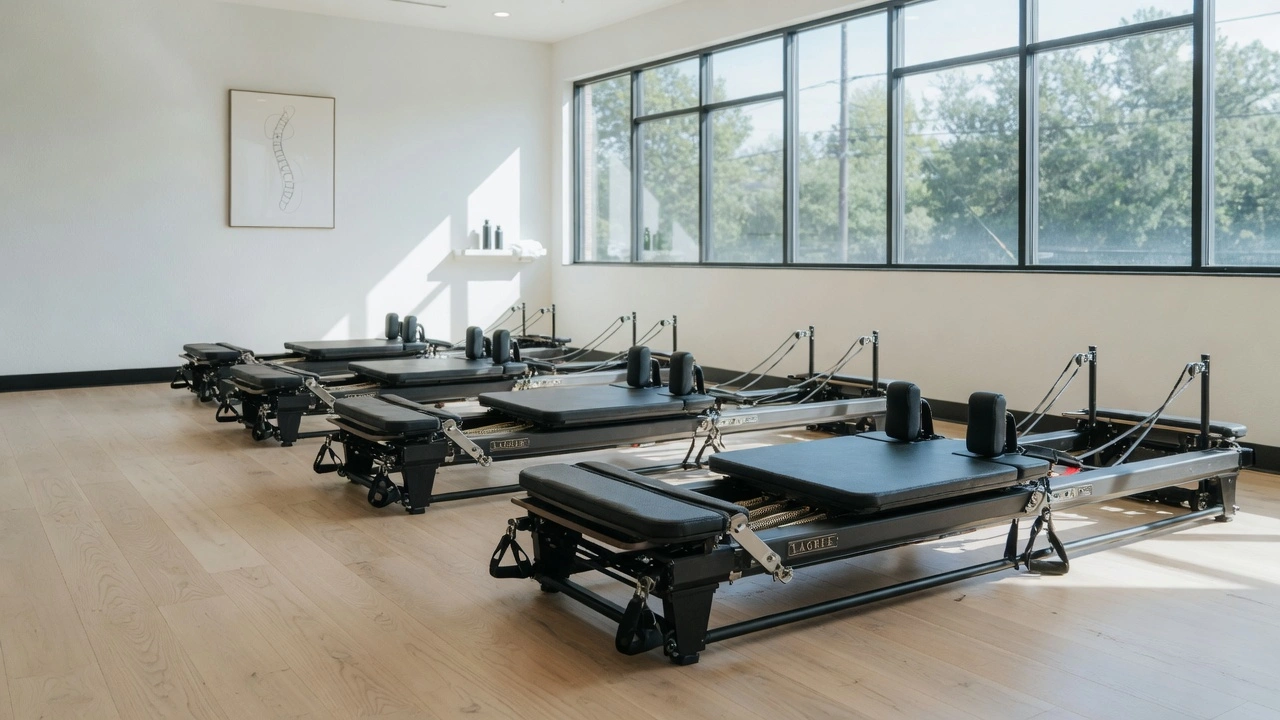
The Megaformer — developed by Sebastien Lagree — requires a specific grip sock designed for its textured carriage platform and sustained spring-resistance movements.
What are Lagree socks?
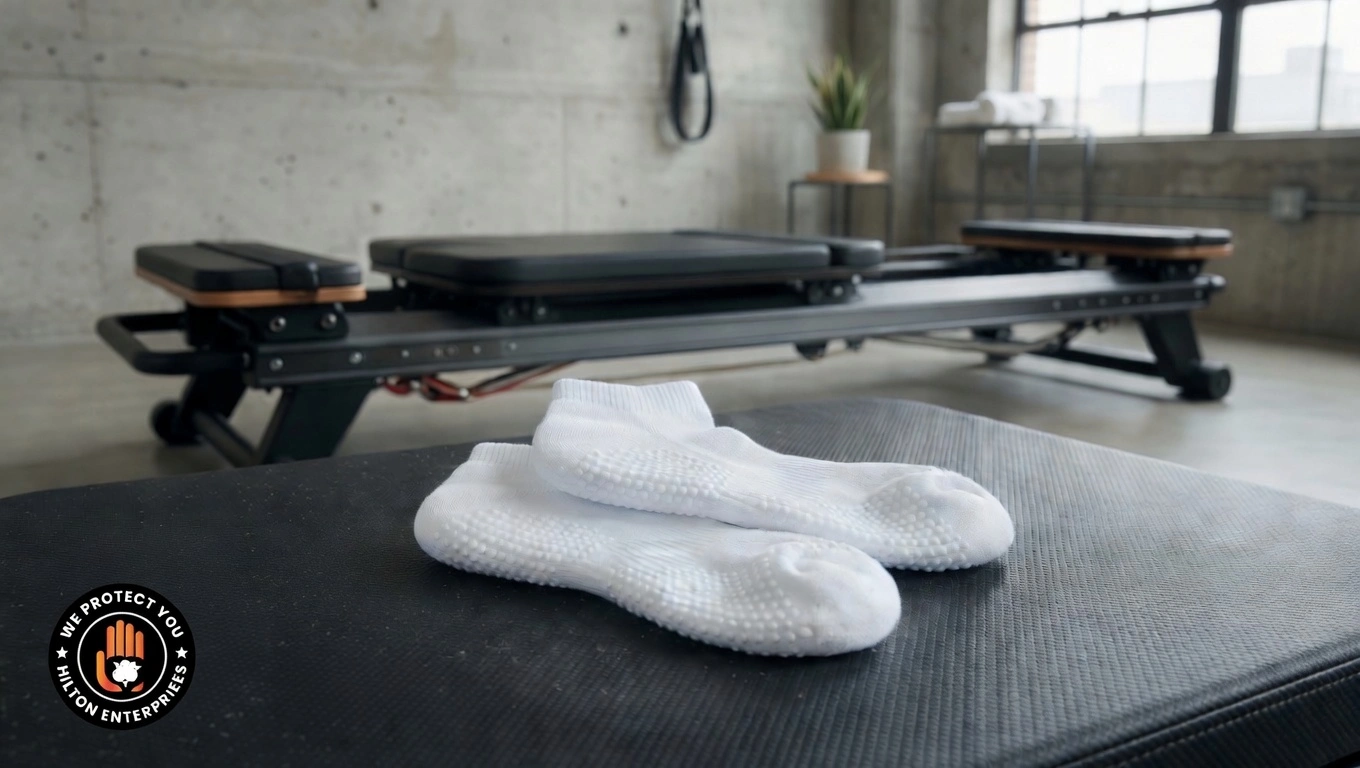
Lagree socks are grip socks worn during workouts on the Megaformer — the spring-resistance machine developed by Sebastien Lagree — featuring a non-slip sole pattern that prevents slipping during the sustained, high-tension movements the Lagree method demands.
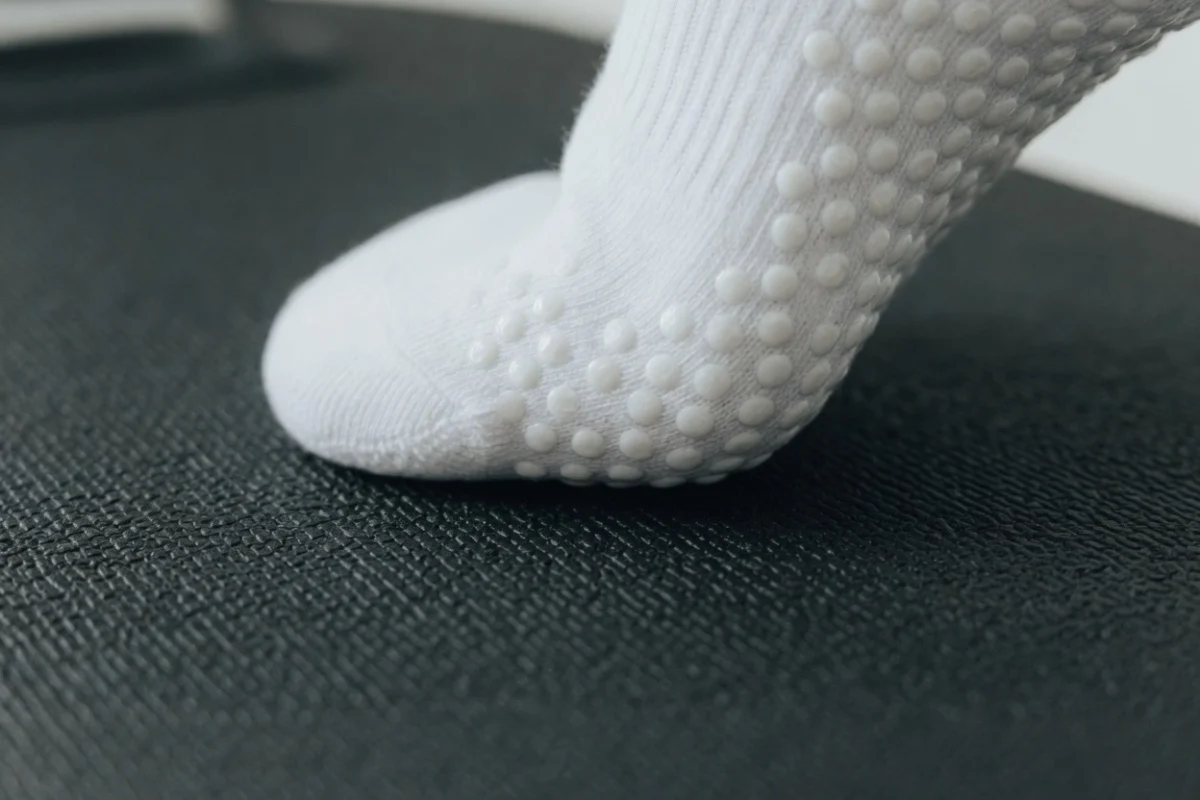
Full-toe silicone grip on the Megaformer’s textured carriage platform — the contact point that makes grip pattern choice critical for lagree versus standard pilates.
The terms ‘lagree socks,’ ‘lagree grip socks,’ and ‘lagree pilates socks’ are used interchangeably. All three describe grip socks used in a Lagree setting. The distinction from standard Pilates socks lies in the surface they must perform on, the intensity and duration of tension they must withstand, and the specific carriage platform geometry of the Megaformer and its variants.
Megaformer variants and how they affect sock choice
The Megaformer has evolved through several generations — the M3, M3S, and the more compact Microformer. The Microformer’s smaller platform surface means the foot has less room to move laterally, making the density of the grip pattern more important. Studios operating a mix of Megaformers and Microformers should specify this when ordering custom socks, as it may affect the optimal sole configuration.
What should I wear to a Lagree class?
If you are attending a Lagree class for the first time, you need grip socks — most Lagree studios require them, and the Megaformer’s carriage platform makes them a genuine safety necessity rather than just a studio rule.
Here is what to know before your first class:
- Grip socks are mandatory at virtually all Lagree studios. Standard trainer socks or bare feet are not permitted on the Megaformer carriage.
- Full-toe grip socks — socks that cover all five toes — are the right choice for lagree. Open-toe designs, common in yoga, leave the toe area unsupported on the carriage platform during kneeling and standing positions.
- Most studios sell grip socks at the desk if you forget. If the studio has its own branded socks, buying a pair there is the easiest option for a first visit.
- One pair is enough for a single session. Lagree socks wash well and last many sessions when cared for properly.
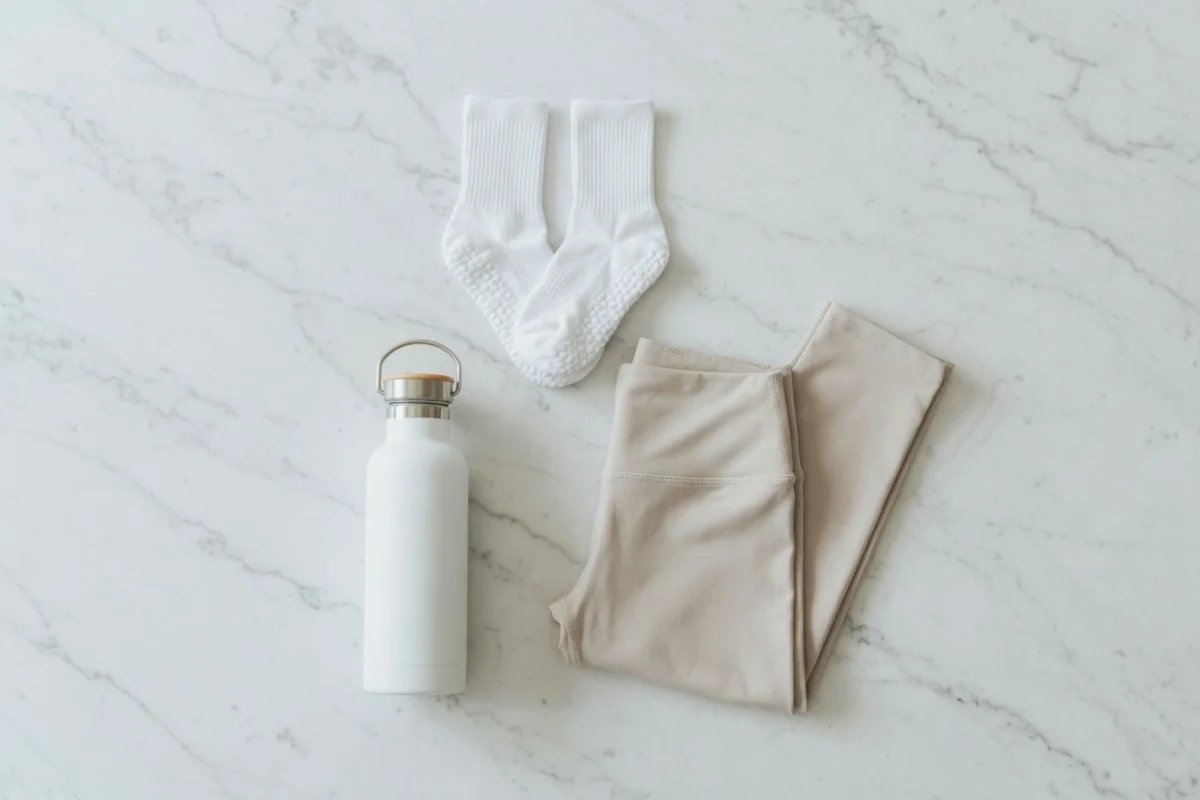
Full-toe grip socks are the one non-negotiable for lagree class. Everything else is optional.
If you are a studio operator reading this: this is the page your clients land on when searching “what to wear to a Lagree class.” Having your own branded grip socks at the desk converts that moment into a sale. Our Custom Grip Socks Wholesale Guide covers exactly how studios order, design, and price custom-branded pairs — including MOQ, lead times, and the full sampling process.
See in detail how studios order custom Lagree socks in bulk.
What makes Lagree grip socks different from standard pilates socks?
Lagree grip socks differ from standard pilates socks in three specific ways: they require full-toe coverage, a fine-density grip pattern that performs under sustained time under tension, and a flexible sole that does not catch on the Megaformer’s textured carriage platform.
1. Surface: Megaformer carriage platform vs standard reformer
A standard Pilates reformer typically has a padded carriage covered in smooth vinyl or fabric. The Megaformer carriage uses a textured non-slip platform covering — a surface that interacts differently with grip sock soles. An overly stiff PVC grip pattern can catch on this texture and restrict the natural foot repositioning that Lagree exercises require, creating a safety risk during spring-resistance transitions.
2. Movement demands: time under tension vs repetition
Unlike traditional pilates, which involves discrete movements with rest between repetitions, Lagree exercises are held under sustained spring tension for extended periods — often 60 to 90 seconds per set. This means the grip sock sole must maintain consistent traction throughout the hold, not just at initial contact. Low-profile, densely distributed grip patterns built for sustained lateral force outperform large-dot or sparse patterns in this context.
3. Toe coverage: full-toe vs open-toe
Open-toe grip socks — preferred in hot yoga and barre for ventilation — leave the toe area unsupported on the Megaformer’s carriage platform. Because lagree involves kneeling positions, standing splits, and toe-loaded spring-resistance work, full-toe coverage is the correct specification. Studios that stock open-toe pilates socks often find they are not optimal once clients begin using the Megaformer.
Do Lagree studios brand their own socks?
Yes — the majority of established Lagree studios now sell or provide their own branded grip socks, and the practice has become a standard part of the boutique fitness merchandise model.
Why Lagree Studios invest in branded socks
- Revenue at the desk. Studios sell branded grip socks to clients who arrive without them. Because wearing grip socks is mandatory, every underprepared client is a guaranteed sale. The margin on custom-manufactured socks sold at studio retail pricing is substantially higher than on retail brands bought for resale.
- Brand extension beyond the studio. A client leaving in your branded grip socks creates brand exposure that no paid advertising can replicate. Lagree has a strong community culture — branded studio merchandise serves as a membership signal, and clients actively wear it outside class.
- Eliminating competitor branding. Studios that stock retail grip sock brands are marketing someone else’s product to their own clients at the moment of highest engagement. Custom socks turn that moment into a brand impression instead.
The same branding principles apply across fitness venue types. If you operate a trampoline park or adventure venue rather than a studio, our Trampoline Park Socks guide covers the specific sock specifications, size-range requirements, and guest pricing models relevant to high-traffic venues.
What we hear from Lagree studio operators
The most common trigger for a first custom sock order is: ‘We’ve been stocking a retail brand at our desk for two years and just realised every pair we sell puts their name — not ours — in front of our clients.’ The switch to custom-branded socks is straightforward once you understand the MOQ and lead time involved.
What grip pattern works best on Lagree reformers?
A fine-density silicone grip pattern, distributed evenly across the full sole, including the toe box, is the optimal specification for the Megaformer and Microformer — providing consistent traction under spring resistance without catching on the carriage platform texture.
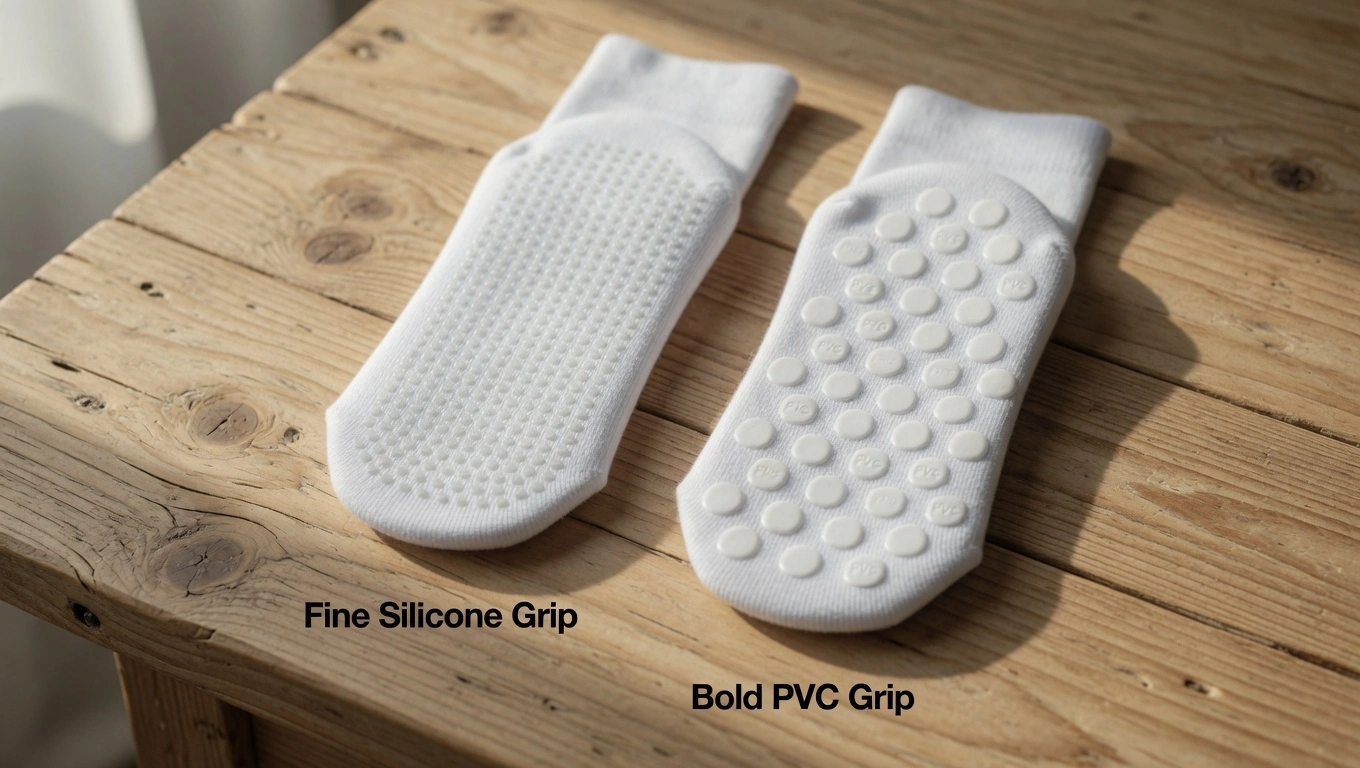
Left: fine-density silicone grip — recommended for the Megaformer’s carriage platform. Right: bold PVC print — can catch on the Megaformer’s textured surface and restrict foot movement
Here is how the main grip pattern options compare in a lagree-specific context:
| Grip Type | Performance on Megaformer / Microformer | Verdict |
| Fine silicone dots — full sole | Excellent. Flexible, consistent traction under sustained tension, no catching on carriage texture | ✓ Recommended |
| Large silicone dots — full sole | Good at rest. Can lose traction consistency under prolonged lateral spring resistance | Acceptable |
| Fine PVC print — full sole | Good on smooth surfaces. Can stiffen on the Megaformer’s textured platform | Acceptable |
| Bold PVC print — full sole | Can catch on the carriage surface during foot repositioning — restricts movement | Not recommended |
| Heel-only spot grip | Insufficient for lagree. Toe-loaded positions have no traction support | Not suitable |
| Knitted / woven grip only | Insufficient traction for spring-resistance intensity. Suitable for light yoga only | Not suitable |
At Hilton, we produce lagree-specific grip socks with a fine silicone dot pattern applied to the full sole — including the toe box — using a heat-press bonding process that maintains grip properties through 50+ wash cycles. For a full technical comparison of silicone vs PVC grip materials, see our Custom Grip Socks Wholesale Guide.
How do you care for Lagree grip socks?
Lagree grip socks should be washed inside-out in cold or warm water (30–40°C maximum), laid flat to dry rather than tumble-dried, and never ironed over the grip sole — following these three steps preserves both the knit structure and the silicone grip pattern through repeated use.
Why care matters more in lagree than in other fitness disciplines
Lagree is a high-intensity, slow-twitch muscle discipline — sessions involve sustained engagement and significant perspiration. Grip socks used in Lagree accumulate more body heat, moisture, and floor contact than socks used in gentle yoga or barre. Without proper washing, grip performance degrades faster, and anti-microbial properties in the yarn are diminished.
| Care Step | Instruction | Why It Matters |
| Washing | Cold or warm wash, 30–40°C max, inside-out | Preserves silicone grip adhesion — high heat degrades the bond |
| Drying | Lay flat or hang dry — no tumble dryer | Tumble heat causes the knit to shrink and grip dots to harden |
| Ironing | Never iron the sole | Direct heat melts silicone and PVC grip patterns permanently |
| Frequency | Wash after every session | Hygiene in high-sweat disciplines preserves anti-microbial yarn properties |
| Storage | Store flat or loosely rolled, not compressed | Compressed storage can flatten grip dots over time |
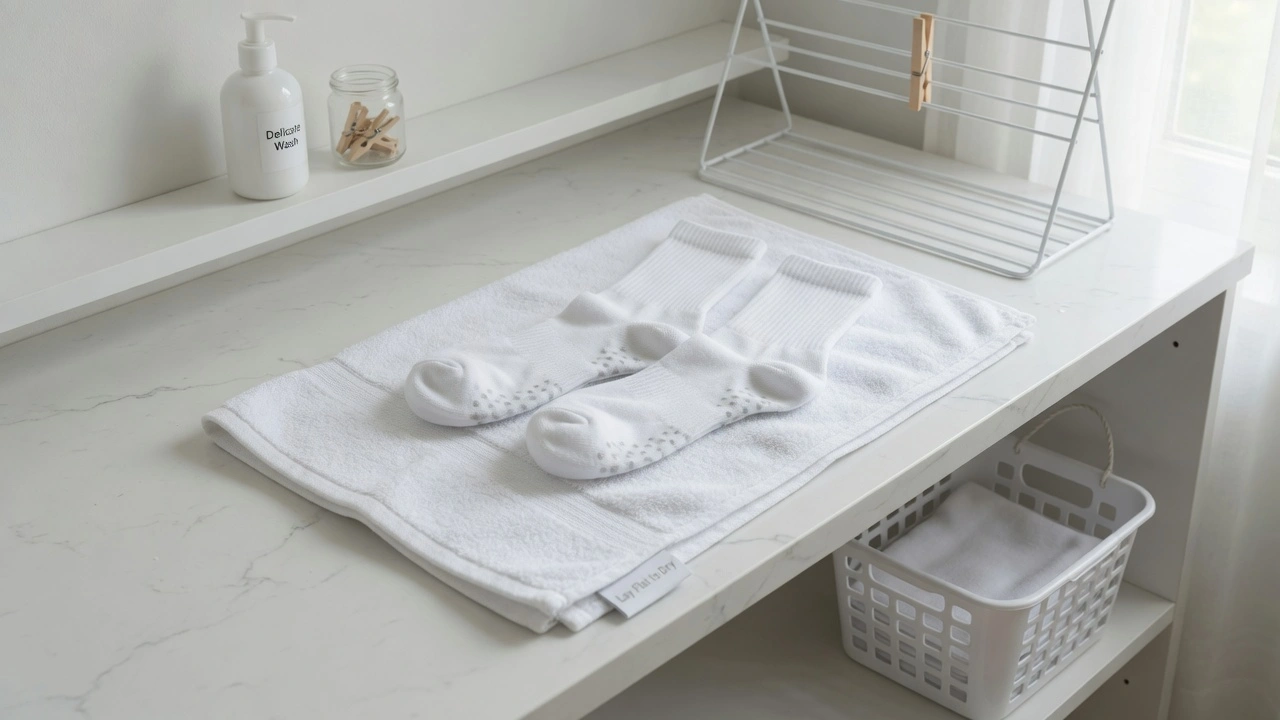
Wash lagree grip socks inside-out on a cool cycle and lay flat to dry — never tumble dry or iron the sole
A note for studio operators on branded sock longevity
Studios that provide or sell branded socks should include a simple care card with each pair. Clients who wash socks incorrectly will report the grip wearing out prematurely — and attribute it to manufacturing quality rather than care. A printed or digital care guide at the point of sale sets expectations correctly and protects your brand.
Anti-microbial yarn specifications are covered in more detail in our Trampoline Park Socks guide — which addresses hygiene requirements at higher-traffic scale — and in the materials section of our Custom Grip Socks Wholesale Guide.
How do studios order custom Lagree socks in bulk?
Studios order custom lagree socks by submitting their logo and design brief to a manufacturer — Hilton Enterprises processes every order through five stages: digital proof, physical sample approval, bulk production, quality inspection, and shipping.
See our manufacturing process from design to dispatch
| Stage | Duration | What Happens |
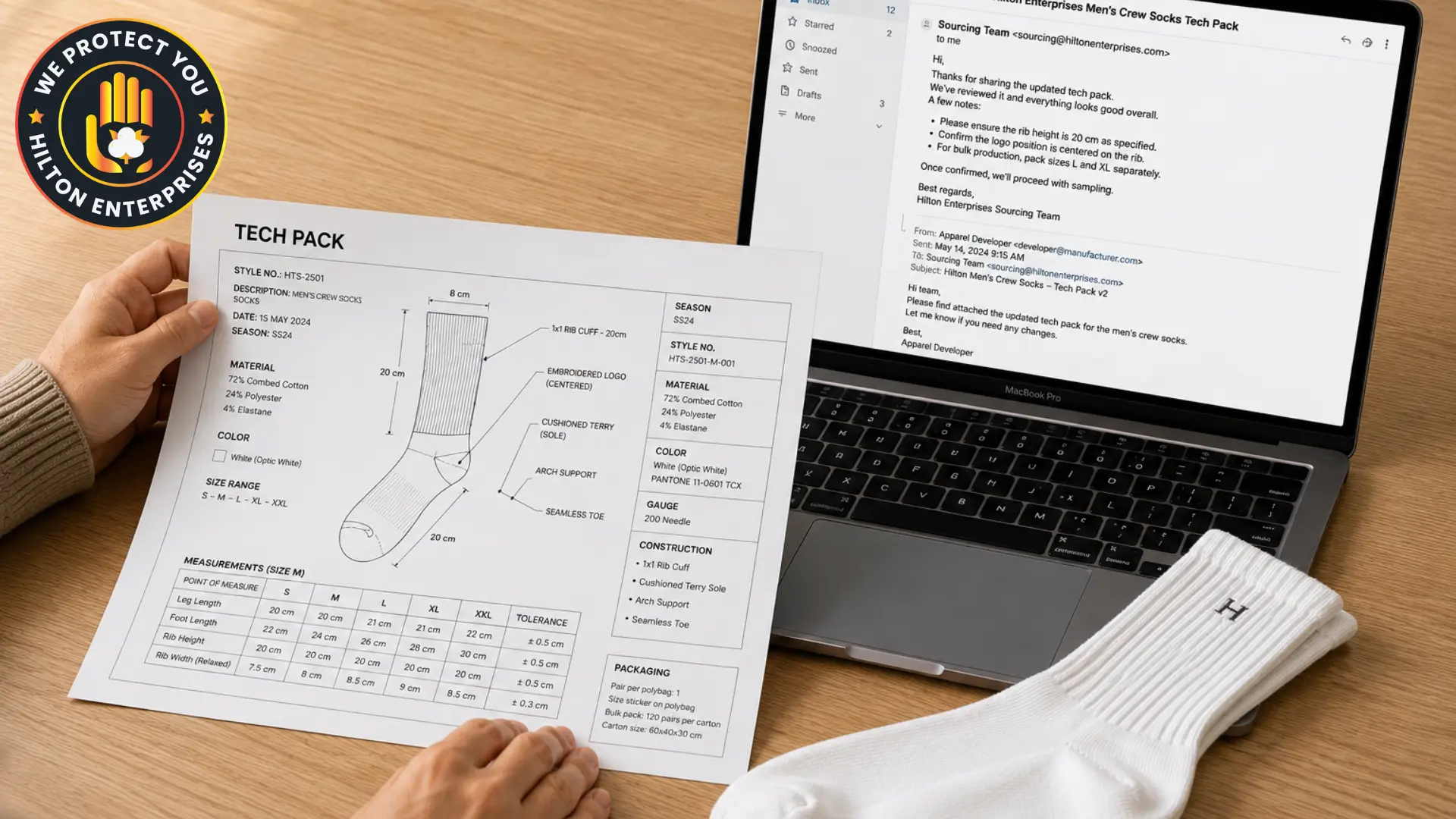
| Design submission | Day 1 | Submit logo + brand guidelines in vector format (.AI, .EPS, or 300dpi PDF) |
| Digital proof | 2–3 business days | We produce a mockup showing your logo, colour, and grip layout on the sock |
| Proof approval | 1–5 business days | You approve or request revisions — typically 1–2 rounds |
| Physical sample | 5–7 business days | One finished pair produced to your specification for final sign-off |
| Bulk production | 18–22 business days | Full order knitted, grip-applied, QC inspected, paired, and packed |
| Sea freight | 18–25 days | Door-to-door delivery to the USA, UK, Canada, EU |
| Air freight | 5–7 days | Available for urgent orders at additional cost |
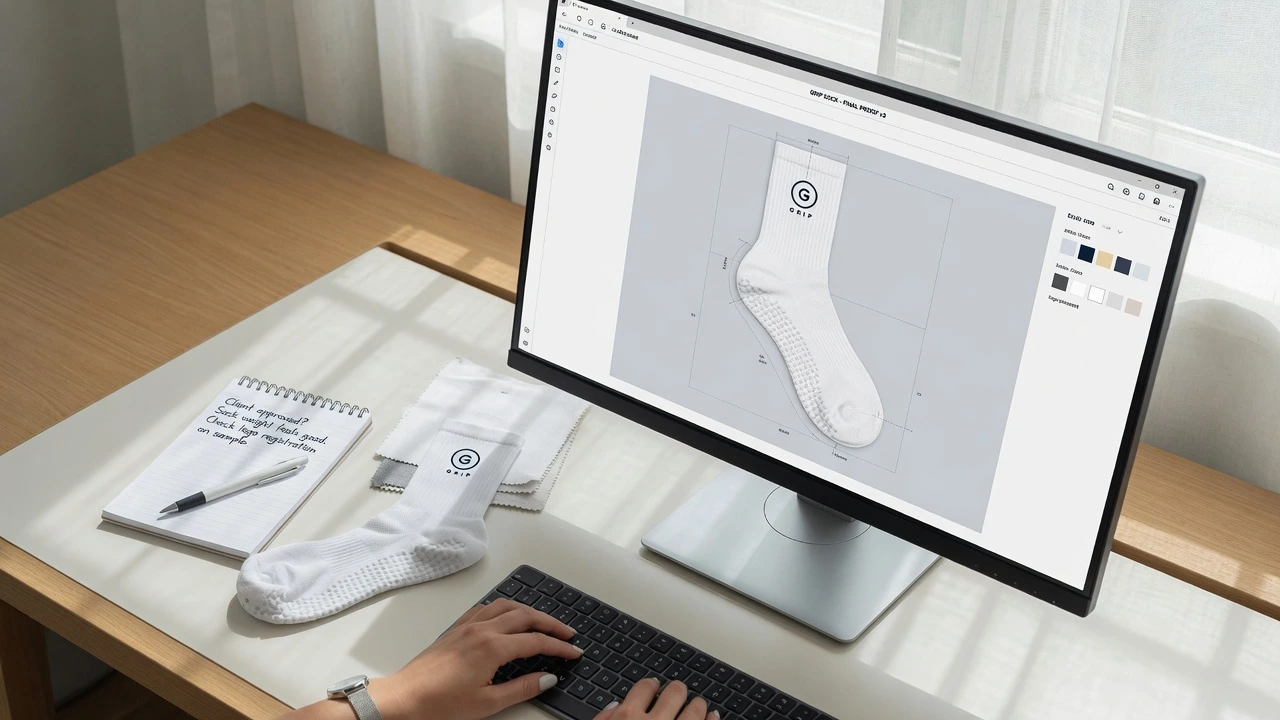
Every Hilton order begins with a digital proof — your exact logo, colour match, and design layout reviewed and approved before a single pair is manufactured.
What to prepare before you contact us
- Studio logo in vector format (.AI or .EPS preferred)
- Brand colour references — Pantone or CMYK values if available
- Required quantity (minimum 5,000 pairs — see MOQ section below)
- Target delivery date or studio opening date
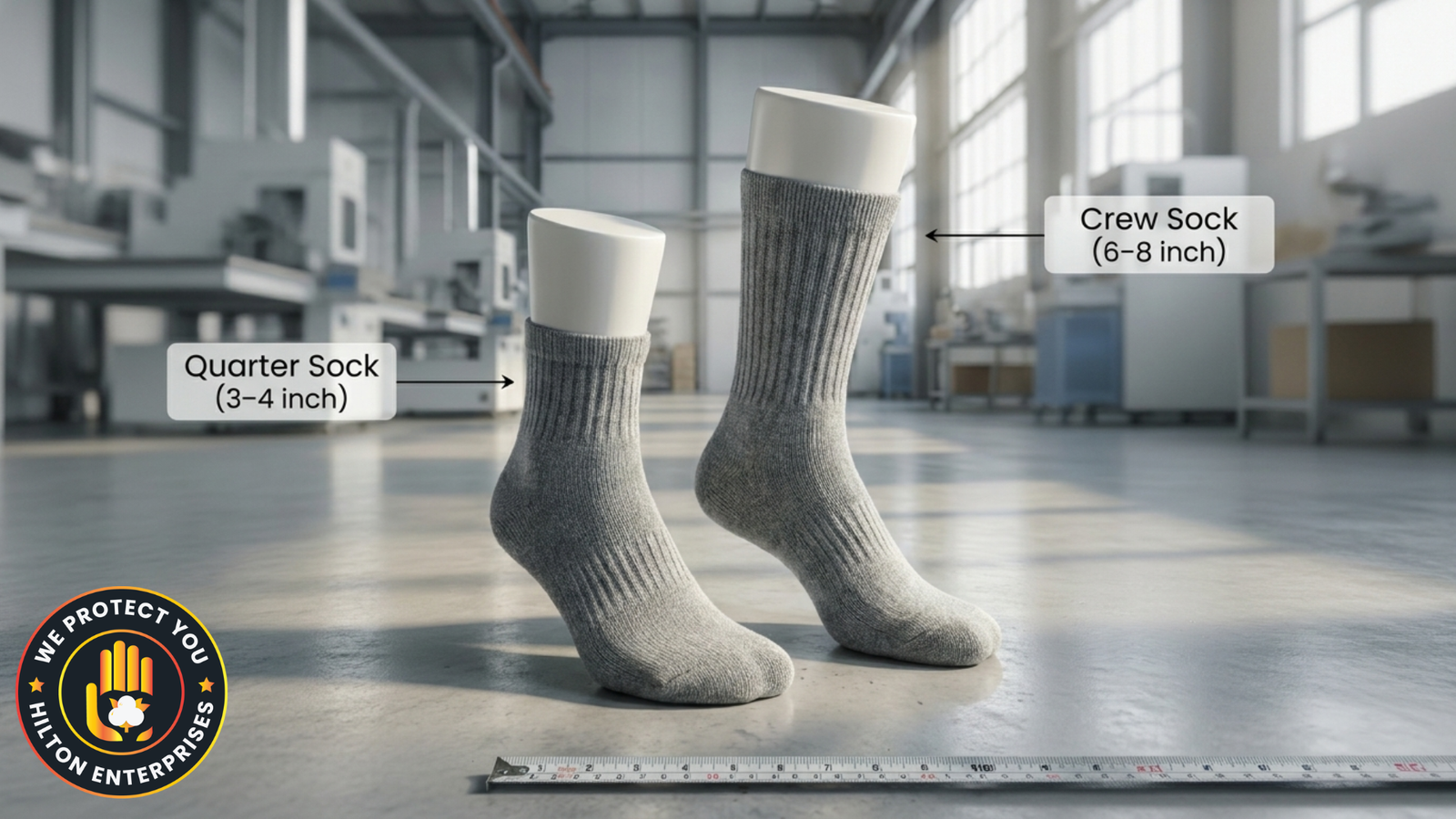
- Sock style preference: ankle or crew height; full-toe (recommended for lagree)
- Megaformer type if known: M3, M3S, or Microformer — affects sole specification recommendation
Design tip for Lagree Studio branding
Lagree studio branding tends to be clean, modern, and athletic — the aesthetic of the method itself. The most effective designs we produce for Lagree Studios: studio name in a bold sans-serif font on the ankle cuff, with a contrasting colour on the toe and heel. Simple, legible at a glance, and distinctive when worn outside the studio.
What is the MOQ and typical cost per pair for custom Lagree socks?
Hilton Enterprises’ standard MOQ for custom lagree grip socks is 5,000 pairs per design — the threshold at which jacquard knitting machine programming, silicone grip application tooling, and custom label production are cost-effective for both parties.
| Order Quantity | Relative Pricing | Lead Time | Branding Included |
| 5,000–9,999 pairs | Standard rate | 35–40 days | Jacquard knit + custom label |
| 10,000–24,999 pairs | 5–10% reduction | 30–35 days | Jacquard knit + custom label |
| 25,000–49,999 pairs | 10–18% reduction | 28–32 days | Jacquard knit + label + packaging |
| 50,000+ pairs | Contact for a quote | 25–30 days | Full custom — label, packaging, dedicated QC |
Factors that move the per-pair cost
- Yarn composition — bamboo-cotton blends carry a premium over standard cotton-nylon
- Grip pattern scope — full-sole fine silicone costs more than a heel-only spot grip
- Sock height — crew-height uses more yarn than ankle-height; affects material cost at scale
- Packaging — individual polybag packing adds cost; bulk carton packing reduces it
Not sure if 5,000 pairs is right for you yet?
If you are a new or single-location Lagree studio, 5,000 pairs may feel like a significant commitment before you know how quickly your clients go through socks. Here is how to think about it:
A studio with 150 active clients running 6 sessions per week will move through approximately 900 pairs per month at a 6:1 client-to-sock ratio. A 5,000-pair run covers roughly 5–6 months of demand — manageable for most established studios.
If you are not yet at that volume, we recommend starting with a physical sample order first. Request a sample pair of your custom design via our Contact page — this lets you validate the design and quality before committing to bulk production.
Studios that grow quickly often wish they had ordered more on their first run. The per-pair cost savings between 5,000 and 10,000 pairs are meaningful — if your trajectory supports it, ordering up is usually the right call.
Order Custom Lagree Socks for Your Studio
Hilton Enterprises manufactures custom grip socks for Lagree Studios, pilates venues, and fitness brands worldwide. We supply direct from our Faisalabad facility — no middlemen, full custom branding from 5,000 pairs, and a physical sample before bulk production begins.
- Browse grip sock styles and specifications on our Grip Socks category page.
- Learn about Hilton’s 50-year manufacturing background on our About page.
- Submit your inquiry — quantity, delivery date, and artwork — via our Contact page. We respond within 1 business day.
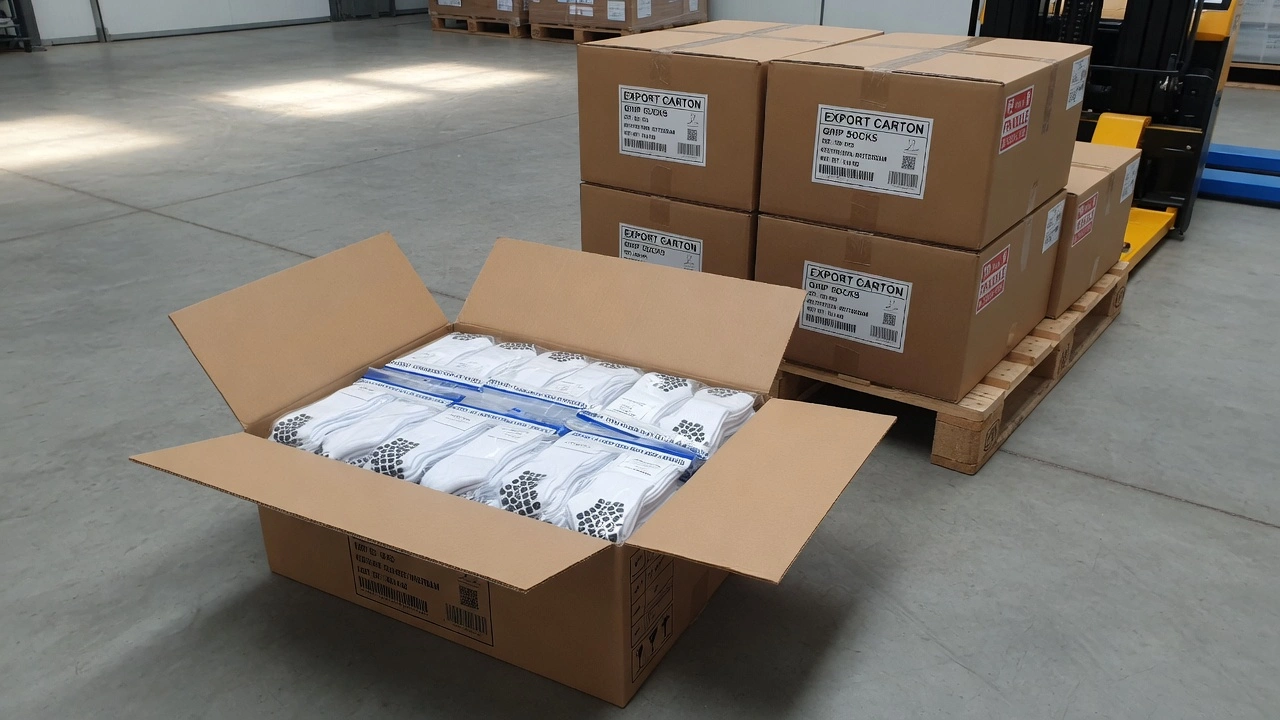
A standard wholesale order from Hilton Enterprises — individually paired, quality-checked, and packed for export worldwide.
Also in this series:
Custom Grip Socks for Pilates & Yoga Studios: Wholesale Manufacturing Guide
Trampoline Park Socks: How Venues Source, Brand & Order in Bulk
Wholesale Pilates Grip Socks: MOQ, Lead Times & Custom Branding
Frequently Asked Questions
These questions and answers should be marked up with FAQPage + Question + Answer structured data on the published page.
Q: What are lagree socks?
A: Lagree socks are grip socks worn during Lagree method workouts on the Megaformer machine. They feature a non-slip silicone grip pattern on the full sole — including the toe box — to prevent slipping during the sustained, spring-resistance movements Lagree exercises involve. Most yoga studios require clients to wear them during class.
Q: What should I wear to a Lagree class?
A: Wear full-toe grip socks to a Lagree class — socks with a non-slip silicone pattern covering the entire sole, including the toes. Open-toe designs or bare feet are not appropriate for the Megaformer’s carriage platform. Most studios sell grip socks at the desk if you do not have a pair.
Q: What makes Lagree grip socks different from standard pilates socks?
A: Three things: full-toe coverage (required for lagree kneeling and toe-loaded positions), a fine-density grip pattern that maintains traction under sustained time under tension, and a flexible silicone sole that does not catch on the Megaformer’s textured carriage platform. Standard pilates socks with open toes or stiff PVC soles are not optimal for Lagree.
Q: What grip pattern works best on the Megaformer?
A: A fine-density silicone dot grip pattern distributed across the full sole, including the toe box. Silicone is more flexible than PVC and provides consistent traction on the Megaformer’s textured carriage surface without catching or restricting foot repositioning during spring-resistance transitions.
Q: How do I wash Lagree grip socks?
A: Wash lagree grip socks inside-out on a cold or warm cycle (30–40°C maximum), then lay flat or hang to dry. Never tumble dry or iron the sole — high heat degrades silicone grip adhesion and causes the knit to shrink. Wash after every session in a high-intensity discipline like Lagree.
Q: What is the MOQ for custom lagree socks at Hilton Enterprises?
A: Our standard MOQ is 5,000 pairs per design. If you are a new studio not yet ready for a 5,000-pair run, we recommend requesting a physical sample first to validate design and quality before committing to bulk. Contact us via our Contact page to discuss your situation.
Q: How long does delivery take for custom Lagree socks?
A: The standard timeline from design submission to delivery is 35–45 days, covering digital proofing, physical sample production, bulk manufacturing, QC inspection, and sea freight. Air freight is available for time-sensitive orders and typically takes 5–7 days from dispatch.