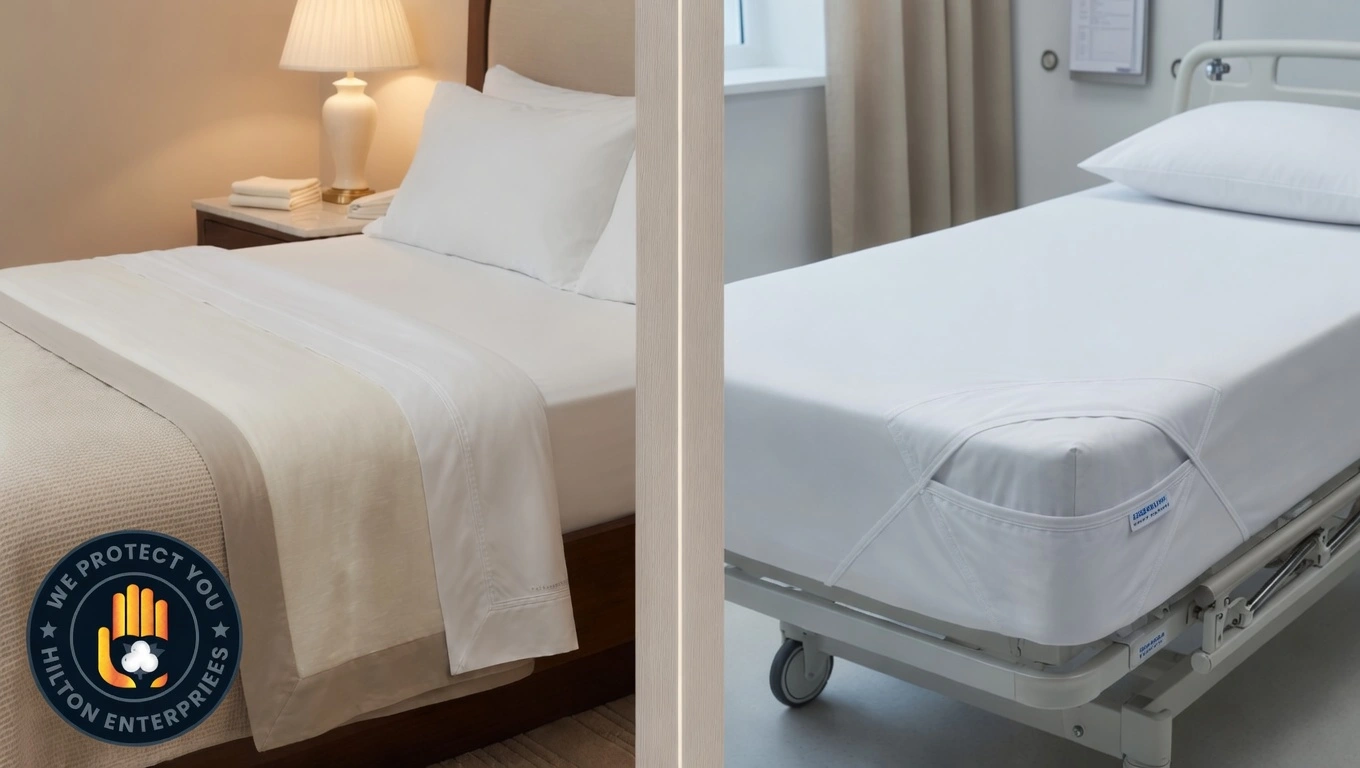
Most guides on flat sheet vs fitted sheet are written for someone furnishing a spare bedroom. This one is written for the procurement manager, linen manager, or hospitality buyer responsible for specifying and sourcing bed sheet flat vs fitted across hundreds or thousands of beds—where the wrong choice affects laundry throughput, housekeeping efficiency, infection control outcomes, and total linen replacement costs.
The distinction between the two sheet types is simple. The procurement decision is not. Below is a complete reference: what each sheet is, how the two perform differently in institutional settings, how hotels and healthcare facilities make the specification decision, and what fabric and MOQ parameters matter when ordering in bulk from a certified manufacturer.
What Is a Fitted Sheet?
Definition and construction
A fitted sheet, also called a bottom sheet, is a rectangular piece of fabric with elasticized corners sewn into a deep pocket that wraps under the mattress. The fitted bed sheet’s meaning is structural: the elastic corner pocket holds the sheet in place against the mattress surface regardless of movement, weight, or bed position changes. Unlike a flat sheet, it cannot be used as a top sheet. Its single function is to create a secure, hygienic barrier between the mattress and the sleeper.
Manufacturers produce fitted sheets in two constructions: woven (rated by thread count, from T-130 to T-250) and knitted (rated by GSM—grams per square meter). Knitted fitted sheets use an inherently elastic fabric structure rather than relying solely on sewn-in elastic at the corners, making them the correct specification for adjustable or articulating beds where woven sheets would repeatedly pull free.
Standard fitted sheet dimensions
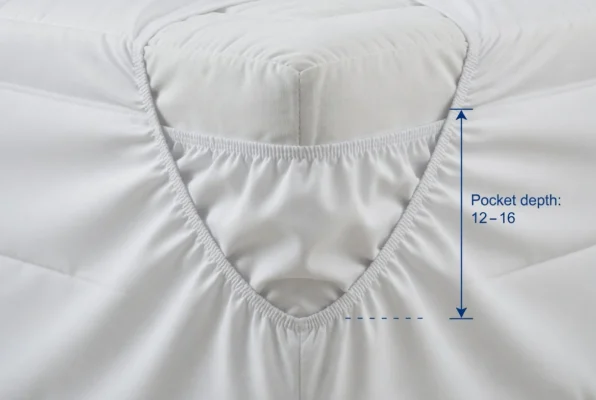
Fitted sheets are sized to mattress dimensions, not bed frame dimensions. The pocket depth, the gusset that wraps under the mattress, is as critical as the flat measurements.
- For standard single or twin beds, the sheet measures 39″ × 75″ with a 10–12″ pocket.
- Queen runs 60″ × 80″ with a 12–14″ pocket, and King at 76″ × 80″ with a 14–16″ pocket.
Healthcare and hospitality applications often require nonstandard dimensions—see Section 5 for hospital-specific sizing.
What Is a Flat Sheet?
Definition and construction
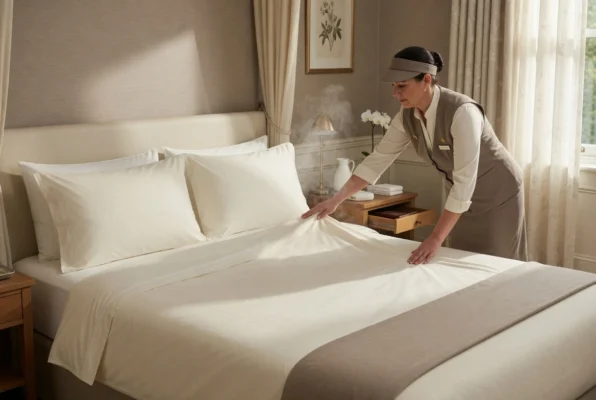
A flat sheet is a rectangular panel of fabric, hemmed on all sides, with no elastic or shaping. Hotels and institutional facilities use it as a top sheet—placed between the sleeper and the duvet or blanket—and, critically in institutional settings, tuck it under the mattress using hospital corners as a bottom layer.
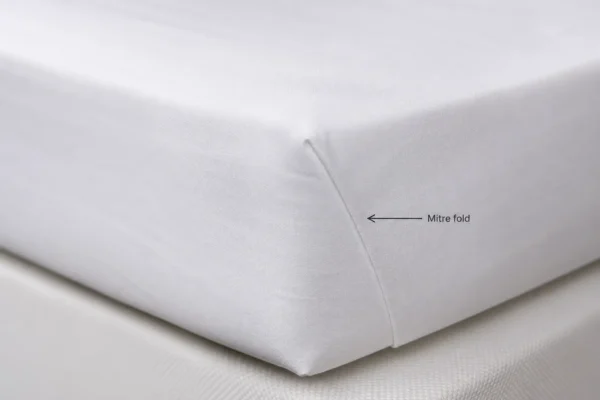
The hospital corner technique creates a tight, miter-folded tuck at each corner that anchors the flat sheet against the mattress surface almost as securely as an elastic pocket, while remaining far easier to process through commercial laundry and ironing equipment. The institutional standard for flat sheet fabric matches the poly-cotton blend that fitted sheet production uses — 55% polyester / 45% cotton at T-180 for general use, stepping up to T-200 or T-250 for premium hospitality applications.
Because flat sheets have no elastic components, they press perfectly flat through commercial ironers, are more space-efficient to fold and store, and do not suffer the elastic degradation that affects fitted sheets after 200–300 industrial wash cycles.
Hospitality flat sheet sizing
Manufacturers cut hotel flat sheets larger than domestic equivalents to allow sufficient tuck-under depth on all sides. A standard hospitality queen flat sheet runs 90″ × 115″ rather than the 90″ × 102″ domestic size. The extra 13 inches provides the tuck-under allowance needed for proper hospital corners on mattresses with protectors and toppers. Always confirm the actual mattress-and-topper stack height with a facility before specifying flat sheet dimensions, as mattress stack depth in hospitality settings now commonly reaches 15–18 inches with all protective layers included.
Flat Sheet vs Fitted Sheet — Side-by-Side Comparison
The difference between fitted and flat bed sheets goes well beyond elastic versus no elastic. The table below captures the full specification picture relevant to bulk institutional buyers.
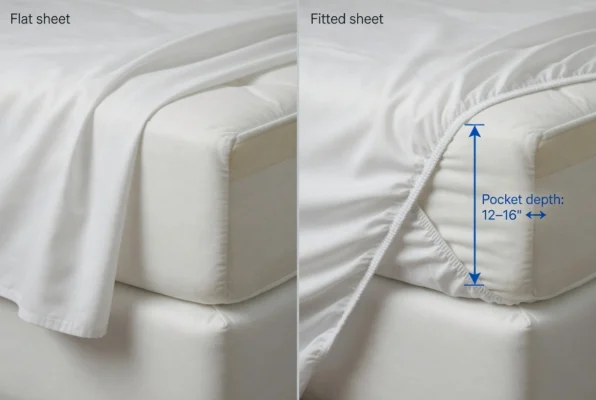
Specifications
| Specification | Flat sheet | Fitted sheet |
|---|---|---|
| Construction | Rectangular panel, no elastic, hemmed on all sides | Elasticated corners sewn into the pocket; some styles use full-perimeter elastic |
| Bed-making method | Tucked under the mattress with hospital corners or folded tuck | Elastic stretches over mattress corners—self-securing, no tuck required |
| Primary use | Top/over-sheet; bottom layer in hotels (hospital corners) | Bottom/mattress layer only; wraps under the mattress surface |
| Laundry handling | Presses flat through the commercial ironer easily; faster processing | Cannot press flat; elastic may require separate handling; slower throughput |
| Storage | Folds flat — space-efficient on linen shelves and carts | Bulkier fold; takes 30–40% more shelf space than an equivalent flat sheet |
| Elastic wear risk | None — no elastic components | Elastic degrades with industrial washing, typically 200–300 cycles before failure |
| Sizing flexibility | One oversize sheet can work across multiple bed widths | Must be matched precisely to mattress dimensions; more SKUs required |
| Infection control | Good — can be tucked tightly; changes faster in high-risk settings | Excellent — stays in place on adjustable beds; preferred in clinical settings |
| Unit cost | Generally lower—simpler construction | Typically 10–20% higher than the equivalent flat sheet due to the elastic and shaping |
| Best suited for | Hotels, hospitality, care home top layers, dual-use linen programs | Hospitals, home care beds, adjustable frames, bariatric beds, and ICU settings |
| Hilton Enterprises | Plain Bedsheet range | Fitted Bedsheet range |
Procurement note: The cost-per-wash advantage of flat sheets (no elastic failure mode, faster ironing throughput) often outweighs the higher unit cost of fitted sheets when assessed across a full linen program lifecycle. However, this calculation changes for facilities with heavy articulating bed use, bariatric wards, or high-acuity clinical settings where fitted sheet performance is non-negotiable.
How Hotels Specify Flat Sheets and Fitted Sheets
Why do most hotels use flat sheets as bottom layers?
Operational economics drive the hospitality industry’s preference for flat sheets as bottom layers — contrary to what most consumers assume — not cost-cutting. The American Hotel & Lodging Association estimates that housekeeping represents 50% or more of a hotel’s labor cost. Anything that reduces per-room bed-making time at scale has a direct financial impact.
Three operational factors make flat sheets the default choice for most full-service properties:
- Commercial ironing throughput. Flat sheets feed through tunnel ironers in a single pass, producing a crisp, pressed finish. Commercial laundries cannot iron fitted sheets flat—their pockets and elastic require either manual finishing (slow) or leaving them unpressed (poor presentation).
- Storage efficiency. A folded flat sheet occupies 30–40% less linen cart and shelf space than an equivalent fitted sheet. At scale—a 200-room hotel, 2–3 par levels of linen—the storage saving is material.
- SKU simplification. One correctly sized flat sheet can function as both the bottom layer and the top sheet, reducing SKU count. A hotel that uses a single flat sheet size across all beds of the same category eliminates ordering, tracking, and inventory errors between bottom and top sheets.
When fitted sheets make more operational sense in hospitality
For the comparison of fitted vs flat bed sheets in hospitality, the answer is not universal. Fitted sheets outperform flat sheets in specific property types and room categories:
- Properties with high mattress stack depth. Beds fitted with 3″ memory foam toppers, mattress protectors, and pillow-top covers can reach 16–20″ total height. At this depth, hospital corners on a flat sheet become unstable during sleep. A fitted sheet with a 16–18″ deep pocket is the correct specification.
- Apartment hotels and long-stay properties. Guests who move freely in bed overnight, or who stay multiple nights between housekeeping visits, will dislodge flat sheet corners. Fitted sheets reduce remake frequency.
- Properties with high seasonal staff turnover. Achieving consistent hospital corners requires training and practice. Fitted sheets reduce the skill dependency in bed-making, producing a consistently tidy result regardless of staff experience level.
The hybrid linen program — the standard approach for mid-scale and above
Most full-service hotels operate a hybrid program: flat sheets for standard room categories where facilities control mattress depth and manage housekeeping centrally, and fitted sheets for suite categories with premium mattress configurations. This limits SKU growth while covering the rooms that genuinely need fitted sheet performance. When specifying a hybrid program, always order both sheet types from the same fabric lot to ensure color, weight, and hand feel consistency across room categories.
Healthcare and Care Facilities: When Fitted Sheets Are Non-Negotiable
Infection control and clinical requirements
In clinical settings, the choice between flat and fitted sheets is not an aesthetic or operational preference—it is a clinical requirement. The CDC guidelines for healthcare linen management categorize soiled linen as a potential vector for pathogen transmission and specify that bed linen must be maintained in a sanitary condition—a standard that is significantly harder to meet when sheets repeatedly pull free from adjustable hospital bed frames. Fitted sheets with full-perimeter elastic and correct pocket depth eliminate the sheet-slippage failure mode that creates exposed mattress surfaces between changes.
The mechanical demands of hospital beds—head and foot articulation, height adjustment, and side-rail operation—mean that flat sheets tucked with hospital corners will pull free under normal clinical use. The force applied to the mattress surface when raising the head section to 45 degrees is sufficient to dislodge a tucked flat sheet in most configurations. A correctly specified fitted sheet, by contrast, tightens against the mattress as the frame adjusts.

Bariatric, ICU, and specialty bed requirements
Bariatric hospital beds, ICU articulating frames, and adjustable home care beds all require fitted sheets rather than flat sheets. For the full clinical specification—standard hospital sizes, bariatric dimensions (42″ and 48″ wide), knitted vs woven construction selection, and pocket depth guidance by bed type, see our detailed guide to fitted sheets for hospital beds. Hilton Enterprises’ fitted bedsheet range covers standard, extra-long, bariatric, and custom dimensions with pocket depth configurable to your mattress specification at the point of order.
Fabric Specification for Bulk Orders: What Procurement Teams Must Know
Thread count and poly-cotton blend selection
Thread count is the most commonly misunderstood specification in institutional linen procurement. Higher thread count does not mean better performance for commercial use. A T-800 single-ply sheet marketed to luxury consumers will not survive 200 industrial laundry cycles at 71°C. What matters for institutional buyers is the thread count and blend combination that delivers the best cost-per-wash ratio at the required service life.
Fabric Comparison
| Fabric | Best application | Wash durability | Buyer note |
|---|---|---|---|
| T-130 (50/50 poly-cotton) | Budget hospitality, vacation rentals, shelters | Moderate — 100–150 cycles | Economy option, thin feel, high-volume, low-cost programs only |
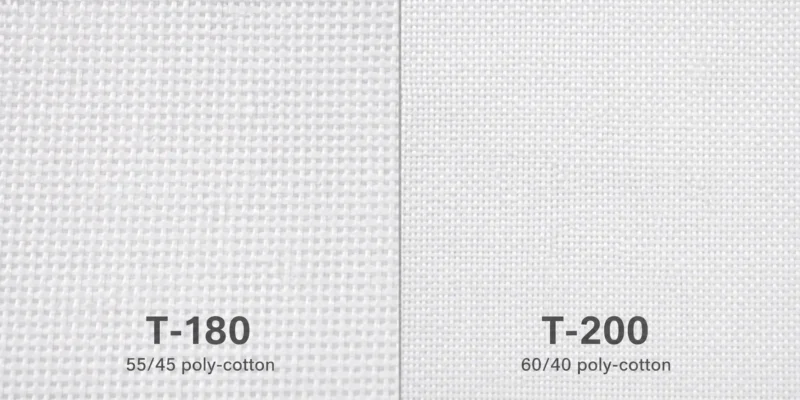
| T-180 (55/45 poly-cotton) | Mid-scale hotels, care homes, and general hospital wards | High — 180–220 cycles | Most widely specified; best cost-per-wash ratio |
| T-200 (60/40 poly-cotton) | 3–4 star hotels, private patient rooms, step-up linens | Very high — 230–280 cycles | Noticeably softer hand; recommended step-up for guest-facing use |
| T-250 (100% cotton percale) | Luxury hotels, premium hospitality, boutique properties | Moderate — needs lower wash temp | Softest finish; higher replacement frequency at industrial temps |
| Knitted GSM (fitted only) | ICU, bariatric beds, adjustable frames | Excellent — elastic absorbs movement | Not rated by thread count; specify by GSM weight (170–220 GSM typical) |
Specification tip: For most hospitality and healthcare linen programs, T-180 in a 55/45 poly-cotton blend delivers the best total cost of ownership—not because it is the most comfortable, but because it survives the most wash cycles before replacement. Step up to T-200 for guest-facing room categories or private patient rooms where hand feel affects perceived quality.
Par-level planning for mixed flat and fitted programs
The industry standard for institutional linen programs is 2.5 to 3 par levels—that is, 2.5 to 3 complete sets of linen per bed. One set is on the bed, one is in the laundry cycle, and the 0.5 to 1 additional set covers inspection rejects, emergency changes, and laundry timing variations. For a 200-bed facility running a hybrid program with both flat and fitted sheets, multiply your total bed count by 2.5 and round up to the nearest 50 units per SKU when placing a bulk order. This avoids short-stock situations without generating excess inventory that occupies storage space and degrades in the linen room.
Ordering from Hilton Enterprises: MOQ and lead times
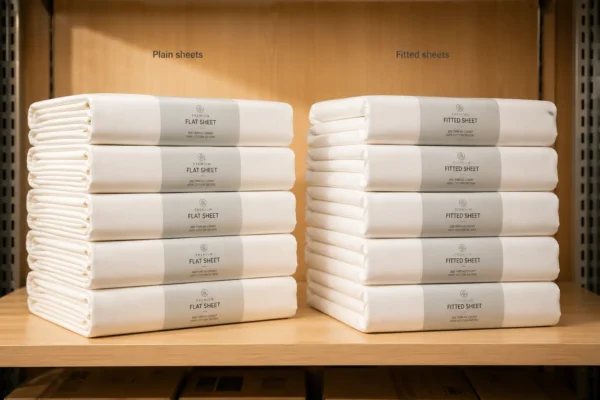
Hilton Enterprises manufactures both flat (plain) and fitted bedsheets in the same facility, from matched fabric lots, ensuring color and weight consistency across a hybrid linen program. Reference MOQ and lead time data for both product types:
| Product type | MOQ | Lead time | Sizes available |
|---|---|---|---|
| Flat sheet (plain) | 5,000 units per size | 3–5 weeks ex-factory | Twin, Full, Queen, King, Hospitality oversized |
| Fitted sheet (standard) | 5,000 units per size | 4–6 weeks ex-factory | Standard, Extra-long, Queen, and King |
| Fitted sheet (bariatric) | 5,000 units per size | 5–7 weeks ex-factory | 42″ and 48″ wide with configurable pocket depth |
| Mixed program (flat + fitted) | 5,000 per SKU each | 4–6 weeks ex-factory | Matched fabric lot and colour across both types |
| Private label (both types) | 5,000 units per size | +1–2 weeks for branding | Custom woven labels, printed labels, retail packaging |
All orders include pre-production sample approval, inline quality inspection at 50% production completion, and full documentation—packing list, certificate of compliance, and test reports on request. Both our fitted bedsheet range and plain bedsheet range are produced to ISO 9001:2015 and ISO 14001:2015 standards in our Sedex and CTPAT-certified facility in Faisalabad, Pakistan. Review our full certification details on the certifications page.
Lead times are ex-factory from Faisalabad. Sea freight to US East Coast ports adds 21–28 transit days. Air freight is available for urgent initial orders or sampling programs.
Frequently Asked Questions
What is a fitted sheet?
A fitted sheet is a rectangular sheet with elasticated corner pockets sewn to a specific depth—the pocket—that wraps under the mattress and holds the sheet in place without tucking. Facilities use it solely as the bottom/mattress layer, and manufacturers size it precisely to the mattress dimensions, including pocket depth. It cannot serve as a top sheet.
What is the difference between a flat sheet and a fitted sheet?
A flat sheet is a rectangular panel with no elastic, hemmed on all sides, used as a top sheet or tucked under the mattress with hospital corners. A fitted sheet has elasticated corners sewn into a pocket that wraps under the mattress. The key difference between flat and fitted bed sheets operationally: flat sheets process faster through commercial laundry and ironing equipment; fitted sheets perform better on adjustable, articulating, or high-mattress beds where flat sheet corners would pull free.
Do hotels use flat sheets or fitted sheets?
Most full-service hotels use flat sheets for both the bottom layer (tucked with hospital corners) and the top layer. This reduces SKU count, simplifies laundry processing, and saves storage space. However, properties with deep pillow-top mattress configurations, high-turnover housekeeping, or seasonal staff often use fitted sheets on the bottom layer for consistency and speed. A hybrid program—flat sheets for standard rooms and fitted sheets for suites or beds with thick toppers—is the most common approach among mid-scale and above properties.
Which lasts longer in commercial laundering—flat or fitted sheets?
Flat sheets last longer in commercial laundry programs because they have no elastic component to degrade. Fitted sheet elastic typically fails after 200–300 industrial wash cycles at 60–71°C. The sheet fabric itself may remain intact while the elastic fails, making the sheet unusable. At T-180 specification, a flat sheet will typically outlast a fitted sheet of identical fabric by 30–50% in high-frequency laundry programs. This is one of the primary reasons hotels default to flat sheets where clinical requirements permit.
What size flat sheets do hotels use?
Hospitality flat sheets are larger than domestic equivalents to allow tuck-under allowance for hospital corners. A standard hospitality queen flat sheet runs 90″ × 115″ versus the domestic 90″ × 102″. King hospitality flat sheets typically run 108″ × 115″. Always confirm the mattress and topper stack height before specifying flat sheet dimensions—hotel mattresses with protectors and toppers commonly reach 15–18″ total height, requiring greater tuck-under depth than a bare mattress specification would suggest.
Can hospitals use a king-size sheet instead of a fitted sheet?
In a standard hospital bed, a flat sheet tucked with hospital corners is generally not appropriate as a bottom layer. Hospital beds articulate at the head and foot, and the mechanical forces applied during position changes will dislodge tucked flat sheet corners. Fitted sheets with full-perimeter elastic and correct pocket depth are the clinical standard for hospital beds. Hospitals use flat sheets as the top/over sheet or as draw sheets for patient repositioning—not as the bottom layer on adjustable clinical frames.
What thread count is best for hotel flat sheets?
For mid-scale hotel flat sheets, T-180 in a 55% polyester/45% cotton blend delivers the best total cost of ownership—durable enough for 180–220 industrial wash cycles while maintaining acceptable guest comfort. For 3–4 star properties, T-200 in a 60/40 poly-cotton blend provides a noticeably softer hand feel. Avoid thread counts above T-250 for flat sheets used in commercial laundry programs—higher thread count cotton sheets require lower wash temperatures and shorter cycle times than standard commercial equipment typically allows.
For questions on sampling policy, payment terms, and export documentation, visit the full FAQ page.
Source Flat Sheets and Fitted Sheets from a Certified Manufacturer
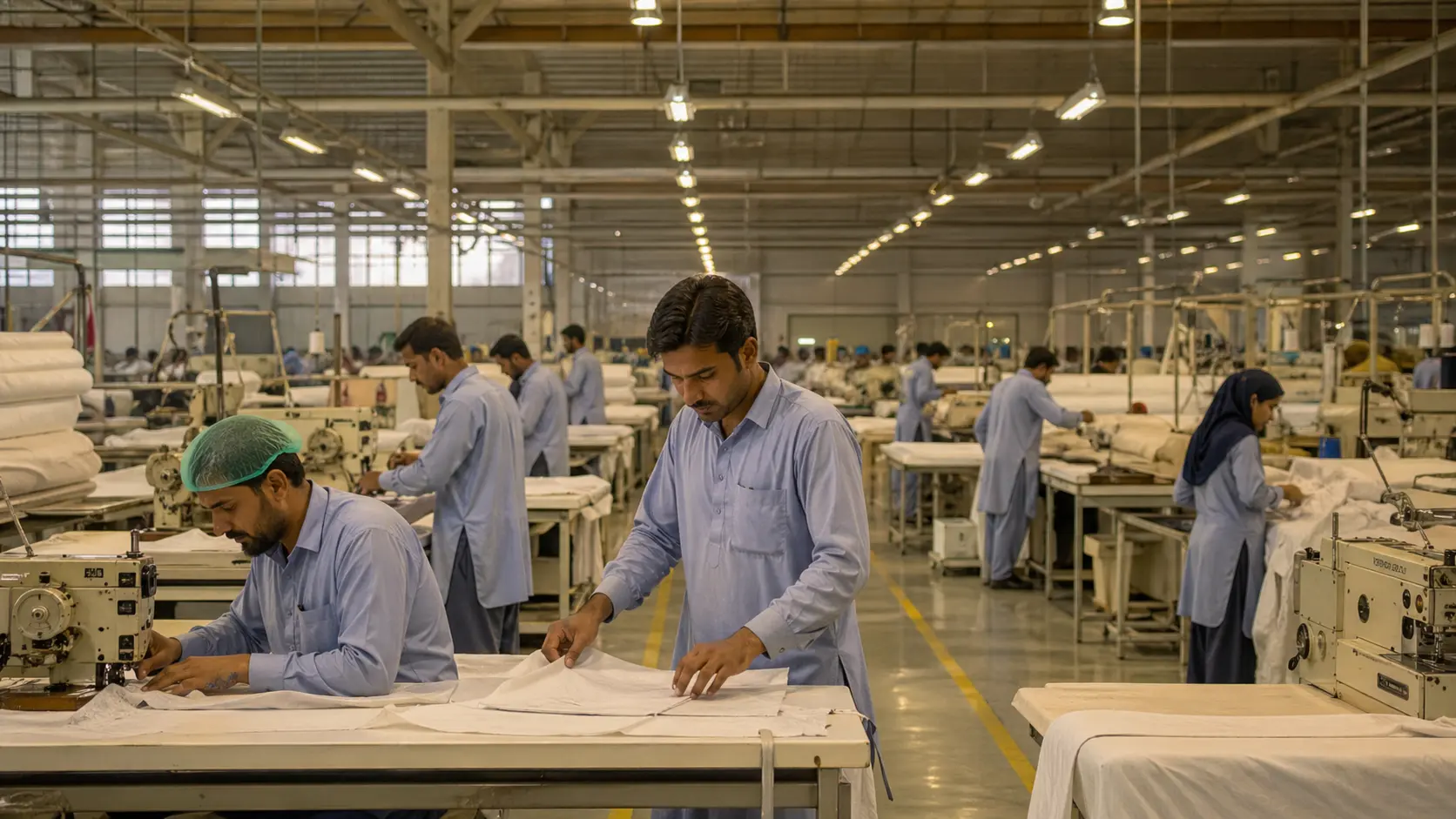
Hilton Enterprises manufactures and exports flat (plain) bedsheets and fitted bedsheets to hotels, hospital groups, distributors, and private label brands across the USA, Canada, the UAE, and Europe.
Hilton Enterprises produces both product lines from the same fabric lots at our ISO 9001, ISO 14001, Sedex, and CTPAT-certified facility in Faisalabad, Pakistan—ensuring consistent color, weight, and hand feel across hybrid linen programs.
- Explore our fitted bedsheet range—standard, extra-long, bariatric, and custom dimensions.
- Explore our plain (flat) bedsheet range—hospitality, healthcare, and institutional sizing available.
- Browse the complete bedsheet division—fitted, printed, and plain.
- Request pricing, samples, or a full specification sheet — our Home Textile team responds within one business day.