
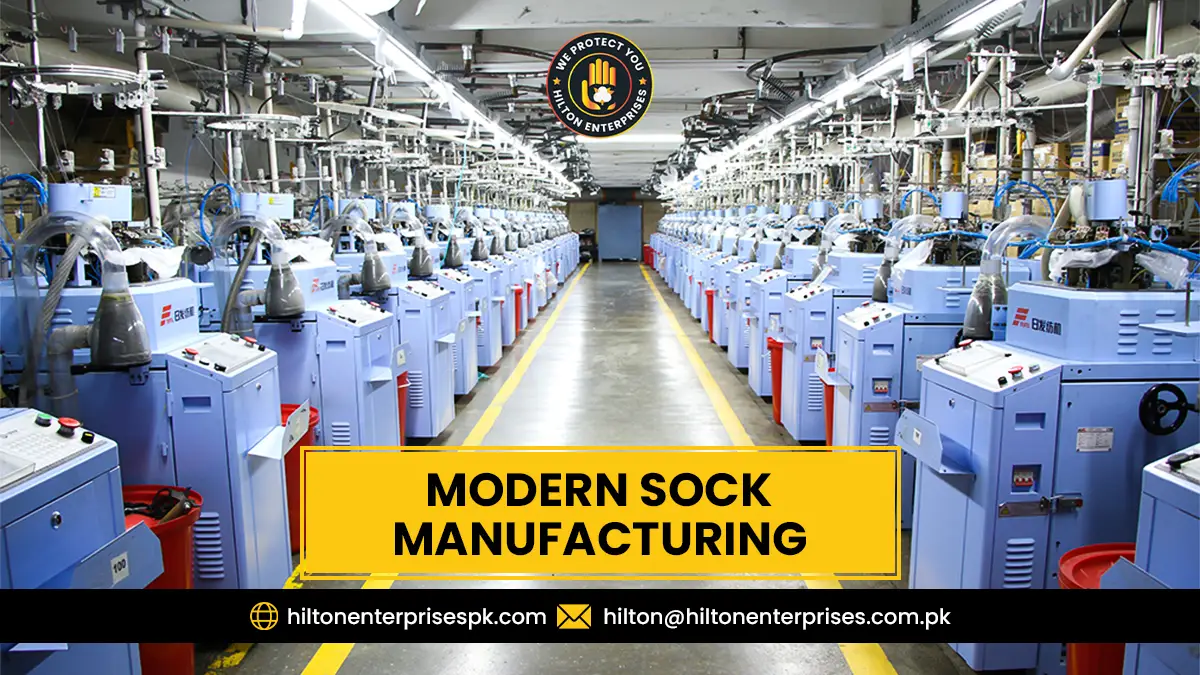
Understanding how socks are made is essential for brands launching a sock line, procurement managers sourcing bulk customization, or entrepreneurs entering the custom sock manufacturing industry. While consumers simply pull on a pair of socks each morning, the sock manufacturing process behind those comfortable garments involves sophisticated knitting machines, precise quality control, and attention to detail that separates premium products from budget alternatives.
This comprehensive guide explains the complete sock production process, from yarn selection through finished product, covering everything from athletic socks to dress socks manufacturing. Whether you’re researching custom sock manufacturers in the USA or planning to work with overseas suppliers, this manufacturing process overview helps you make informed sourcing decisions.
What is Sock Manufacturing?
Sock manufacturing refers to the industrial production of knitted footwear using specialized sock knitting machines. Unlike hand-knitting or hobbyist sock making, commercial manufacturing of socks involves automated circular knitting machines that can produce hundreds of pairs daily with consistent quality and sizing.
Modern sock production facilities range from small-scale operations producing custom logo socks for niche brands to large factories creating millions of pairs annually for major retailers. The sock manufacturing industry primarily concentrates in countries with established textile infrastructure, though USA sock manufacturer facilities still operate domestically, particularly for premium and private label sock production.
For brands considering custom sock manufacturing, understanding the manufacturing process helps evaluate potential suppliers, set realistic lead times, and make informed decisions about materials, construction methods, and quality standards.
How Are Socks Manufactured? The Complete Process
The sock manufacturing process follows six essential steps, each requiring specialized equipment and expertise. Here’s how socks are manufactured from raw yarn to finished products ready for retail.
Step 1: Knitting the Sock Body
The knitting process begins with circular knitting machines that create tubular fabric from yarn. These sophisticated sock knitting machines feature multiple needles arranged in a cylinder, with each needle working simultaneously to create the sock structure.
Key knitting machine specifications:
- Gauge: 168-200 needles per inch for athletic and crew socks
- Fine gauge: 200+ needles per inch for dress socks and business styles
- Production speed: 100-300 socks per machine per day, depending on complexity
- Yarn types: Combed cotton, polyester, nylon, spandex, bamboo, or merino wool
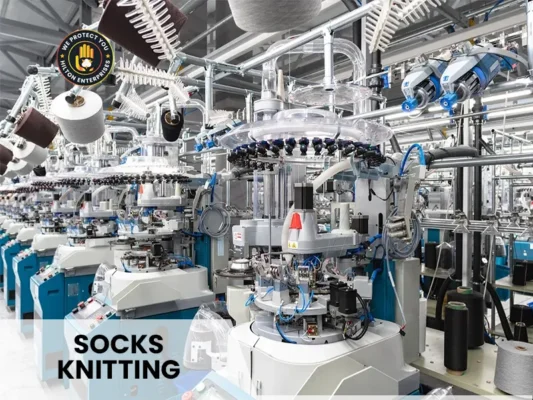
During knitting, the machine creates distinct zones for different parts of the sock. The cuff typically uses tighter stitches with elastic yarn for a secure fit, while the leg and foot may use different stitch densities for comfort and durability. Athletic socks often incorporate cushioning zones on the heel and ball of the foot through terry loop construction.
Step 2: Toe Closing
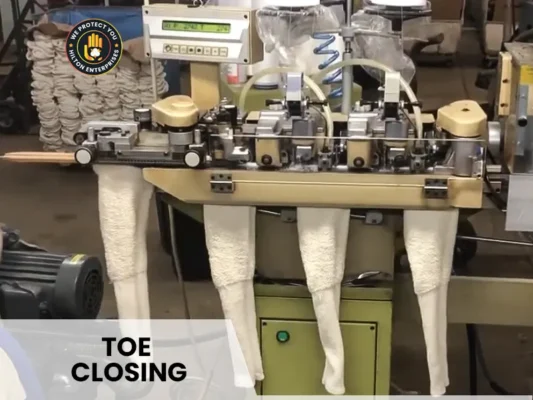
After the sock body comes off the knitting machine, it has an open toe that needs to be closed. Two primary methods accomplish this:
- Rosso Linking: Automated machines create nearly invisible seams by mimicking hand-knitting techniques, joining toe edges stitch-by-stitch. Preferred for premium dress socks and athletic socks.
- Hand-Linking: Skilled workers manually join toe edges using specialized sewing machines, creating flat seams that prevent irritation. Common for high-end production where attention to detail matters most.
- Traditional Seaming: Budget option using overlock stitching that creates a visible ridge but reduces manufacturing costs significantly.
Step 3: Shaping and Boarding
Raw knitted socks emerge from production slightly misshapen and need forming to achieve their final dimensions. The boarding process involves placing socks on heated metal or ceramic forms shaped like feet and legs. Heat-setting under controlled temperature and humidity fixes the sock’s shape, ensuring consistent sizing and professional appearance.
This step is particularly critical for dress socks and crew socks that must maintain their form through multiple washings. The boarding process also helps set any textured patterns or ribbing, ensuring these design elements remain visible and functional throughout the sock’s life.
Step 4: Dyeing (Optional)
Sock manufacturers use two primary dyeing approaches:
- Yarn Dyeing (Pre-Dyed): Dyeing yarn before knitting offers better color consistency and fastness. Preferred for solid-color dress socks and athletic socks requiring precise Pantone color matching for custom sock manufacturing.
- Piece Dyeing (Post-Production): Dyeing completed socks allows manufacturers to produce undyed inventory that can be colored based on demand. May result in slight color variations between batches.
For custom logo socks requiring specific brand colors, yarn-dyed production typically delivers superior results with less color variation across production runs.
Step 5: Finishing and Customization
The finishing stage transforms basic socks into branded products through quality control inspections and customization.
Quality control checkpoints:
- Examine each sock for dropped stitches and uneven knitting
- Verify proper toe closure and seam quality
- Check sizing consistency against specifications
- Inspect for color uniformity and yarn defects
- Remove defective socks (quality manufacturers maintain defect rates below 2-3%)
Customization options include:
- Logo Application: Embroidery, heat transfer printing, or jacquard knitting (logos knitted directly into the sock)
- Grip Dots: Silicone or rubber applications on soles for traction
- Arch Support: Additional compression bands for athletic performance
- Branding Elements: Custom hang tags, packaging inserts, and branded labels
For bulk customization orders, this stage allows brands to add unique features that differentiate their sock line from competitors. Private label sock manufacturing includes all finishing touches that transform generic socks into branded products ready for retail.
Step 6: Pairing and Packaging
Manufacturing facilities use automated systems to pair individual socks, ensuring left and right socks match in color, size, and quality. Each pair of socks is typically banded together, folded, and packaged according to client specifications.
Packaging options by market segment:
- Bulk Wholesale: Simple plastic poly bags, 12-24 pairs per polybag
- Retail Premium: Individual boxes with tissue paper and hang tags
- Corporate Gifting: Custom presentation boxes with brand messaging
- Eco-Friendly: Recycled cardboard sleeves or compostable bags
Manufacturing Differences by Sock Type
Different sock styles require specific knitting machine configurations, materials, and manufacturing techniques. Understanding these differences helps brands make informed decisions when planning their sock line.
Crew Socks Manufacturing
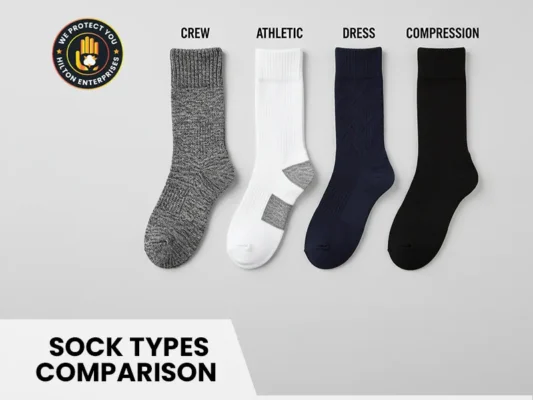
Crew socks extending to mid-calf require taller knitting machine cylinders and more yarn per pair than ankle or no-show styles. The extended length demands consistent tension throughout knitting to prevent sagging or bunching.
Crew sock specifications:
- Length: 6-8 inches from heel to cuff
- Material usage: 20-30% more yarn than ankle socks
- Manufacturing cost: Approximately 20-30% higher than ankle styles
- Typical retail: $8-15 per pair for quality brands
Crew socks typically feature ribbed cuffs with elastic for a secure fit without excessive tightness, making them popular for sports teams, corporate uniforms, and casual fashion markets.
Athletic Socks Production
This Socks Category requires specialized construction featuring moisture-wicking synthetic fibers, arch compression bands, and targeted cushioning zones.
Athletic sock features:
- Terry loop cushioning on the heel and forefoot for impact absorption
- Mesh ventilation zones on top of the foot for breathability
- Arch compression bands for support
- Left/right specific construction with anatomical shaping
- Moisture-wicking synthetic fiber blends (polyester, nylon, spandex)
The left/right specific construction requires more sophisticated knitting machine programming and separate production runs, increasing manufacturing complexity and minimum order quantities.
Diabetic Socks
Diabetic socks require specialized knitting techniques that create graduated pressure from ankle to calf.
Medical sock requirements:
- Graduated compression: 15-20 mmHg for mild, 20-30 mmHg for moderate, 30-40 mmHg for firm
- Non-binding tops to prevent circulation restriction
- Seamless construction to prevent irritation and pressure points
- Moisture-wicking materials to maintain skin health
- Testing and certification to ensure therapeutic effectiveness
Manufacturing these specialized socks often requires certifications and compliance with medical device regulations. Brands entering medical sock markets should partner with manufacturers experienced in compression garment production and familiar with relevant regulatory requirements, as noted by the Cotton Incorporated textile manufacturing guidelines.
Custom Sock Manufacturing for Brands
Custom sock manufacturing allows brands to create unique products differentiated by materials, construction, design, and features. Understanding the custom manufacturing landscape helps brands identify suitable partners and set realistic expectations for their sock line launch.
Finding USA Sock Manufacturers
While most sock production has moved overseas, several USA sock manufacturer facilities continue operating, particularly in North Carolina’s historic hosiery region.
USA manufacturing advantages:
- Shorter lead times: 4-6 weeks vs 10-14 weeks for overseas
- Smaller minimums: Often 500-1,000 pairs vs 3,000-5,000 overseas
- Easier communication: Same time zone, no language barriers
- Made in USA labeling: Premium positioning and marketing appeal
- Faster sampling: 1-2 weeks vs 3-4 weeks international
USA manufacturing considerations:
- Costs are typically 2-3x higher than overseas production
- Limited capacity may restrict order sizes
- Fewer material options compared to overseas suppliers
When evaluating custom sock manufacturers in the USA, ask about their experience with your sock type, review samples of previous work, and verify their capacity to handle your projected order volumes as your brand grows.
Minimum Order Quantities (MOQs)
Most sock manufacturers require minimum order quantities ranging from 1,000 to 5,000 pairs per design. Understanding MOQ structures helps brands plan inventory and cash flow.
Typical MOQ ranges:
- Low MOQ manufacturers: 500-1,000 pairs (higher per-pair costs)
- Standard MOQ: 1,000-3,000 pairs per colorway
- Large-scale production: 5,000-10,000 pairs per design
- Overseas manufacturers: Typically require 3,000-5,000 pairs minimums
A low MOQ socks manufacturer might accept 500-1,000 pairs for simple designs, though per-pair costs increase significantly at lower volumes. Some manufacturers calculate MOQs per colorway (allowing 500 black + 500 white + 500 gray to meet a 1,500-pair minimum), while others require minimums per individual SKU.
For bulk customization orders, manufacturers often offer volume discounts at 3,000, 5,000, and 10,000+ pair tiers, optimizing cost-per-pair while building sufficient inventory for launch.
Private Label Sock Manufacturing
This enables brands to create proprietary products under their own label without investing in manufacturing equipment or expertise.
Private label vs white label comparison:
- White Label: Pre-designed socks sold to multiple brands with only logo changes. Lower costs ($1.50-$3 per pair), faster turnaround (4-6 weeks), limited differentiation.
- Private Label: Custom designs manufactured exclusively for your brand. Higher costs ($3-$7 per pair), longer development (8-12 weeks), strong product differentiation, and brand identity.
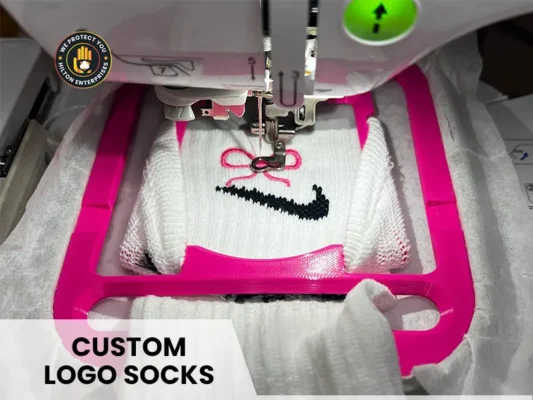
When developing a sock line through private label manufacturing, consider working with manufacturers offering design consultation, prototyping services, and flexible customization options. The right partner helps translate your vision into manufacturable products while navigating the technical constraints of sock production.
Cost to Manufacture Socks
Understanding manufacturing costs helps brands set realistic pricing and calculate profit margins.
Manufacturing cost ranges (overseas production, 3,000+ pairs):
- Basic cotton crew socks: $1.50-$3.00 per pair
- Athletic socks with cushioning: $3.00-$5.00 per pair
- Premium dress socks: $4.00-$7.00 per pair
- Compression/medical socks: $6.00-$10.00 per pair
Additional costs to budget:
- Shipping and freight: 10-15% of product cost
- Import duties: 5-10% depending on the country of origin
- Custom packaging: $0.25-$1.00 per pair
- Logo setup fees: $100-$300 per design (one-time)
USA manufacturing costs run approximately 2-3x overseas prices, with basic socks costing $4-$8 per pair and technical athletic socks ranging $8-$15 per pair. However, lower MOQs, faster turnaround, and reduced shipping costs can offset higher manufacturing costs for certain business models.
Eco-Friendly Sock Manufacturing
Growing consumer demand for sustainable products has driven eco-friendly innovations in sock manufacturing. Sustainable sock production encompasses organic or recycled materials, low-impact dyeing processes, renewable energy use, and ethical labor practices.
Sustainable material options:
- Organic Cotton: Grown without synthetic pesticides, GOTS certified
- Recycled Polyester: Made from plastic bottles or textile waste
- Bamboo Fiber: Fast-growing, naturally antimicrobial, biodegradable
- Recycled Nylon: Repurposed from fishing nets and industrial waste
- Hemp Blends: Durable, requires minimal water and pesticides
Eco-conscious brands should verify manufacturer certifications (GOTS, OEKO-TEX, Fair Trade) and audit supply chains to ensure sustainability claims are legitimate. Many manufacturers now offer carbon-neutral production options and sustainable packaging alternatives, including compostable poly bags and recycled paperboard.
Quality Control in Sock Production
Rigorous quality control distinguishes premium sock manufacturers from budget operations. Comprehensive quality control covers multiple inspection points throughout the manufacturing process.
Quality control inspection points:
- Incoming Materials: Yarn quality verification for fiber content, weight, and color
- During Knitting: Monitor for machine malfunctions, dropped stitches, and tension irregularities
- Post-Knitting: Examine toe closure quality, overall construction, and sizing accuracy
- Final Inspection: Measurement verification, appearance inspection, hand-feel assessment
- Random Sampling: Pull samples from each production batch for detailed testing
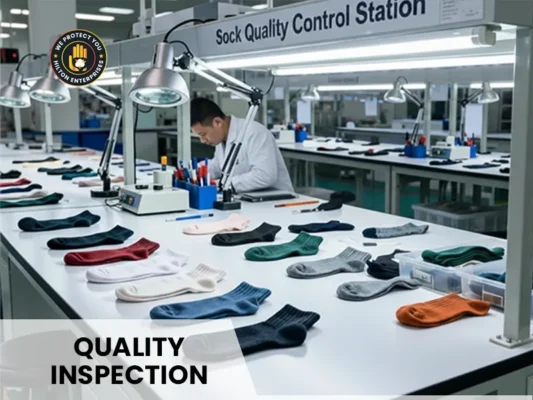
Top-tier manufacturers maintain defect rates below 2%, removing substandard products before packaging. This attention to detail protects brand reputation and reduces customer returns, ultimately proving more cost-effective than accepting higher defect rates despite increased inspection costs.
How to Start Sock Manufacturing
For entrepreneurs considering how to manufacture socks as a business venture rather than outsourcing to existing manufacturers, understanding capital requirements and operational complexity proves essential.
Equipment investment required:
- Circular knitting machines: $15,000-$50,000 per machine
- Boarding/forming equipment: $5,000-$15,000
- Toe linking machines: $8,000-$25,000
- Pairing and packaging systems: $3,000-$10,000
- Quality control tools: $2,000-$5,000
- Total startup investment: $100,000-$200,000 minimum
Beyond equipment, successful manufacturing requires skilled machine operators, yarn sourcing relationships, facility space, and quality control expertise. Most brands find partnering with established manufacturers more practical than building manufacturing capacity internally, allowing them to focus resources on design, marketing, and sales.
Frequently Asked Questions:
Q. How much does it cost to manufacture socks?
Manufacturing costs range from $1.50-$3.00 per pair for basic socks to $4.00-$7.00 per pair for premium athletic or dress socks at volumes of 3,000+ pairs. USA sock manufacturer costs typically run 2-3x higher than overseas production. Bulk customization orders at 5,000+ pairs receive volume discounts, reducing per-pair costs by 15-25%.
Q. What is the minimum order for custom socks?
Most manufacturers require 1,000-5,000 pairs per design as a minimum order. A low MOQ socks manufacturer might accept 500-1,000 pairs for simple designs with limited customization. MOQs depend on customization complexity, with custom logo socks and special constructions requiring higher minimums than simple, solid-color reorders.
Q. How long does sock manufacturing take?
Typical sock production timelines run 8-12 weeks from order placement to delivery, including sampling (2-3 weeks), production (4-6 weeks), and international shipping (2-3 weeks). USA sock manufacturer facilities offer faster 4-6 week total timelines. Rush production may be available at premium pricing for urgent orders.
Q. Can I manufacture socks with my logo?
Yes, custom logo socks are common in sock manufacturing. Logos can be applied through embroidery, heat transfer printing, or jacquard knitting (woven directly into the sock). Each method has different minimum quantities, costs, and design limitations. Most manufacturers require one-time setup fees of $100-$300 for logo digitization and equipment setup.
Q. What’s the difference between knit and woven socks?
Socks are always knitted, never woven. The knitting process uses interlocking loops, creating stretchable fabric that conforms to foot shapes. Woven fabrics use perpendicular threads, creating non-stretch material unsuitable for socks. Sock knitting machines include circular knitting machines for tube-sock construction and flat-knitting machines for seamless whole-garment production.
Q. Where are most socks manufactured?
The majority of sock production occurs in China, India, Pakistan, and Turkey due to established textile infrastructure and competitive labor costs. However, several USA sock manufacturer facilities continue operating, particularly for premium products, technical athletic socks, and smaller production runs. Domestic manufacturing represents less than 5% of U.S. sock consumption.
Q. How do I find a sock manufacturer in the USA?
Research custom sock manufacturers in the USA through industry directories, trade shows like the Outdoor Retailer or MAGIC trade shows, and industry associations. Key domestic manufacturing regions include North Carolina’s historic hosiery district. When evaluating manufacturers, request samples, verify production capacity, clarify MOQ requirements, and compare lead times and pricing across multiple suppliers.
Q. What is private label sock manufacturing?
Private label sock manufacturing involves creating socks under your brand name without owning manufacturing facilities. Private label sock manufacturers in the USA and overseas offer design consultation, production, and packaging services, allowing brands to launch sock lines without capital investment in equipment. This model suits startups and established brands expanding product categories without manufacturing expertise.
Partner with Hilton Enterprises for Professional Sock Manufacturing
With 54 years of textile manufacturing experience, Hilton Enterprises brings proven expertise to custom sock manufacturing projects. Our attention to detail ensures every pair of socks meets rigorous quality standards, whether you’re launching a boutique sock line or sourcing bulk customization for corporate gifting programs.
We manufacture all major sock styles, including crew socks, ankle socks, athletic socks, diabetic socks, and grip socks
Our comprehensive sock production services include:
- Custom sock design consultation and technical development
- Flexible MOQs starting at 1,000 pairs for qualified projects
- Complete customization, including custom logo socks, unique colorways, and specialty materials
- Private label sock manufacturing with full branding services
- Quality control maintains defect rates below 2%
- Eco-friendly production options, including organic and recycled materials
- Competitive pricing with transparent cost breakdowns
- Reliable production timelines with regular progress updates
Whether you’re researching how to manufacture socks for the first time or seeking to upgrade your current manufacturing partner, our experienced team provides the technical expertise and production capacity to bring your sock line vision to reality. From initial design concepts through final delivery, we support brands at every stage of the sock manufacturing process.
Contact Hilton Enterprises today to discuss your custom sock manufacturing requirements, request samples of our work, and receive a detailed quote for your project. Let’s create exceptional socks that build your brand and satisfy your customers.

Recent Comments